
印度高血压控制倡议——2018-2020 年在印度五个邦的 26 个地区的早期结果。
The India Hypertension Control Initiative-early outcomes in 26 districts across five states of India, 2018-2020.
机构信息
Division of Noncommunicable Diseases, ICMR-National Institute of Epidemiology, Chennai, India.
Dept of Noncommunicable Diseases, WHO Country Office for India, New Delhi, India.
出版信息
J Hum Hypertens. 2023 Jul;37(7):560-567. doi: 10.1038/s41371-022-00742-5. Epub 2022 Aug 9.
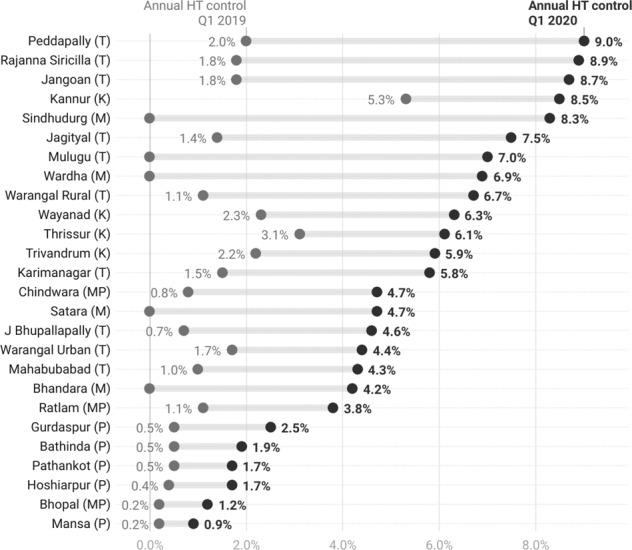
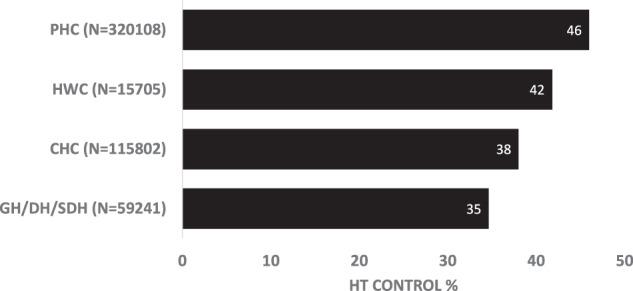
Hypertension is the leading single preventable risk factor for cardiovascular disease. The India Hypertension Control Initiative (IHCI) project was designed to improve hypertension control in public sector clinics. The project was launched in 2018-2019 in 26 districts across five states: Punjab (5), Madhya Pradesh (3), Kerala (4), Maharashtra (4), and Telangana (10), with five core strategies: standard treatment protocol, reliable supply of free antihypertensive drugs, team-based care, patient-centered care, and an information system to track individual patient treatment and blood pressure control. All states implemented simple treatment protocols with three drugs: a long-acting dihydropyridine calcium channel blocker (amlodipine), angiotensin receptor blocker (telmisartan), and thiazide or a thiazide-like diuretic (hydrochlorothiazide or chlorthalidone). Medication supplies were adequate to support at least one month of treatment. Overall, 570,365 hypertensives were enrolled in 2018-2019; 11% did not have follow-up visits in the most recent 12 months. Clinic-level blood pressure control averaged 43% (range 22-79%) by Jan-March, 2020. The proportion of the estimated people with hypertension who had it controlled and documented in public clinics increased three-fold, albeit from very low levels (1.4-5.0%). The IHCI demonstrated the feasibility of implementing protocol-based hypertension treatment and control supported by a reliable drug supply and accurate information systems at scale in Indian primary health care facilities. Lessons from the IHCI's initial phase will inform plans to improve screening in health care facilities, increase retention in care, and ensure a sustained supply of drugs as part of a nationwide hypertension control program.
高血压是心血管疾病的首要可预防的单一风险因素。印度高血压控制倡议(IHCI)项目旨在改善公共部门诊所的高血压控制。该项目于 2018-2019 年在五个邦的 26 个地区启动:旁遮普邦(5 个)、中央邦(3 个)、喀拉拉邦(4 个)、马哈拉施特拉邦(4 个)和特伦甘纳邦(10 个),有五个核心策略:标准治疗方案、可靠供应免费抗高血压药物、以团队为基础的护理、以患者为中心的护理以及一个跟踪个体患者治疗和血压控制的信息系统。所有邦都实施了简单的治疗方案,包含三种药物:长效二氢吡啶钙通道阻滞剂(氨氯地平)、血管紧张素受体阻滞剂(替米沙坦)和噻嗪类或噻嗪类利尿剂(氢氯噻嗪或氯噻酮)。药物供应足以支持至少一个月的治疗。总体而言,2018-2019 年有 570365 名高血压患者入组;在最近的 12 个月中,有 11%的患者没有随访。截至 2020 年 1 月至 3 月,诊所级别的血压控制平均为 43%(范围为 22-79%)。在公共诊所中,经估计患有高血压且得到控制并记录的人数比例增加了两倍,尽管这一比例仍非常低(1.4-5.0%)。IHCI 证明了在印度基层医疗设施中,基于方案的高血压治疗和控制是可行的,这得益于可靠的药物供应和准确的信息系统。IHCI 初始阶段的经验教训将为改善卫生保健设施中的筛查、提高护理保留率以及确保药物持续供应提供信息,这是全国高血压控制计划的一部分。

 Zotero 插件