
家庭结构与欧洲儿童和青少年体重指数和代谢评分的关系。
Family structure in relation to body mass index and metabolic score in European children and adolescents.
机构信息
School of Public Health and Community Medicine, Institute of Medicine, Sahlgrenska Academy, University of Gothenburg, Göteborg, Sweden.
Institute of Medical Biometry and Epidemiology, University Medical Center Hamburg-Eppendorf, Hamburg, Germany.
出版信息
Pediatr Obes. 2022 Dec;17(12):e12963. doi: 10.1111/ijpo.12963. Epub 2022 Aug 10.
BACKGROUND
Living in single parent and blended families or as an only child-compared to living in two-parent biological families or with siblings, respectively-is associated with a higher body mass index (BMI) in cross-sectional studies. However, longitudinal research addressing the children's BMI in this context is scarce. Further, little is known about the association between family structure and metabolic health.
OBJECTIVES
This study aimed at investigating the association between both aspects of family structure with BMI and a metabolic score (MetS).
METHODS
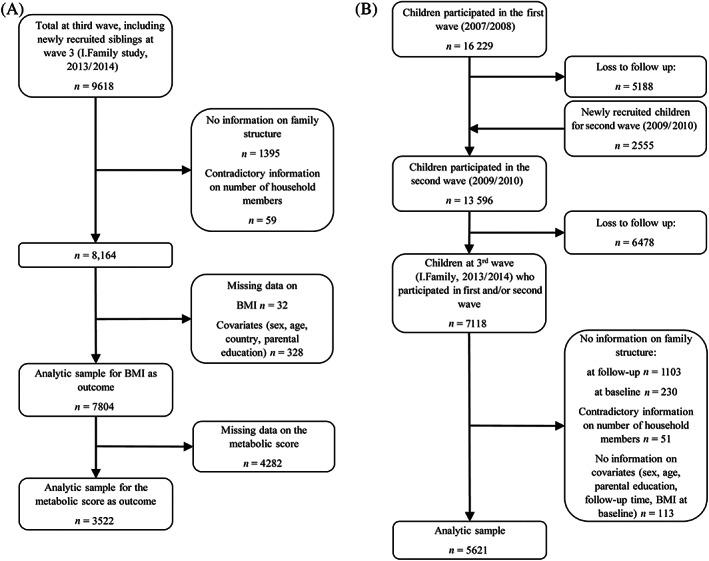
Cross-sectional data from 7804 children participating in the European multi-center I.Family study (2013/2014) and longitudinal data from 5621 children who also participated previously in the IDEFICS study (2007-2010) were used. Family structure was assessed by a detailed interview. BMI z-score and the MetS were based on measured anthropometry, blood pressure, high-density lipoprotein, blood glucose, and triglycerides. Linear regressions were performed to model associations between family structure with BMI and MetS.
RESULTS
Children from single-parent families had higher BMI z-scores in the cross-sectional (β = 0.09, 95% confidence interval [CI]: 0.001 to 0.18) and longitudinal analyses compared to those from two-parent families. Cross-sectionally, the number of siblings was associated with lower BMI z-scores (β = -0.07, 95% CI: -0.10 to -0.03) and lower MetS (β = -0.14, 95% CI: -0.26 to -0.01). Longitudinally, only children between baseline and follow-up had higher BMI z-scores at follow-up (β = 0.07, 95% CI: 0.01 to 0.14) compared to stable siblings.
CONCLUSION
Obesity prevention measures should focus on single-parent households and families with an only child.
背景
与生活在双亲家庭或有兄弟姐妹的家庭相比,生活在单亲或混合家庭(分别为)的儿童的体质指数(BMI)更高,这在横断面研究中已有报道。然而,纵向研究对此类儿童 BMI 的研究较少。此外,对于家庭结构与代谢健康之间的关联知之甚少。
目的
本研究旨在探讨家庭结构的两个方面与 BMI 和代谢评分(MetS)之间的关系。
方法
本研究使用了 7804 名儿童参加的欧洲多中心 I.Family 研究(2013/2014 年)的横断面数据和 5621 名之前参加过 IDEFICS 研究(2007-2010 年)的儿童的纵向数据。家庭结构通过详细访谈进行评估。BMI 标准差和 MetS 基于测量的人体测量学、血压、高密度脂蛋白、血糖和甘油三酯。采用线性回归模型分析家庭结构与 BMI 和 MetS 的关系。
结果
与双亲家庭的儿童相比,单亲家庭的儿童在横断面(β=0.09,95%置信区间 [CI]:0.001-0.18)和纵向分析中 BMI 标准差更高。在横断面研究中,兄弟姐妹数量与 BMI 标准差较低(β=-0.07,95%CI:-0.10 至 -0.03)和 MetS 较低有关(β=-0.14,95%CI:-0.26 至 -0.01)。在纵向研究中,仅基线时有兄弟姐妹的儿童在随访时 BMI 标准差更高(β=0.07,95%CI:0.01 至 0.14),而稳定的兄弟姐妹则没有。
结论
肥胖预防措施应侧重于单亲家庭和仅有一个孩子的家庭。
 Zotero 插件