
青少年睡眠时间和看电视时间与心血管代谢风险之间的关系。
Relationship between sleep duration and TV time with cardiometabolic risk in adolescents.
作者信息
Sehn Ana Paula, Gaya Anelise Reis, Dias Arieli Fernandes, Brand Caroline, Mota Jorge, Pfeiffer Karin Allor, Sayavera Javier Brazo, Renner Jane Dagmar Pollo, Reuter Cézane Priscila
机构信息
Graduate Program in Health Promotion, University of Santa Cruz do Sul (UNISC), Santa Cruz do Sul, RS, Brazil.
Graduate Program in Human Movement Sciences, Physical Education, Physiotherapy and Dance School, Federal University of Rio Grande do Sul (UFRGS), Porto Alegre, RS, Brazil.
出版信息
Environ Health Prev Med. 2020 Aug 21;25(1):42. doi: 10.1186/s12199-020-00880-7.
OBJECTIVE
To verify the association between sleep duration and television time with cardiometabolic risk and the moderating role of age, gender, and skin color/ethnicity in this relationship among adolescents.
METHODS
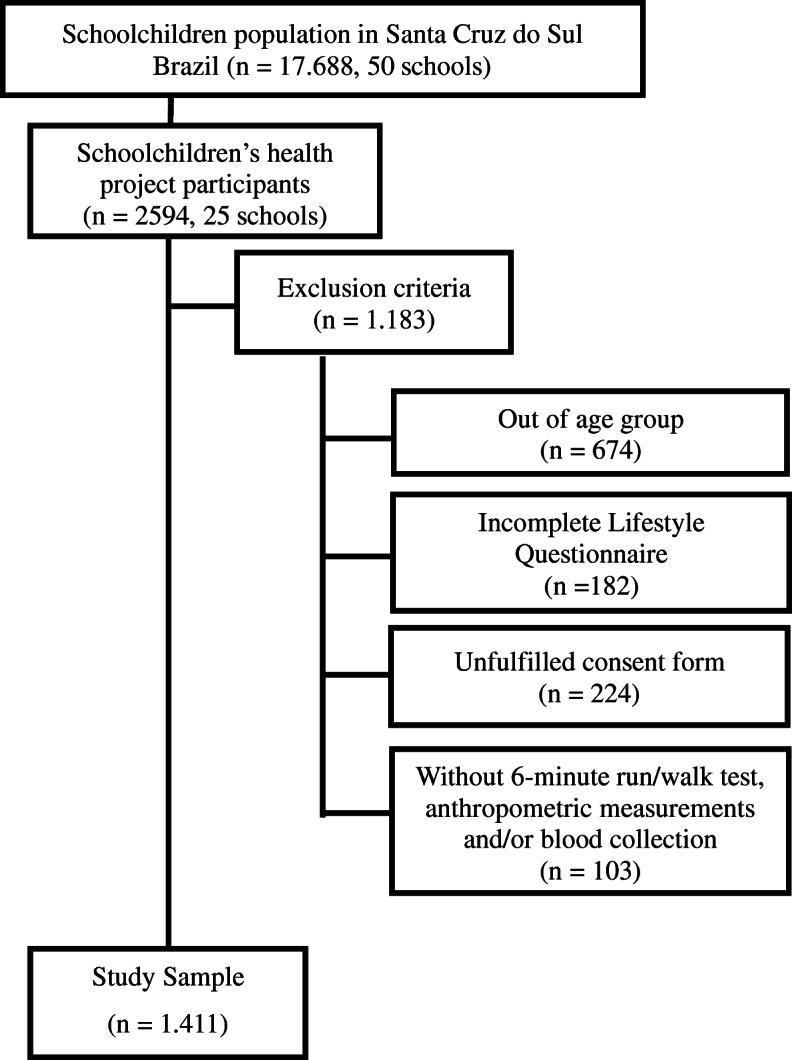
Cross-sectional study with 1411 adolescents (800 girls) aged 10 to 17 years. Television time, sleep duration, age, gender, and skin color/ethnicity were obtained by self-reported questionnaire. Cardiometabolic risk was evaluated using the continuous metabolic risk score, by the sum of the standard z-score values for each risk factor: high-density lipoprotein cholesterol, triglycerides, glycemia, cardiorespiratory fitness, systolic blood pressure, and waist circumference. Generalized linear regression models were used.
RESULTS
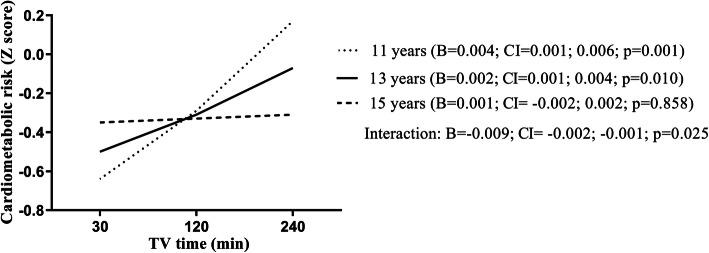
There was an association between television time and cardiometabolic risk (β, 0.002; 95% CI, 0.001; 0.003). Short sleep duration (β, 0.422; 95% CI, 0.012; 0.833) was positively associated with cardiometabolic risk. Additionally, age moderated the relationship between television time and cardiometabolic risk (β, - 0.009; 95% CI, - 0.002; - 0.001), suggesting that this relationship was stronger at ages 11 and 13 years (β, 0.004; 95% CI, 0.001; 0.006) compared to 13 to 15 years (β, 0.002; 95% CI, 0.001; 0.004). No association was found in older adolescents (β, 0.001; 95% CI, - 0.002; 0.002).
CONCLUSIONS
Television time and sleep duration are associated with cardiometabolic risk; adolescents with short sleep have higher cardiometabolic risk. In addition, age plays a moderating role in the relationship between TV time and cardiometabolic risk, indicating that in younger adolescents the relationship is stronger compared to older ones.
目的
验证睡眠时间和看电视时间与青少年心脏代谢风险之间的关联,以及年龄、性别和肤色/种族在这种关系中的调节作用。
方法
对1411名年龄在10至17岁的青少年(800名女孩)进行横断面研究。通过自我报告问卷获取看电视时间、睡眠时间、年龄、性别和肤色/种族信息。使用连续代谢风险评分评估心脏代谢风险,该评分由每个风险因素的标准z评分值总和得出:高密度脂蛋白胆固醇、甘油三酯、血糖、心肺适能、收缩压和腰围。采用广义线性回归模型。
结果
看电视时间与心脏代谢风险之间存在关联(β,0.002;95%置信区间,0.001;0.003)。睡眠时间短(β,0.422;95%置信区间,0.012;0.833)与心脏代谢风险呈正相关。此外,年龄对看电视时间与心脏代谢风险之间的关系有调节作用(β,-0.009;95%置信区间,-0.002;-0.001),这表明与13至15岁(β,0.002;95%置信区间,0.001;0.004)相比,这种关系在11岁和13岁时更强(β,0.004;95%置信区间,0.001;0.006)。在年龄较大的青少年中未发现关联(β,0.001;95%置信区间,-0.002;0.002)。
结论
看电视时间和睡眠时间与心脏代谢风险相关;睡眠短的青少年心脏代谢风险更高。此外,年龄在看电视时间与心脏代谢风险的关系中起调节作用,表明与年龄较大的青少年相比,年龄较小的青少年中这种关系更强。
 Zotero 插件