
儿童和青少年的屏幕使用时间、睡眠时间、休闲体育活动、肥胖与心血管代谢风险:一项为期两年的交叉滞后研究。
Screen time, sleep duration, leisure physical activity, obesity, and cardiometabolic risk in children and adolescents: a cross-lagged 2-year study.
作者信息
Sehn Ana Paula, Silveira João Francisco de Castro, Brand Caroline, Lemes Vanilson Batista, Borfe Letícia, Tornquist Luciana, Pfeiffer Karin Allor, Renner Jane Dagmar Pollo, Andersen Lars Bo, Burns Ryan Donald, Reuter Cézane Priscila
机构信息
Graduate Program in Health Promotion, University of Santa Cruz do Sul (UNISC), Santa Cruz do Sul, RS, Brazil.
Graduate Program in Human Movement Sciences, Federal University of Rio Grande do Sul (UFRGS), Porto Alegre, RS, Brazil.
出版信息
BMC Cardiovasc Disord. 2024 Oct 1;24(1):525. doi: 10.1186/s12872-024-04089-2.
BACKGROUND
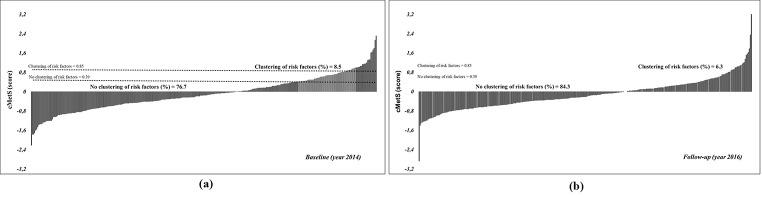
Considering the previous research that suggested that screen time (ST), sleep duration, physical activity (PA), obesity and cardiometabolic risk factors are related, it is essential to identify how these variables are associated over time, to provide knowledge for the development of intervention strategies to promote health in pediatric populations. Also, there is a lack of studies examining these associations longitudinally. The aims of the present study were: (1) to investigate the longitudinal relationships between ST, sleep duration, leisure PA, body mass index (BMI), and cardiometabolic risk score (cMetS) in children and adolescents; and (2) to verify scores and prevalence of cMetS risk zones at baseline and follow-up.
METHODS
This observational longitudinal study included 331 children and adolescents (aged six to 17 years; girls = 57.7%) from schools in a southern city in Brazil. ST, sleep duration, and leisure PA were evaluated by a self-reported questionnaire. BMI was evaluated using the BMI z-scores (Z_BMI). The cMetS was determined by summing sex- and age-specific z-scores of total cholesterol/high-density lipoprotein cholesterol (HDL-C) ratio, triglycerides, glucose, and systolic blood pressure and dividing it by four. A two-wave cross-lagged model was implemented.
RESULTS
ST, sleep duration, and leisure PA were not associated with cMetS after 2-years. However, it was observed that higher ST at baseline was associated with shorter sleep duration at follow-up (B=-0.074; 95%IC=-0.130; -0.012), while higher Z_BMI from baseline associated with higher cMetS of follow-up (B = 0.154; 95%CI = 0.083;0.226). The reciprocal model of relationships indicated that the variance of ST, sleep time, leisure PA, Z_BMI, and cMetS explained approximately 9%, 14%, 10%, 67% and 22%, respectively, of the model. Individual change scores and prevalence indicated that cMetS had individual changes from 2014 to 2016.
CONCLUSION
Sleep duration, ST and leisure PA were not associated with cMetS after 2 years. ST showed an inverse association with sleep duration, and Z_BMI was positively associated with cMetS after a 2-year follow-up. Finally, the prevalence of no clustering of risk factors increased after two years. These findings suggest the need to promote healthy lifestyle habits from childhood and considering individual factors that can influence cardiometabolic health in children and adolescents.
背景
鉴于先前的研究表明屏幕使用时间(ST)、睡眠时间、身体活动(PA)、肥胖与心脏代谢危险因素之间存在关联,确定这些变量随时间的关联方式至关重要,以便为制定促进儿童群体健康的干预策略提供知识。此外,缺乏纵向研究这些关联的研究。本研究的目的是:(1)调查儿童和青少年的ST、睡眠时间、休闲PA、体重指数(BMI)和心脏代谢风险评分(cMetS)之间的纵向关系;(2)验证基线和随访时cMetS风险区的评分和患病率。
方法
这项观察性纵向研究纳入了巴西南部一个城市学校的331名儿童和青少年(6至17岁;女孩占57.7%)。通过自我报告问卷评估ST、睡眠时间和休闲PA。使用BMI z评分(Z_BMI)评估BMI。通过将总胆固醇/高密度脂蛋白胆固醇(HDL-C)比值、甘油三酯、血糖和收缩压的性别和年龄特异性z评分相加并除以4来确定cMetS。实施了两波交叉滞后模型。
结果
2年后,ST、睡眠时间和休闲PA与cMetS无关。然而,观察到基线时较高的ST与随访时较短的睡眠时间相关(B=-0.074;95%IC=-0.130;-0.012),而基线时较高的Z_BMI与随访时较高的cMetS相关(B = 0.154;95%CI = 0.083;0.226)。关系的互惠模型表明,ST、睡眠时间、休闲PA、Z_BMI和cMetS的方差分别解释了模型的约9%、14%、10%、67%和22%。个体变化评分和患病率表明,2014年至2016年cMetS有个体变化。
结论
2年后,睡眠时间、ST和休闲PA与cMetS无关。ST与睡眠时间呈负相关,2年随访后Z_BMI与cMetS呈正相关。最后,两年后无危险因素聚集的患病率增加。这些发现表明,需要从儿童时期就促进健康的生活方式习惯,并考虑可能影响儿童和青少年心脏代谢健康的个体因素。


 Zotero 插件