
新型冠状病毒感染后的精液参数:文献综述
Semen parameters after SARS-CoV-2 infection: A literature review.
作者信息
Tufvesson Kathrine, Catalini Laura, Fedder Jens
机构信息
Research Unit of Reproductive Medicine, Faculty of Health Sciences University of Southern Denmark Odense Denmark.
Centre of Andrology and Fertility Clinic Dept. D, Odense University Hospital Odense Denmark.
出版信息
Health Sci Rep. 2022 Aug 10;5(5):e745. doi: 10.1002/hsr2.745. eCollection 2022 Sep.
BACKGROUND AND AIMS
The severe acute respiratory syndrome coronavirus 2 (SARS-CoV-2) is known to affect multiple organs by binding to angiotensin-converting enzyme 2 receptors and might therefore affect male fertility. This review aims to collect all original articles on the effects of SARS-CoV-2 infection on male fertility, including the duration of time after infection required for these effects to begin to manifest and recommend how clinicians should approach cases with a recent illness.
METHODS
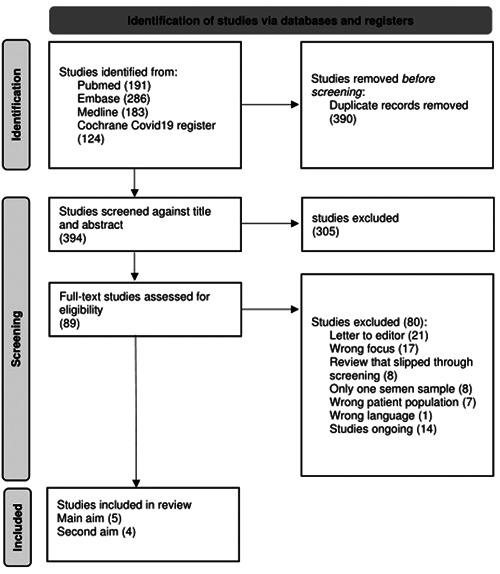
This review was developed according to the preferred reporting items for systematic reviews and meta-analyses guidelines. The search string was applied to four online databases-namely Pubmed, Embase, Medline, and the Cochrane COVID-19 Register-and screened using the online tool Covidence.org. Articles were eligible for inclusion if they were cohort studies involving a healthy male population diagnosed with COVID-19, each of whom had semen samples collected before and after the infection or two different semen samples collected after the diagnosis.
RESULTS
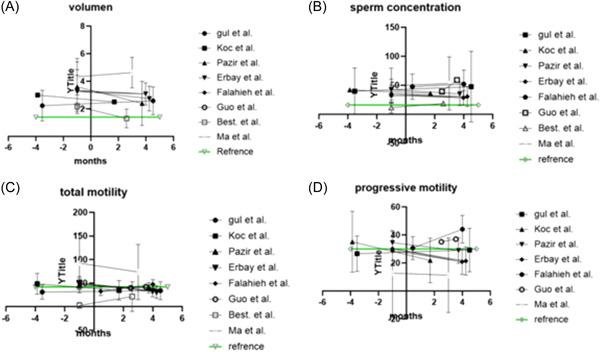
Nine cohort studies were eventually included. Five articles had pre- and post-COVID-19 data while four had two sets of post-COVID-19 data. The three largest studies found a statistically significant decrease in all semen parameters when waiting less than 3 months from diagnosis before sample collection, and no significant differences in results when the ejaculate was analyzed more than 3 months after recovery. One study compared the COVID-19 patients with a control group and found a significant decrease in semen parameters in the COVID-19 group.
CONCLUSION
Spermatogenesis seems to be affected by SARS-CoV-2 infection, but the impact tends to reverse within 3-4 months. It is still unclear why male fertility is affected by SARS-CoV-2 infection, and it might be the result of several different components. Clinicians should consider recent SARS-CoV-2 infection as a possible reason for the low semen quality of patients' semen samples, and might therefore need to collect new samples after 4 months before further treatment.
背景与目的
已知严重急性呼吸综合征冠状病毒2(SARS-CoV-2)通过与血管紧张素转换酶2受体结合影响多个器官,因此可能影响男性生育能力。本综述旨在收集所有关于SARS-CoV-2感染对男性生育能力影响的原始文章,包括感染后这些影响开始显现所需的时间,并建议临床医生应如何处理近期患病的病例。
方法
本综述根据系统评价和Meta分析的首选报告项目指南制定。检索词应用于四个在线数据库,即PubMed、Embase、Medline和Cochrane COVID-19注册库,并使用在线工具Covidence.org进行筛选。如果文章是涉及诊断为COVID-19的健康男性人群的队列研究,且每个人在感染前后都采集了精液样本,或者在诊断后采集了两份不同的精液样本,则符合纳入标准。
结果
最终纳入9项队列研究。5篇文章有COVID-19前后的数据,4篇有两组COVID-19后的数据。三项最大规模的研究发现,从诊断到样本采集等待时间少于3个月时,所有精液参数均有统计学意义的下降,而在康复后3个月以上分析射精样本时,结果无显著差异。一项研究将COVID-19患者与对照组进行比较,发现COVID-19组精液参数显著下降。
结论
精子发生似乎受到SARS-CoV-2感染的影响,但这种影响在3至4个月内趋于逆转。目前尚不清楚男性生育能力为何会受到SARS-CoV-2感染的影响,这可能是多种不同因素导致的结果。临床医生应将近期的SARS-CoV-2感染视为患者精液样本质量低下的一个可能原因,因此可能需要在4个月后采集新的样本再进行进一步治疗。
 Zotero 插件