
新型冠状病毒疫苗对精子质量的影响:系统评价。
Effects of SARS-CoV-2 Vaccines on Sperm Quality: Systematic Review.
机构信息
Reproductive Medicine Center, Department of Obstetrics and Gynecology, the First Affiliated Hospital of Anhui Medical University, Hefei, China.
National Health Commission Key Laboratory of Study on Abnormal Gametes and Reproductive Tract, Hefei, China.
出版信息
JMIR Public Health Surveill. 2023 Dec 6;9:e48511. doi: 10.2196/48511.
BACKGROUND
The COVID-19 pandemic, caused by SARS-CoV-2, has triggered a global public health crisis of unprecedented proportions. SARS-CoV-2 vaccination is a highly effective strategy for preventing infections and severe COVID-19 outcomes. Although several studies have concluded that COVID-19 vaccines are unlikely to affect fertility, concerns have arisen regarding adverse events, including the potential impact on fertility; these concerns are plagued by limited and inconsistent evidence.
OBJECTIVE
This review aims to provide a recent assessment of the literature on the impact of COVID-19 vaccines on male sperm quality. The possible impact of COVID-19 vaccines on fertility potential was also examined to draw a clearer picture and to evaluate the effects of COVID-19 on male reproductive health.
METHODS
PubMed, Scopus, Web of Science, Embase, and Cochrane databases were searched from their inception to October 2023. Eligible studies included articles reporting SARS-CoV-2 vaccination and human semen quality and fertility, as well as the impact of vaccination on assisted reproductive technology treatment outcomes. The quality of cohort studies was assessed using the Newcastle-Ottawa Scale, and the quality of cross-sectional studies was assessed using the quality evaluation criteria recommended by the Agency for Healthcare Research and Quality. The systematic review followed PRISMA (Preferred Reporting Items for Systematic Reviews and Meta-Analyses) guidelines.
RESULTS
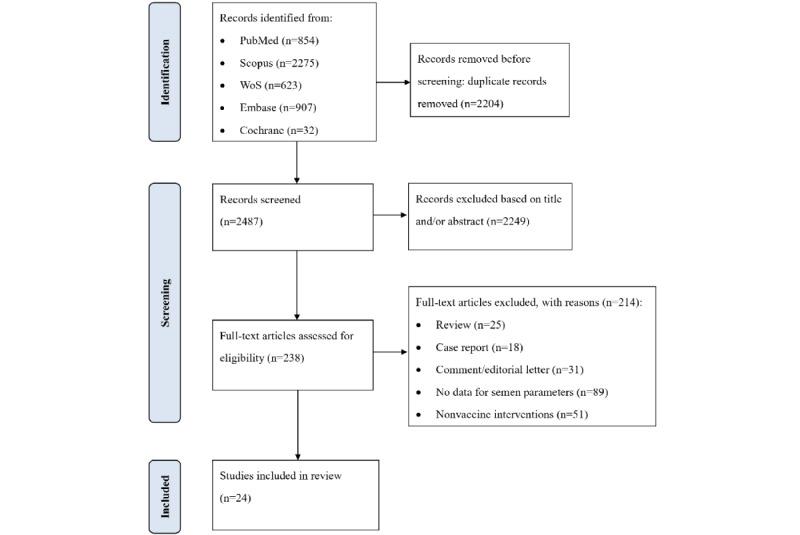
The initial literature search yielded 4691 records by searching 5 peer-reviewed databases (PubMed, Scopus, Web of Science, Embase, and Cochrane). Finally, 24 relevant studies were selected for our study. There were evident research inequalities at the regional level, with the United States and Western European countries contributing 38% (9/24) of the studies, Middle Eastern countries contributing 38% (9/24), China accounting for 21% (5/24), and Africa and South America accounting for none. Nonetheless, the overall quality of the included studies was generally good. Our results demonstrated that serious side effects of the COVID-19 vaccine are extremely rare, and men experience few problems with sperm parameters or reproductive potential after vaccination.
CONCLUSIONS
On the basis of the studies published so far, the COVID-19 vaccine is safe for male reproductive health. Obviously, vaccination is a wise option rather than experience serious adverse symptoms of viral infections. These instances of evidence may help reduce vaccine hesitancy and increase vaccination coverage, particularly among reproductive-age couples. As new controlled trials and prospective cohort studies with larger sample sizes emerge, the possibility of a negative effect of the COVID-19 vaccine on sperm quality must be further clarified.
背景
由 SARS-CoV-2 引起的 COVID-19 大流行引发了一场前所未有的全球公共卫生危机。SARS-CoV-2 疫苗接种是预防感染和严重 COVID-19 结局的高度有效策略。尽管有几项研究得出结论认为 COVID-19 疫苗不太可能影响生育能力,但人们对不良事件表示担忧,包括对生育能力的潜在影响;这些担忧受到有限且不一致证据的困扰。
目的
本综述旨在对 COVID-19 疫苗对男性精子质量影响的文献进行最新评估。还检查了 COVID-19 疫苗对生育潜力的可能影响,以更清楚地了解情况并评估 COVID-19 对男性生殖健康的影响。
方法
从创建到 2023 年 10 月,在 PubMed、Scopus、Web of Science、Embase 和 Cochrane 数据库中进行了搜索。符合条件的研究包括报告 SARS-CoV-2 疫苗接种和人类精液质量和生育能力的文章,以及疫苗接种对辅助生殖技术治疗结局的影响。使用纽卡斯尔-渥太华量表评估队列研究的质量,使用医疗保健研究和质量局推荐的质量评估标准评估横断面研究的质量。系统评价遵循 PRISMA(系统评价和荟萃分析的首选报告项目)指南。
结果
通过搜索 5 个同行评议数据库(PubMed、Scopus、Web of Science、Embase 和 Cochrane),最初的文献检索产生了 4691 条记录。最后,选择了 24 项相关研究进行研究。在区域层面存在明显的研究不平等,美国和西欧国家占 38%(9/24),中东国家占 38%(9/24),中国占 21%(5/24),非洲和南美洲均为零。尽管如此,纳入研究的总体质量通常较好。我们的结果表明,COVID-19 疫苗的严重副作用极为罕见,男性在接种疫苗后很少出现精子参数或生殖能力问题。
结论
根据迄今为止发表的研究,COVID-19 疫苗对男性生殖健康是安全的。显然,接种疫苗是一个明智的选择,而不是经历病毒感染的严重不良反应。这些证据实例可能有助于减少对疫苗的犹豫并提高疫苗接种率,尤其是在育龄夫妇中。随着新的对照试验和具有更大样本量的前瞻性队列研究的出现,必须进一步澄清 COVID-19 疫苗对精子质量的潜在负面影响。

 Zotero 插件