
COVID-19 疫苗对生育能力的影响——系统评价和荟萃分析。
The impact of COVID-19 vaccines on fertility-A systematic review and meta-analysis.
机构信息
Section of Hygiene, Department of Life Sciences and Public Health, Universita Cattolica del Sacro Cuore, Largo F. Vito, 00168 Rome, Italy; Infectious Diseases Unit, University of Rome Tor Vergata, Rome, Italy.
Section of Hygiene, Department of Life Sciences and Public Health, Universita Cattolica del Sacro Cuore, Largo F. Vito, 00168 Rome, Italy.
出版信息
Vaccine. 2022 Oct 6;40(42):6023-6034. doi: 10.1016/j.vaccine.2022.09.019. Epub 2022 Sep 12.
BACKGROUND
Despite literature's evidence about COVID-19 vaccines' safety, concerns have arisen regarding adverse events, including the possible impact on fertility, accentuated by misinformation and anti-vaccine campaigns. The present study aims to answer the question: Is there any impact of COVID-19 vaccines on the fertility of men and women of reproductive age?
METHODS
PubMed, Scopus, Web of Science, Cochrane and Embase databases were searched for eligible studies until June 8th, 2022. The search was restricted to articles regarding humans, published in any languages, without additional restrictions. Studies' quality was assessed by the Newcastle-Ottawa and the Before and After Quality Assessment scales for cohort and pre-post studies, respectively. Random-effect meta-analyses were performed for parameters considered in ≥ 2 studies, calculating means, p-values and 95 % Confidence Intervals (CIs).
RESULTS
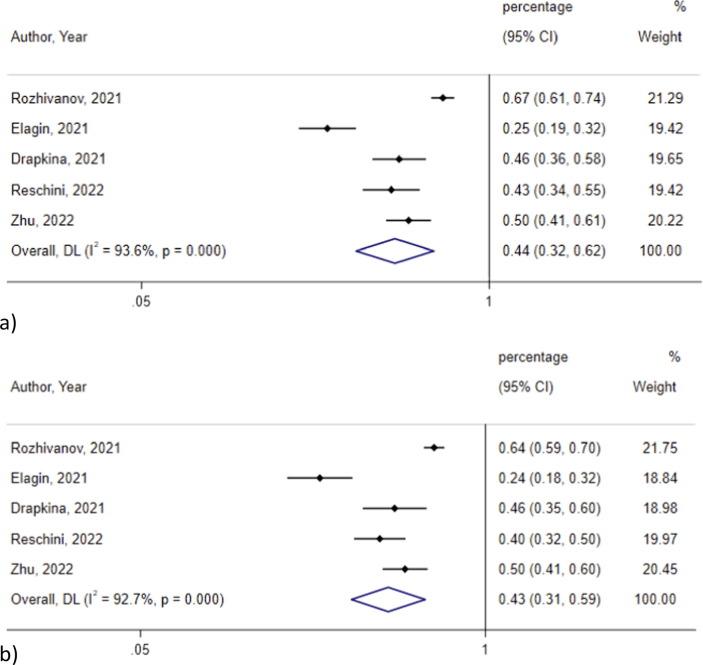
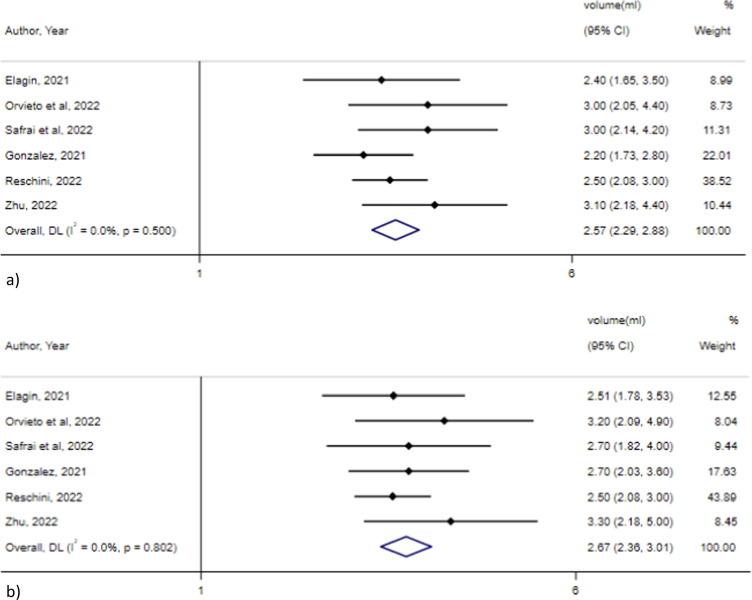
Out of 1406 studies screened, 29 were included in the systematic review. These studies, conducted in Israel (34.5 %), USA (24.1 %), Russia (20.7 %) China (10.3 %), Italy (3.5 %), North America (3.5%) and Turkey (3.5 %) were of poor (34.5 %), moderate (58.6 %) and good (6.9 %) quality. Meta-analyses were performed for pre- and post-vaccination sperm progressive motility (44 %, 95 % CI 42 %-62 % vs 43 %, 95 % CI 31 %-59 % p = 0.07) and concentration (50.6 mln/ml, 95 % CI 35.1-72.8 vs 55.4 mln/ml, 95 % CI 37.4-82.2p = 0.12). Biochemical (0.51, 95 % CI 0.40-0.66 vs 0.60, 95 % CI 0.53-0.68p = 0.45) and clinical (0.45, 95 % CI 0.37-0.54 vs 0.47, 95 % CI 0.40-0.55 p = 0.31) pregnancy rate did not differ among vaccinated and not vaccinated groups. Subgroup meta-analyses based on the type of vaccine showed no significant difference: between vaccinated with mRNA vaccines and non-vaccinated regarding biochemical pregnancy rates; pre- and post-vaccination with Gam-COVID-Vac regarding testosterone, FSH and LH levels; pre- and post-vaccination with BNT162b2 vaccines regarding sperm volumes.
CONCLUSION
Based on the studies published so far, there is no scientific proof of any association between COVID-19 vaccines and fertility impairment in men or women.
背景
尽管有文献证明 COVID-19 疫苗的安全性,但人们对不良事件仍存在担忧,包括疫苗对生育能力的可能影响,而错误信息和反疫苗运动则加剧了这种担忧。本研究旨在回答以下问题:COVID-19 疫苗是否会对育龄男女的生育能力产生影响?
方法
检索了 PubMed、Scopus、Web of Science、Cochrane 和 Embase 数据库,以获取截至 2022 年 6 月 8 日的合格研究。搜索仅限于针对人类的文章,发表于任何语言,没有其他限制。使用纽卡斯尔-渥太华量表和前后质量评估量表分别评估队列研究和前后研究的研究质量。对于考虑了≥2 项研究的参数,进行了随机效应荟萃分析,计算平均值、p 值和 95%置信区间(CI)。
结果
在筛选出的 1406 项研究中,有 29 项被纳入系统评价。这些研究分别在以色列(34.5%)、美国(24.1%)、俄罗斯(20.7%)、中国(10.3%)、意大利(3.5%)、北美(3.5%)和土耳其(3.5%)进行,质量差(34.5%)、中(58.6%)和高(6.9%)。对疫苗接种前后精子前向运动(44%,95%CI 42%-62%与 43%,95%CI 31%-59%,p=0.07)和浓度(5060 万/ml,95%CI 35.1-72.8 与 5540 万/ml,95%CI 37.4-82.2,p=0.12)进行了荟萃分析。生化(0.51,95%CI 0.40-0.66 与 0.60,95%CI 0.53-0.68,p=0.45)和临床(0.45,95%CI 0.37-0.54 与 0.47,95%CI 0.40-0.55,p=0.31)妊娠率在疫苗接种组和未接种组之间没有差异。基于疫苗类型的亚组荟萃分析显示无显著差异:mRNA 疫苗接种者与未接种者之间的生化妊娠率;Gam-COVID-Vac 疫苗接种前后的睾丸激素、FSH 和 LH 水平;BNT162b2 疫苗接种前后的精子量。
结论
根据迄今为止发表的研究,没有科学证据表明 COVID-19 疫苗与男性或女性的生育能力受损之间存在任何关联。





 Zotero 插件