
揭示鼻咽癌与肿瘤微环境中免疫细胞的串扰。
Revealing the crosstalk between nasopharyngeal carcinoma and immune cells in the tumor microenvironment.
机构信息
Department of Radiation Oncology, Fudan University Shanghai Cancer Center, Shanghai, 200032, China.
Department of Oncology, Shanghai Medical College, Fudan University, Shanghai, 200032, China.
出版信息
J Exp Clin Cancer Res. 2022 Aug 13;41(1):244. doi: 10.1186/s13046-022-02457-4.
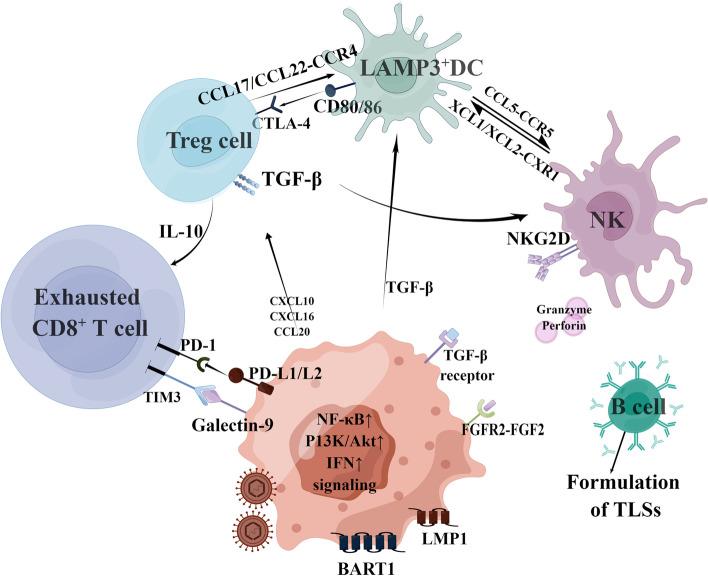
Nasopharyngeal carcinoma (NPC) arises from the epithelial cells located in the nasopharynx and has a distinct geographic distribution. Chronic Epstein-Barr virus (EBV) infection, as its most common causative agents, can be detected in 100% of NPC types. In-depth studies of the cellular and molecular events leading to immunosuppression in NPC have revealed new therapeutic targets and diverse combinations that promise to benefit patients with highly refractory, advanced and metastatic NPC. This paper reviews the mechanisms by which NPC cells to circumvent immune surveillance and approaches being attempted to restore immunity. We integrate existing insights into anti-NPC immunity and molecular signaling pathways as well as targeting therapies in anticipation of broader applicability and effectiveness in advanced metastatic NPC.
鼻咽癌(NPC)来源于鼻咽部的上皮细胞,具有独特的地理分布。慢性 EBV(Epstein-Barr virus)感染是其最常见的致病因素,在 100%的 NPC 类型中均可检测到。对导致 NPC 免疫抑制的细胞和分子事件的深入研究揭示了新的治疗靶点和多种组合,有望使高度难治性、晚期和转移性 NPC 患者受益。本文综述了 NPC 细胞逃避免疫监视的机制,以及正在尝试恢复免疫的方法。我们整合了现有的抗 NPC 免疫和分子信号通路的见解,以及靶向治疗,以期在晚期转移性 NPC 中更广泛地应用和提高疗效。


 Zotero 插件