
跨学科渔业研究的目标、挑战及后续步骤:早期职业研究人员的观点与经验
Goals, challenges, and next steps in transdisciplinary fisheries research: perspectives and experiences from early-career researchers.
作者信息
Nyboer Elizabeth A, Reid Andrea J, Jeanson Amanda L, Kelly Rachel, Mackay Mary, House Jenny, Arnold Sarah M, Simonin Paul W, Sedanza Mary Grace C, Rice Emma D, Quiros T E Angela L, Pierucci Andrea, Ortega-Cisneros Kelly, Nakamura Julia N, Melli Valentina, Mbabazi Stella, Martins Mariana S L, Ledesma Anne Brigette B, Obregón Clara, Labatt Chepkemboi K, Kadykalo Andrew N, Heldsinger Michael, Green Madeline E, Fuller Jessica L, Franco-Meléndez Milagros, Burnett Matthew J, Bolin Jessica A, Andrade-Vera Solange, Cooke Steven J
机构信息
Department of Biology and Institute of Environmental and Interdisciplinary Science, Carleton University, Carleton Technology and Training Centre, Ottawa, ON 4440KK1S 5B6 Canada.
Centre for Indigenous Fisheries, Institute for the Oceans and Fisheries, The University of British Columbia, 2202 Main Mall, Vancouver, V6T 1Z4 Canada.
出版信息
Rev Fish Biol Fish. 2023;33(2):349-374. doi: 10.1007/s11160-022-09719-6. Epub 2022 Aug 5.
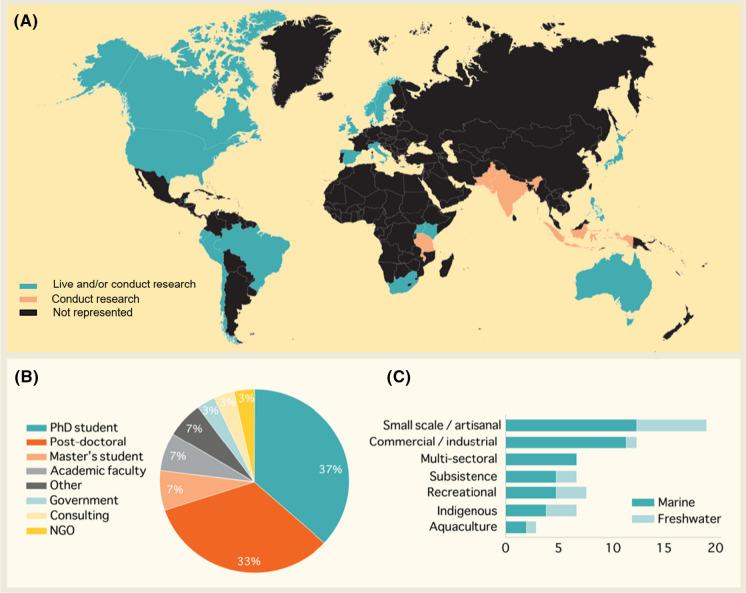
Fisheries are highly complex social-ecological systems that often face 'wicked' problems from unsustainable resource management to climate change. Addressing these challenges requires transdisciplinary approaches that integrate perspectives across scientific disciplines and knowledge systems. Despite widespread calls for transdisciplinary fisheries research (TFR), there are still limitations in personal and institutional capacity to conduct and support this work to the highest potential. The viewpoints of early career researchers (ECRs) in this field can illuminate challenges and promote systemic change within fisheries research. This paper presents the perspectives of ECRs from across the globe, gathered through a virtual workshop held during the 2021 World Fisheries Congress, on goals, challenges, and future potential for TFR. Big picture goals for TFR were guided by principles of co-production and included (i) integrating transdisciplinary thinking at all stages of the research process, (ii) ensuring that research is inclusive and equitable, (iii) co-creating knowledge that is credible, relevant, actionable, and impactful, and (iv) consistently communicating with partners. Institutional inertia, lack of recognition of the extra time and labour required for TFR, and lack of skill development opportunities were identified as three key barriers in conducting TFR. Several critical actions were identified to help ECRs, established researchers, and institutions reach these goals. We encourage ECRs to form peer-mentorship networks to guide each other along the way. We suggest that established researchers ensure consistent mentorship while also giving space to ECR voices. Actions for institutions include retooling education programs, developing and implementing new metrics of impact, and critically examining individualism and privilege in academia. We suggest that the opportunities and actions identified here, if widely embraced now, can enable research that addresses complex challenges facing fishery systems contributing to a healthier future for fish and humans alike.
渔业是高度复杂的社会生态系统,常常面临从不可持续的资源管理到气候变化等“棘手”问题。应对这些挑战需要跨学科方法,整合各科学学科和知识体系的观点。尽管人们广泛呼吁开展跨学科渔业研究(TFR),但在个人和机构能力方面,开展并将这项工作发挥到最大潜力仍存在局限性。该领域早期职业研究人员(ECR)的观点能够阐明挑战,并推动渔业研究的系统性变革。本文介绍了通过2021年世界渔业大会期间举办的一次虚拟研讨会收集的全球各地ECR对TFR的目标、挑战和未来潜力的看法。TFR的总体目标以共同生产原则为指导,包括:(i)在研究过程的各个阶段整合跨学科思维;(ii)确保研究具有包容性和平等性;(iii)共同创造可信、相关、可操作且有影响力的知识;(iv)持续与合作伙伴沟通。机构惰性、对TFR所需额外时间和精力缺乏认识以及缺乏技能发展机会被确定为开展TFR的三个关键障碍。确定了几项关键行动,以帮助ECR、资深研究人员和机构实现这些目标。我们鼓励ECR形成同行指导网络,在这个过程中相互指导。我们建议资深研究人员确保持续指导,同时也为ECR的声音留出空间。机构的行动包括调整教育项目、制定和实施新的影响力指标,以及批判性审视学术界的个人主义和特权现象。我们认为,如果现在广泛接受这里所确定的机会和行动,就能开展应对渔业系统面临的复杂挑战的研究,为鱼类和人类创造更健康的未来。

 Zotero 插件