
迈向拥有生机勃勃的鱼类种群和惠及所有人的可持续渔业:从过去30年中汲取经验,为未来30年提供指导。
Towards vibrant fish populations and sustainable fisheries that benefit all: learning from the last 30 years to inform the next 30 years.
作者信息
Cooke Steven J, Fulton Elizabeth A, Sauer Warwick H H, Lynch Abigail J, Link Jason S, Koning Aaron A, Jena Joykrushna, Silva Luiz G M, King Alison J, Kelly Rachel, Osborne Matthew, Nakamura Julia, Preece Ann L, Hagiwara Atsushi, Forsberg Kerstin, Kellner Julie B, Coscia Ilaria, Helyar Sarah, Barange Manuel, Nyboer Elizabeth, Williams Meryl J, Chuenpagdee Ratana, Begg Gavin A, Gillanders Bronwyn M
机构信息
Fish Ecology and Conservation Physiology Laboratory, Department of Biology and Institute of Environmental and Interdisciplinary Science, Carleton University, 1125 Colonel By Dr., Ottawa, ON K1S 5B6 Canada.
CSIRO Environment, Hobart, 7001 TAS Australia.
出版信息
Rev Fish Biol Fish. 2023;33(2):317-347. doi: 10.1007/s11160-023-09765-8. Epub 2023 Mar 4.
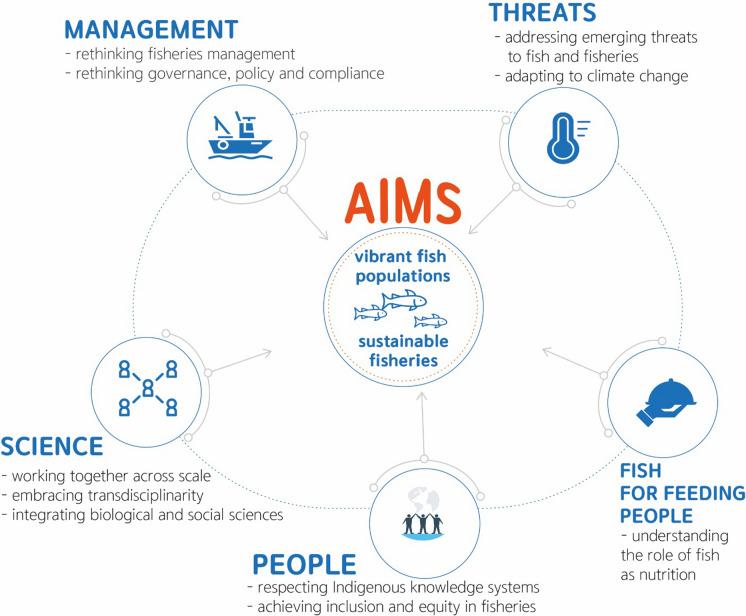
A common goal among fisheries science professionals, stakeholders, and rights holders is to ensure the persistence and resilience of vibrant fish populations and sustainable, equitable fisheries in diverse aquatic ecosystems, from small headwater streams to offshore pelagic waters. Achieving this goal requires a complex intersection of science and management, and a recognition of the interconnections among people, place, and fish that govern these tightly coupled socioecological and sociotechnical systems. The World Fisheries Congress (WFC) convenes every four years and provides a unique global forum to debate and discuss threats, issues, and opportunities facing fish populations and fisheries. The 2021 WFC meeting, hosted remotely in Adelaide, Australia, marked the 30th year since the first meeting was held in Athens, Greece, and provided an opportunity to reflect on progress made in the past 30 years and provide guidance for the future. We assembled a diverse team of individuals involved with the Adelaide WFC and reflected on the major challenges that faced fish and fisheries over the past 30 years, discussed progress toward overcoming those challenges, and then used themes that emerged during the Congress to identify issues and opportunities to improve sustainability in the world's fisheries for the next 30 years. Key future needs and opportunities identified include: rethinking fisheries management systems and modelling approaches, modernizing and integrating assessment and information systems, being responsive and flexible in addressing persistent and emerging threats to fish and fisheries, mainstreaming the human dimension of fisheries, rethinking governance, policy and compliance, and achieving equity and inclusion in fisheries. We also identified a number of cross-cutting themes including better understanding the role of fish as nutrition in a hungry world, adapting to climate change, embracing transdisciplinarity, respecting Indigenous knowledge systems, thinking ahead with foresight science, and working together across scales. By reflecting on the past and thinking about the future, we aim to provide guidance for achieving our mutual goal of sustaining vibrant fish populations and sustainable fisheries that benefit all. We hope that this prospective thinking can serve as a guide to (i) assess progress towards achieving this lofty goal and (ii) refine our path with input from new and emerging voices and approaches in fisheries science, management, and stewardship.
渔业科学专业人士、利益相关者和权利持有者的一个共同目标是,确保从小型源头溪流到近海远洋水域等多样水生生态系统中,生机勃勃的鱼类种群能够持续存在并具备恢复力,实现可持续、公平的渔业发展。要实现这一目标,需要科学与管理的复杂交叉融合,并且要认识到在这些紧密相连的社会生态和社会技术系统中,人与地点及鱼类之间的相互联系。世界渔业大会(WFC)每四年召开一次,提供了一个独特的全球论坛,用于辩论和讨论鱼类种群及渔业所面临的威胁、问题和机遇。2021年WFC会议在澳大利亚阿德莱德以远程方式举行,这是自首次会议在希腊雅典召开后的第30年,此次会议提供了一个契机,来反思过去30年取得的进展,并为未来提供指导。我们召集了一支参与阿德莱德WFC会议的多元化团队,反思了过去30年鱼类和渔业面临的主要挑战,讨论了在克服这些挑战方面取得的进展,然后利用大会期间出现的主题,确定未来30年改善全球渔业可持续性的问题和机遇。确定的关键未来需求和机遇包括:重新思考渔业管理系统和建模方法,使评估和信息系统现代化并实现整合,在应对鱼类和渔业面临的持续及新出现威胁时保持响应能力和灵活性,将渔业的人文层面纳入主流,重新思考治理、政策和合规问题,以及在渔业中实现公平和包容。我们还确定了一些贯穿各领域的主题,包括更好地理解鱼类在饥饿世界中作为营养来源的作用、适应气候变化、接纳跨学科性、尊重本土知识体系、运用前瞻性科学进行前瞻性思考,以及跨尺度合作。通过反思过去并展望未来,我们旨在为实现维持生机勃勃的鱼类种群和造福所有人的可持续渔业这一共同目标提供指导。我们希望这种前瞻性思考能够作为一个指南,(i)评估在实现这一崇高目标方面取得的进展,以及(ii)根据渔业科学、管理和养护领域新出现的声音和方法所提供的意见,完善我们的道路。
 Zotero 插件