
靶向同源定向修复实现精确基因编辑的前沿趋势:小分子与改良CRISPR-Cas9系统的综合综述
Advance trends in targeting homology-directed repair for accurate gene editing: An inclusive review of small molecules and modified CRISPR-Cas9 systems.
作者信息
Shams Forough, Bayat Hadi, Mohammadian Omid, Mahboudi Somayeh, Vahidnezhad Hassan, Soosanabadi Mohsen, Rahimpour Azam
机构信息
Department of Medical Biotechnology, School of Advanced Technologies in Medicine, Shahid Beheshti University of Medical Sciences, Tehran, Iran.
Department of Molecular Genetics, Faculty of Biological Sciences, Tarbiat Modares University, Tehran, Iran.
出版信息
Bioimpacts. 2022;12(4):371-391. doi: 10.34172/bi.2022.23871. Epub 2022 Jun 22.
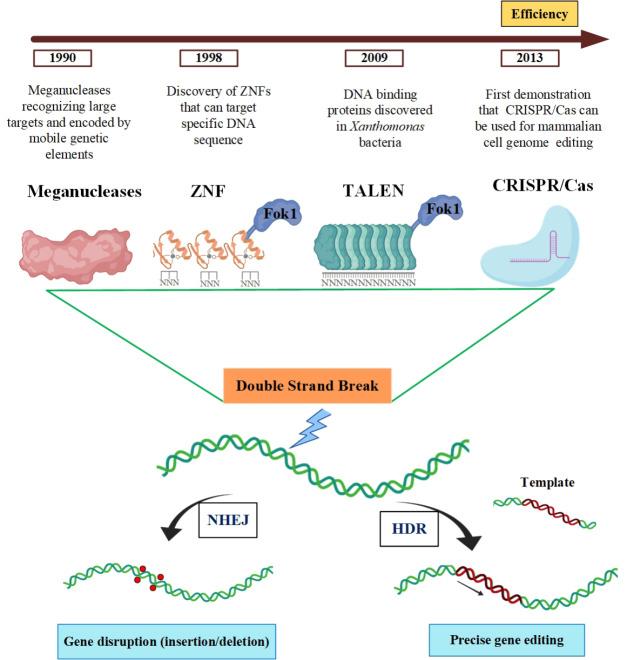
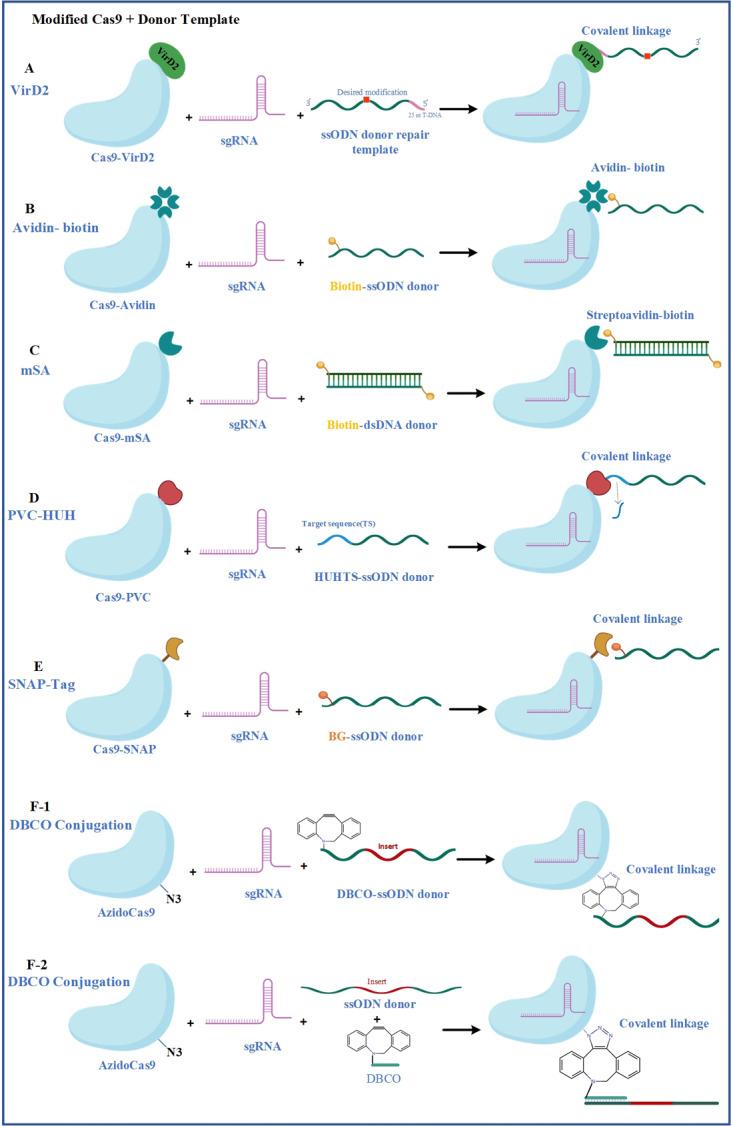
Clustered regularly interspaced short palindromic repeat and its associated protein (CRISPR-Cas)-based technologies generate targeted modifications in host genome by inducing site-specific double-strand breaks (DSBs) that can serve as a substrate for homology-directed repair (HDR) in both and models. HDR pathway could enhance incorporation of exogenous DNA templates into the CRISPR-Cas9-mediated DSB site. Owing to low rate of HDR pathway, the efficiency of accurate genome editing is diminished. Enhancing the efficiency of HDR can provide fast, easy, and accurate technologies based on CRISPR-Cas9 technologies. The current study presents an overview of attempts conducted on the precise genome editing strategies based on small molecules and modified CRISPR-Cas9 systems. In order to increase HDR rate in targeted cells, several logical strategies have been introduced such as generating CRISPR effector chimeric proteins, anti-CRISPR proteins, modified Cas9 with donor template, and using validated synthetic or natural small molecules for either inhibiting non-homologous end joining (NHEJ), stimulating HDR, or synchronizing cell cycle. Recently, high-throughput screening methods have been applied for identification of small molecules which along with the CRISPR system can regulate precise genome editing through HDR. The stimulation of HDR components or inhibiting NHEJ can increase the accuracy of CRISPR-Cas-mediated engineering systems. Generating chimeric programmable endonucleases provide this opportunity to direct DNA template close proximity of CRISPR-Cas-mediated DSB. Small molecules and their derivatives can also proficiently block or activate certain DNA repair pathways and bring up novel perspectives for increasing HDR efficiency, especially in human cells. Further, high throughput screening of small molecule libraries could result in more discoveries of promising chemicals that improve HDR efficiency and CRISPR-Cas9 systems.
成簇规律间隔短回文重复序列及其相关蛋白(CRISPR-Cas)技术通过诱导位点特异性双链断裂(DSB)在宿主基因组中产生靶向修饰,该双链断裂可作为同源定向修复(HDR)在原核和真核模型中的底物。HDR途径可增强外源DNA模板整合到CRISPR-Cas9介导的DSB位点的效率。由于HDR途径的发生率较低,精确基因组编辑的效率会降低。提高HDR效率可以提供基于CRISPR-Cas9技术的快速、简便且准确的技术。本研究概述了基于小分子和修饰的CRISPR-Cas9系统的精确基因组编辑策略的尝试。为了提高靶细胞中的HDR率,已经引入了几种合理的策略,例如生成CRISPR效应嵌合蛋白、抗CRISPR蛋白、带有供体模板的修饰Cas9,以及使用经过验证的合成或天然小分子来抑制非同源末端连接(NHEJ)、刺激HDR或同步细胞周期。最近,高通量筛选方法已应用于鉴定与CRISPR系统一起可通过HDR调节精确基因组编辑的小分子。刺激HDR组分或抑制NHEJ可以提高CRISPR-Cas介导的工程系统的准确性。生成嵌合可编程核酸内切酶提供了将DNA模板引导至CRISPR-Cas介导的DSB附近的机会。小分子及其衍生物也可以有效地阻断或激活某些DNA修复途径,并为提高HDR效率带来新的视角,尤其是在人类细胞中。此外,对小分子文库进行高通量筛选可能会发现更多有前景的化学物质,这些化学物质可以提高HDR效率和CRISPR-Cas9系统。



 Zotero 插件