
新冠疫情期间 Medicaid 受助人阿片类药物使用障碍治疗参与度的变化趋势。
Trends in Engagement With Opioid Use Disorder Treatment Among Medicaid Beneficiaries During the COVID-19 Pandemic.
机构信息
Department of Family Medicine, Boston University School of Medicine/Boston Medical Center, Boston, Massachusetts.
Department of Public Service and Administration, Texas A&M University, College Station, Texas.
出版信息
JAMA Health Forum. 2022 Mar 11;3(3):e220093. doi: 10.1001/jamahealthforum.2022.0093. eCollection 2022 Mar.
IMPORTANCE
Disruptions in care during the COVID-19 pandemic may have decreased access to care for patients with opioid use disorder.
OBJECTIVE
To examine trends in opioid use disorder treatment including buprenorphine possession, urine drug testing, and opioid treatment program services during the COVID-19 public health emergency.
DESIGN SETTING AND PARTICIPANTS
This cohort study included 6453 parent and childless adult Medicaid beneficiaries, aged 18 to 64 years, with opioid use disorder and continuous enrollment from December 1, 2018, to September 30, 2020, in Wisconsin. Logistic regression compared differences in study outcomes before, early, and later in the COVID-19 public health emergency. Analyses were conducted from January 2021 to October 2021.
EXPOSURES
Early (March 16, 2020, to May 15, 2020) and later (May 16, 2020, to September 30, 2020) in the public health emergency.
MAIN OUTCOMES AND MEASURES
Person-week outcomes included possession of buprenorphine, completion of outpatient urine drug testing, and receipt of opioid treatment program services.
RESULTS
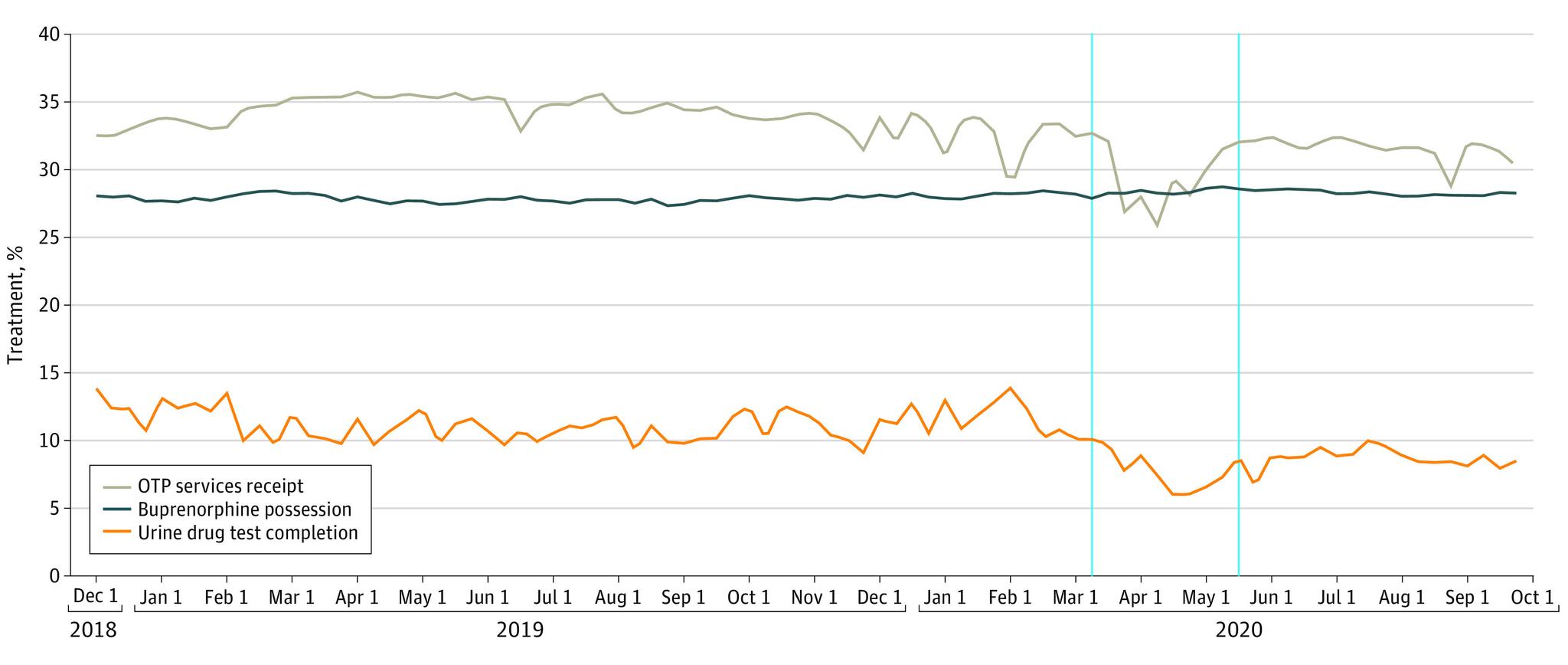
The final cohort of 6453 participants included 3986 (61.8%) childless adults; 5741 (89%) were younger than 50 years, 3435 (53.2%) were women, 5036 (78.0%) White, and 22.0% were racial and ethnic minority groups (American Indian, 269 [4.2%]; Asian, 26 [0.4%]; Black, 458 [7.1%]; Hispanic, 292 [4.5%]; Pacific Islander, 1 [.02%]; Multiracial, 238 [3.7%]). Overall, 2858 (44.3%), 5074 (78.6%), and 2928 (45.4%) received buprenorphine, urine drug testing, or opioid treatment program services during the study period, respectively. Probability of buprenorphine possession did not change in the early or later part of the public health emergency. Probability of urine drug testing initially decreased (marginal effect [ME], -0.04; 95% CI, -0.04 to -0.03; < .001) and then partially recovered in the later public health emergency (ME, -0.02; 95% CI, -0.03 to -0.02; < .001). Probability of opioid treatment program services followed a similar pattern, with an early decrease (ME, -0.05; 95% CI, -0.05 to -0.04; < .001) followed by partial recovery (ME, -0.02; 95% CI, -0.03 to -0.02; < .001).
CONCLUSIONS AND RELEVANCE
In a sample of continuously enrolled adult Medicaid beneficiaries, the COVID-19 public health emergency was not associated with decreased probability of buprenorphine possession, but was associated with decreased probability of urine drug testing and opioid treatment program services. These findings suggest patients in office-based settings retained access to buprenorphine despite decreased on-site services like urine drug tests, whereas patients at opioid treatment programs experienced greater disruption in care. Given the importance of medications for opioid use disorder in preventing overdose, policy makers should consider permanent policy changes based on lessons learned from the public health emergency to enable ongoing enhanced access to these medications.
重要性:在 COVID-19 大流行期间,医疗服务中断可能会降低阿片类药物使用障碍患者的医疗服务可及性。
目的:在 COVID-19 公共卫生紧急事件期间,检查阿片类药物使用障碍治疗(包括丁丙诺啡拥有、尿液药物检测和阿片类药物治疗计划服务)的趋势。
设计、设置和参与者:这项队列研究包括威斯康星州 6453 名父母和无子女的成年医疗补助受益人,年龄在 18 至 64 岁之间,患有阿片类药物使用障碍,并从 2018 年 12 月 1 日至 2020 年 9 月 30 日连续入组。逻辑回归比较了 COVID-19 公共卫生紧急事件前后研究结果的差异。分析于 2021 年 1 月至 2021 年 10 月进行。
暴露:公共卫生紧急事件的早期(2020 年 3 月 16 日至 2020 年 5 月 15 日)和后期(2020 年 5 月 16 日至 2020 年 9 月 30 日)。
主要结果和措施:个人周结果包括丁丙诺啡拥有、完成门诊尿液药物检测和接受阿片类药物治疗计划服务。
结果:最终的 6453 名参与者中有 3986 名(61.8%)无子女成年人;5741 名(89%)年龄小于 50 岁,3435 名(53.2%)为女性,5036 名(78.0%)为白人,22.0%为少数民族群体(美洲印第安人,269[4.2%];亚洲人,26[0.4%];黑人,458[7.1%];西班牙裔,292[4.5%];太平洋岛民,1[0.02%];多种族,238[3.7%])。在研究期间,共有 2858 人(44.3%)、5074 人(78.6%)和 2928 人(45.4%)分别接受了丁丙诺啡、尿液药物检测或阿片类药物治疗计划服务。在公共卫生紧急事件的早期和后期,丁丙诺啡拥有的可能性都没有改变。尿液药物检测的可能性最初下降(边际效应[ME],-0.04;95%CI,-0.04 至-0.03;<.001),然后在公共卫生紧急事件的后期部分恢复(ME,-0.02;95%CI,-0.03 至-0.02;<.001)。阿片类药物治疗计划服务也呈现出类似的模式,早期下降(ME,-0.05;95%CI,-0.05 至-0.04;<.001),随后部分恢复(ME,-0.02;95%CI,-0.03 至-0.02;<.001)。
结论和相关性:在连续入组的成年医疗补助受益人群中,COVID-19 公共卫生紧急事件与丁丙诺啡拥有可能性降低无关,但与尿液药物检测和阿片类药物治疗计划服务可能性降低有关。这些发现表明,尽管现场服务(如尿液药物检测)减少,但在门诊环境中,患者仍能获得丁丙诺啡,而在阿片类药物治疗项目中的患者则经历了更大的医疗服务中断。鉴于阿片类药物使用障碍药物对预防过量用药的重要性,政策制定者应考虑根据公共卫生紧急事件吸取的经验教训,做出永久性政策改变,以便为这些药物的持续增强提供机会。
 Zotero 插件