
在 COVID-19 大流行期间,丁丙诺啡和纳曲酮控释制剂的种族和民族差异。
Racial and Ethnic Disparities in Buprenorphine and Extended-Release Naltrexone Filled Prescriptions During the COVID-19 Pandemic.
机构信息
Department of Health Management and Policy, School of Public Health, University of Michigan, Ann Arbor.
Department of Economics, Tulane University, New Orleans, Louisiana.
出版信息
JAMA Netw Open. 2022 Jun 1;5(6):e2214765. doi: 10.1001/jamanetworkopen.2022.14765.
IMPORTANCE
COVID-19 disrupted delivery of buprenorphine and naltrexone treatment for opioid use disorder (OUD), and during the pandemic, members of racial and ethnic minority groups experienced increased COVID-19 and opioid overdose risks compared with White individuals. However, whether filled buprenorphine and naltrexone prescriptions varied across racial and ethnic groups during the COVID-19 pandemic remains unknown.
OBJECTIVE
To investigate whether disruptions in filled buprenorphine and naltrexone prescriptions differed by race and ethnicity and insurance status or payer type.
DESIGN, SETTING, AND PARTICIPANTS: This cross-sectional study used retail pharmacy claims from May 2019 to June 2021 from the Symphony Health database, which includes 92% of US retail pharmacy claims, with race and ethnicity data spanning all insurance status and payer categories. Interrupted time series were used to estimate levels and trends of dispensed buprenorphine and naltrexone prescriptions before and after pandemic onset. Included individuals were those who filled buprenorphine and extended-release naltrexone prescriptions. Data were analyzed from July 2021 through March 2022.
MAIN OUTCOMES AND MEASURES
Weekly rates of dispensed buprenorphine and extended-release naltrexone prescription fills per 1000 patients and proportion of longer (ie, ≥14 days' supply) buprenorphine prescription fills were calculated. Analyses were stratified by patient race and ethnicity and further by insurance status and payer type for White and Black patients.
RESULTS
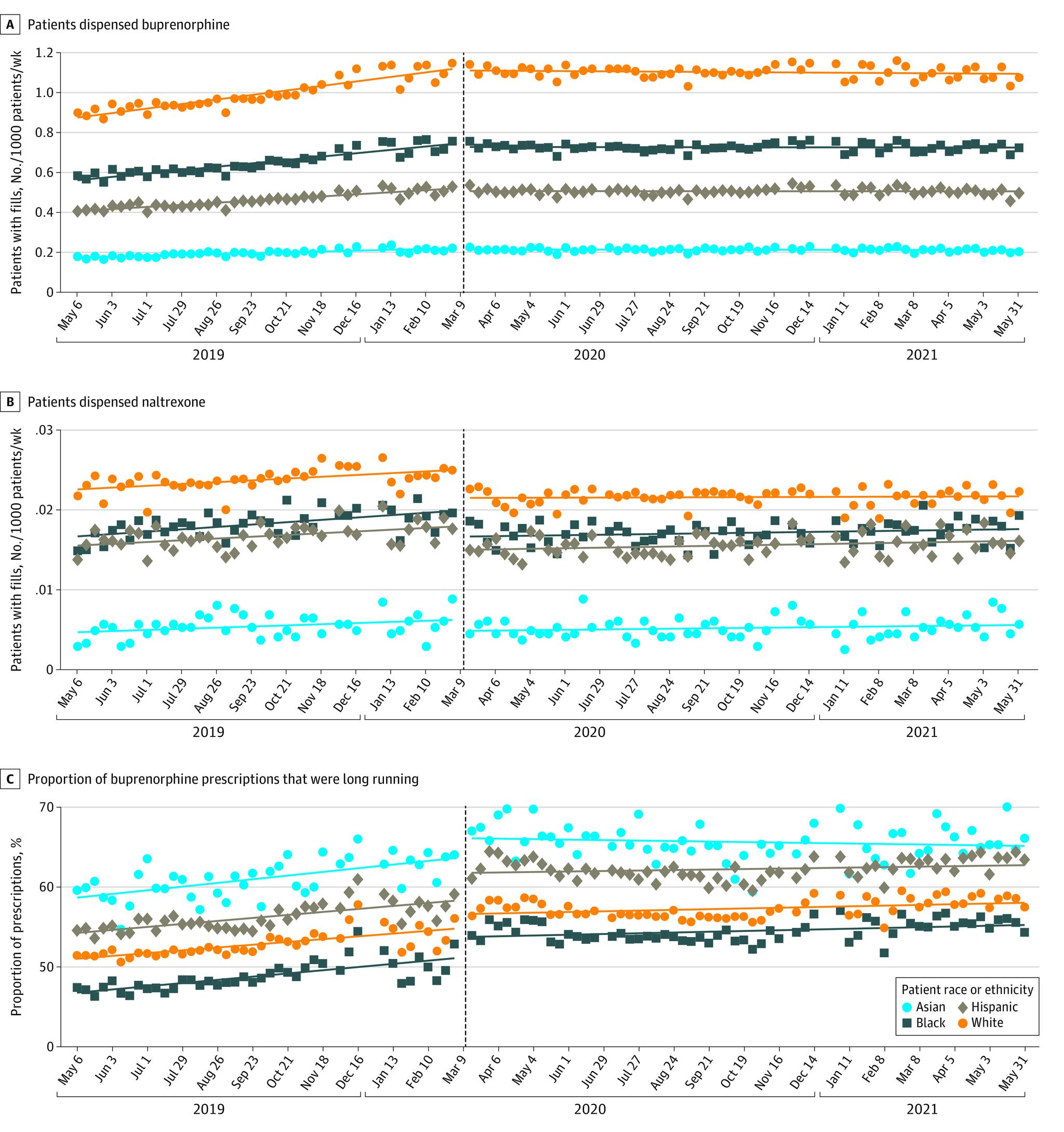
A total of 1 556 860 individuals who filled buprenorphine prescriptions (4359 Asian [0.3%], 94 657 Black [6.1%], 55 369 Hispanic [3.6%], and 664 779 White [42.7%]) and 127 506 individuals who filled extended-release naltrexone prescriptions (344 Asian [0.3%], 8186 Black [6.4%], 5343 Hispanic [4.2%], and 53 068 White [41.6%]) from May 6, 2019, to June 5, 2021, were analyzed. Prepandemic increases in buprenorphine fill rate flattened for all groups after COVID-19 onset (30.5 percentage point difference in trend; P < .001) compared with prepandemic trends. Significant level decreases in buprenorphine fills (ranging from 2.5% for Black patients; P = .009 to 4.0% for Hispanic patients; P = .009) at pandemic onset were observed for members of racial and ethnic minority groups but not White patients. At pandemic onset, rate of buprenorphine fills decreased in level for Medicare and cash-paying patients but with greater decreases for Black patients (Medicare: 10.0%; P < .001; cash: 20.0%; P < .001) than White patients (Medicare: 3.5%; P = .004; cash: 15.0%; P < .001). No decreases were found among Medicaid patients. Unlike buprenorphine, extended-release naltrexone had uniform level (from 10.0% for White patients with private insurance; P < .001 to 23.3% for Black patients with Medicare; P < .001) and trend (from 15.5 percentage points for White patients with Medicaid; P = .001 to 52.0 percentage points for Black patients with private insurance; P < .001) decreases across groups.
CONCLUSIONS AND RELEVANCE
This study found that the COVID-19 pandemic was associated with immediate decreases in filled buprenorphine prescriptions by members of racial and ethnic minority groups but not White individuals. These findings suggest that members of racial and ethnic minority groups had larger losses in buprenorphine access during the pandemic across payer types.
重要性:COVID-19 中断了阿片类药物使用障碍(OUD)的丁丙诺啡和纳曲酮治疗,在大流行期间,与白人个体相比,少数族裔群体的成员经历了 COVID-19 和阿片类药物过量的风险增加。然而,在 COVID-19 大流行期间,不同种族和族裔群体的丁丙诺啡和纳曲酮处方的填充情况是否存在差异仍不清楚。
目的:研究 COVID-19 大流行是否导致丁丙诺啡和纳曲酮处方的中断存在种族和族裔差异,以及是否与保险状况或支付类型有关。
设计、地点和参与者:这项横断面研究使用了 Symphony Health 数据库从 2019 年 5 月至 2021 年 6 月的零售药店数据,该数据库涵盖了 92%的美国零售药店数据,种族和族裔数据涵盖了所有保险状况和支付类别。使用中断时间序列来估计大流行前和大流行后丁丙诺啡和纳曲酮处方的发放水平和趋势。纳入的个体是那些填写丁丙诺啡和纳曲酮缓释片处方的个体。数据分析于 2021 年 7 月至 2022 年 3 月进行。
主要结果和措施:计算了每 1000 名患者的丁丙诺啡和纳曲酮缓释片处方发放率和较长(即≥14 天供应量)丁丙诺啡处方发放率。分析按患者的种族和族裔以及白人和黑人患者的保险状况和支付类型进行分层。
结果:从 2019 年 5 月 6 日至 2021 年 6 月 5 日,共分析了 1556860 名服用丁丙诺啡处方(0.3%为亚洲人,6.1%为黑人,3.6%为西班牙裔,42.7%为白人)和 127506 名服用纳曲酮缓释片处方(0.3%为亚洲人,6.4%为黑人,4.2%为西班牙裔,41.6%为白人)的人。与大流行前趋势相比,COVID-19 爆发后,所有群体的丁丙诺啡处方发放率的增长趋势趋于平稳(差异为 30.5 个百分点;P <.001)。在大流行期间,观察到少数族裔群体成员(从黑人患者的 2.5%;P =.009 到西班牙裔患者的 4.0%;P =.009)的丁丙诺啡用量显著下降,但白人患者没有这种情况。在大流行期间,丁丙诺啡的发放率水平下降,医疗保险和现金支付患者的降幅更大,但黑人患者的降幅大于白人患者(医疗保险:10.0%;P <.001;现金:20.0%;P <.001)。医疗补助患者没有下降。与丁丙诺啡不同,纳曲酮缓释片的水平(从私人保险的白人患者的 10.0%;P <.001 到医疗保险的黑人患者的 23.3%;P <.001)和趋势(从医疗补助的白人患者的 15.5 个百分点;P =.001 到私人保险的黑人患者的 52.0 个百分点;P <.001)在所有群体中都有所下降。
结论和相关性:本研究发现,COVID-19 大流行与少数族裔群体成员的丁丙诺啡处方立即减少有关,但白人个体没有这种情况。这些发现表明,在大流行期间,不同支付类型的少数族裔群体在丁丙诺啡的获取方面损失更大。
 Zotero 插件