
阿片类物质使用障碍药物获取趋势。
Trends in Access to Medications for Opioid Use Disorder.
作者信息
Gupta Sumedha, James Aditya, Miles Jennifer, Samples Hillary, Crystal Stephen, Simon Kosali
机构信息
Department of Economics, Indiana University Indianapolis, Indianapolis.
Indiana University, Bloomington.
出版信息
JAMA Health Forum. 2025 Apr 4;6(4):e250393. doi: 10.1001/jamahealthforum.2025.0393.
IMPORTANCE
Medicaid, the largest payer for medications for opioid use disorder (MOUD), disenrolled more than 19.1 million individuals by March 2024 after the continuous coverage requirement ended in April 2023-a process termed Medicaid unwinding-but the impact on buprenorphine receipt remains unknown.
OBJECTIVE
To assess the association between Medicaid unwinding and dispensing of prescription buprenorphine, overall and by payment sources nationally and by state.
DESIGN, SETTING, AND PARTICIPANTS: Cross-sectional study of buprenorphine dispensing (age ≥18 years) from April 2020 to March 2024 using the IQVIA Longitudinal Prescription (LRx) database containing more than 90% of US retail pharmacy claims. Interrupted time-series estimated levels and trends of buprenorphine prescription dispensation before and after Medicaid unwinding.
MAIN OUTCOMES AND MEASURES
The number of patients with filled buprenorphine prescriptions each month was analyzed by payer type (Medicaid, Medicare, commercial, or self-pay) and by state. Stratified analyses assessed state factors, including automated (ex parte) Medicaid renewal rates (higher or lower than the median), income verification sources used for automated renewals (≤3, 4-5, or 6-7), and Affordable Care Act Medicaid expansion status.
RESULTS
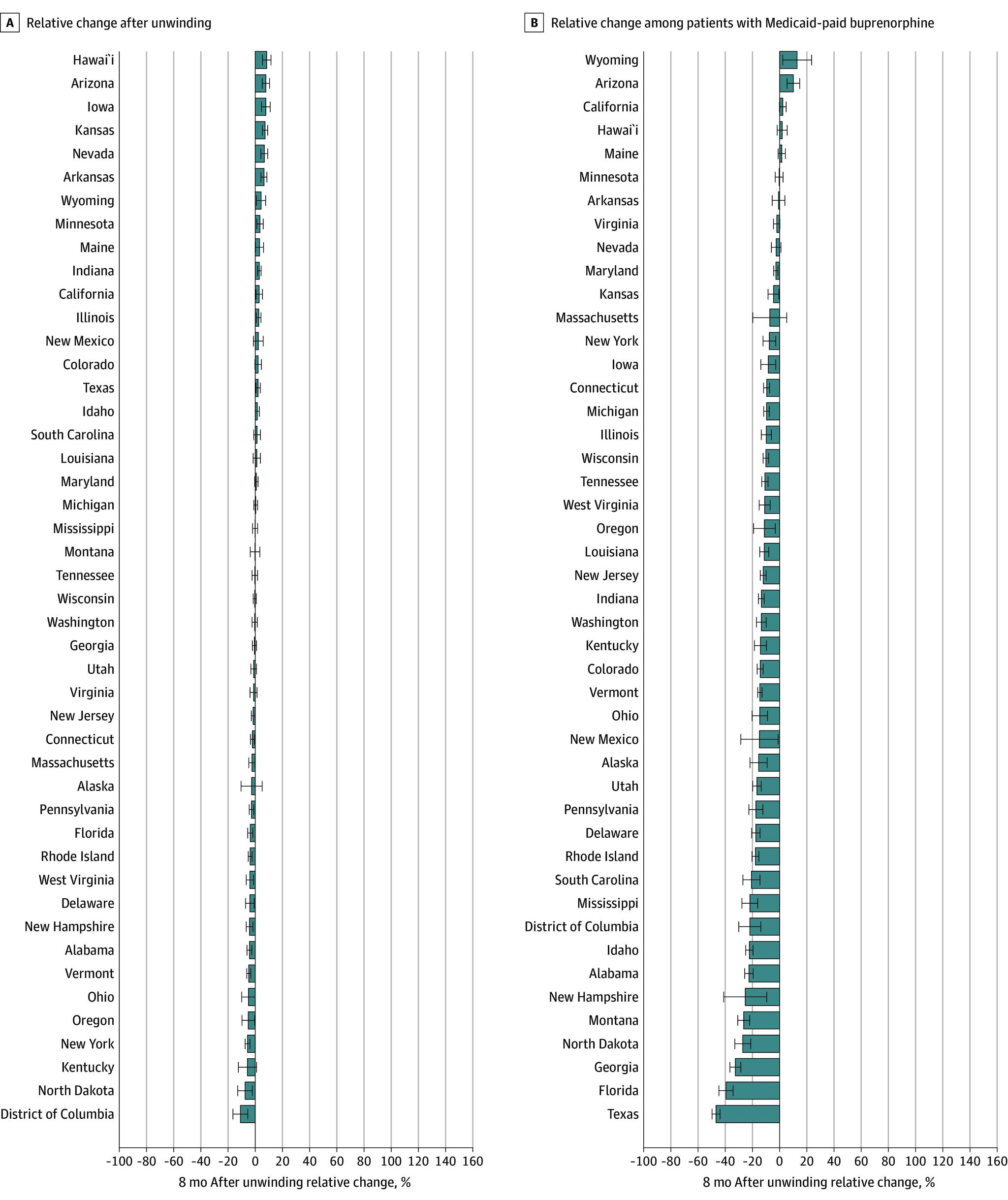
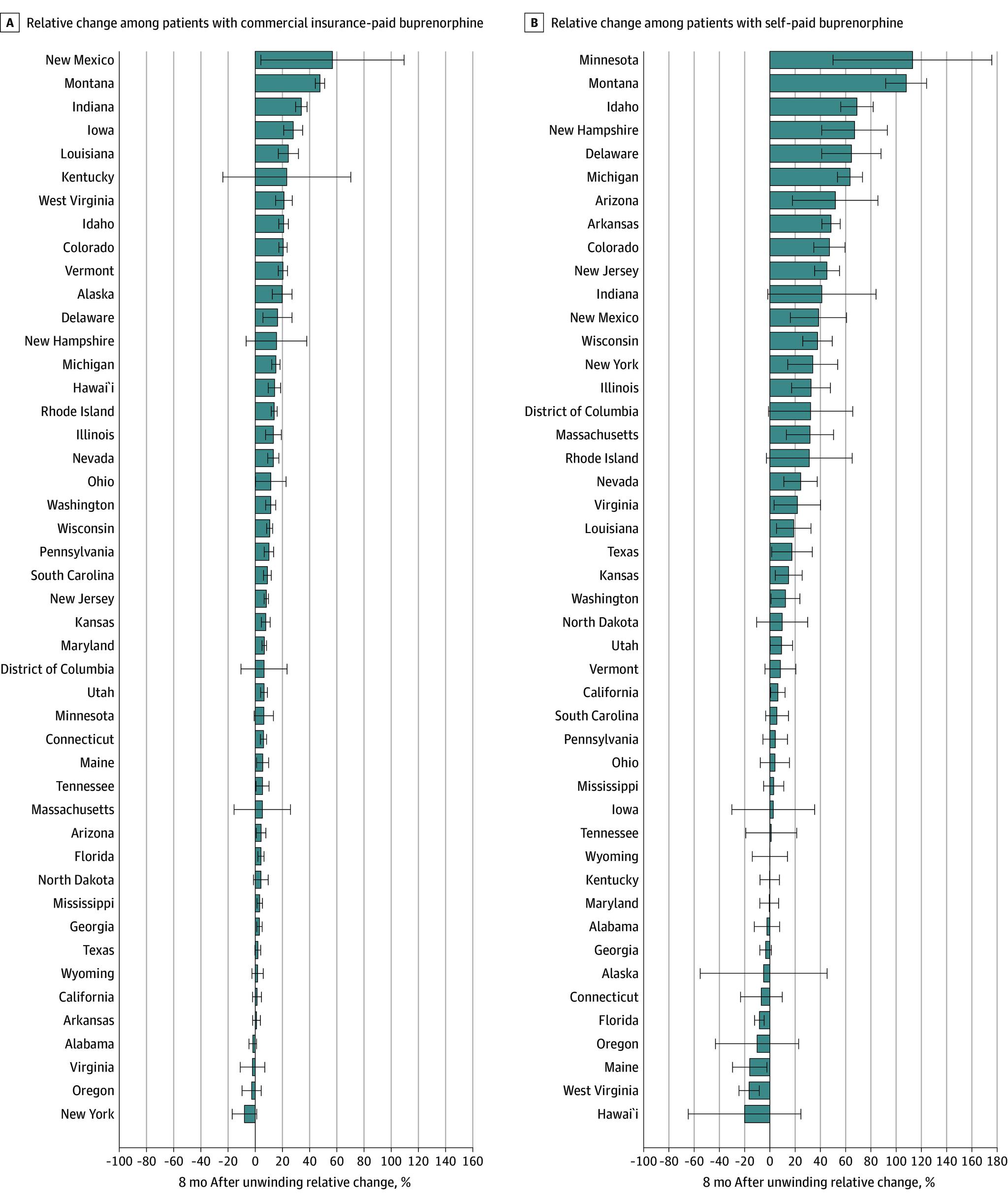
Of the 2 405 970 adults who filled buprenorphine prescriptions between April 2020 and March 2024, 1 154 866 (48%) had at least 1 fill covered by Medicaid, 288 716 (12%) by Medicare, 1 106 746 (46%) by commercial insurance, and 264 657 (11%) by self-pay. Medicaid unwinding was associated with reversal of previously increasing trends in buprenorphine prescriptions, with 2.9% fewer patients (-23 855 [95% CI, -32 661 to -15 054]) receiving buprenorphine each month by 8 months after unwinding vs the month before unwinding began. This decline was driven by a 12.7% drop in patients with Medicaid-paid fills (-46 545 [95% CI, -51 362 to -41 730]), partially offset by increases in patients with commercial (6.12%, 19 809 [95% CI, 12 109 to 27 509]) and self-paid (7.24%, 2525 [95% CI, 1246 to 3805]) fills. Sixteen states saw overall declines in buprenorphine use after unwinding, with reductions among patients with Medicaid-covered prescriptions in 36 states, partially offset by increases in patients with commercial insurance covered fills (32 states) and self-paid fills (23 states). Buprenorphine prescriptions remained stable in states with above-median automated Medicaid renewal rates and more income verification sources, whereas states with below-median automated renewal rates, fewer verification sources, and nonexpansion state status experienced smaller offsets for Medicaid-related losses, highlighting importance of state-specific policies.
CONCLUSIONS AND RELEVANCE
This cross-sectional study of Medicaid unwinding and filled buprenorphine prescriptions found that although shifts to commercial and self-pay sources mitigated some losses, rising self-pay reliance poses affordability barriers that threaten treatment continuity. Addressing access disparities is critical amid persistently high US overdose rates.
重要性
医疗补助计划是阿片类药物使用障碍药物(MOUD)的最大支付方,自2023年4月连续参保要求结束后,截至2024年3月,已有超过1910万人被取消该计划参保资格(这一过程称为医疗补助计划缩减),但其对丁丙诺啡获取的影响仍不明确。
目的
评估医疗补助计划缩减与全国及各州按支付来源划分的丁丙诺啡处方配药情况之间的关联,包括总体情况及各类支付来源的情况。
设计、设置和参与者:使用IQVIA纵向处方(LRx)数据库进行的横断面研究,该数据库包含美国超过90%的零售药房报销记录,研究时间为2020年4月至2024年3月期间丁丙诺啡配药情况(年龄≥18岁)。中断时间序列分析估计了医疗补助计划缩减前后丁丙诺啡处方配药的水平和趋势。
主要结局和指标
每月开具丁丙诺啡处方的患者数量按支付方类型(医疗补助计划、医疗保险、商业保险或自费)及州进行分析。分层分析评估了州相关因素,包括自动(单方面)医疗补助计划续保率(高于或低于中位数)、自动续保所使用的收入核实来源数量(≤3个、4 - 5个或6 - 7个)以及《平价医疗法案》医疗补助计划扩展状态。
结果
在2020年4月至2024年3月期间开具丁丙诺啡处方的2405970名成年人中,1154866人(48%)至少有一次配药由医疗补助计划支付,288716人(12%)由医疗保险支付,1106746人(46%)由商业保险支付,264657人(11%)为自费。医疗补助计划缩减与丁丙诺啡处方此前上升趋势的逆转相关,缩减开始8个月后,每月接受丁丙诺啡治疗的患者比缩减开始前一个月减少了2.9%(-23855人[95%置信区间,-32661至-15054])。这种下降是由医疗补助计划支付配药的患者减少12.7%(-46545人[95%置信区间,-51362至-41730])导致的,部分被商业保险支付(6.12%,19809人[95%置信区间,12109至27509])和自费支付(7.24%,2525人[95%置信区间,1246至3805])的患者增加所抵消。16个州在缩减后丁丙诺啡使用总体下降,36个州医疗补助计划覆盖处方的患者数量减少,部分被商业保险支付(32个州)和自费支付(23个州)的患者增加所抵消。在自动医疗补助计划续保率高于中位数且收入核实来源更多的州,丁丙诺啡处方保持稳定,而自动续保率低于中位数、核实来源较少且未扩展的州,与医疗补助计划相关损失的抵消幅度较小,凸显了州特定政策至关重要。
结论和相关性
这项关于医疗补助计划缩减和丁丙诺啡处方配药的横断面研究发现,尽管向商业保险和自费支付来源的转变减轻了一些损失,但自费支付依赖增加带来了可负担性障碍,威胁到治疗的连续性。在美国过量用药率持续居高不下的情况下,解决获取差异问题至关重要。


 Zotero 插件