
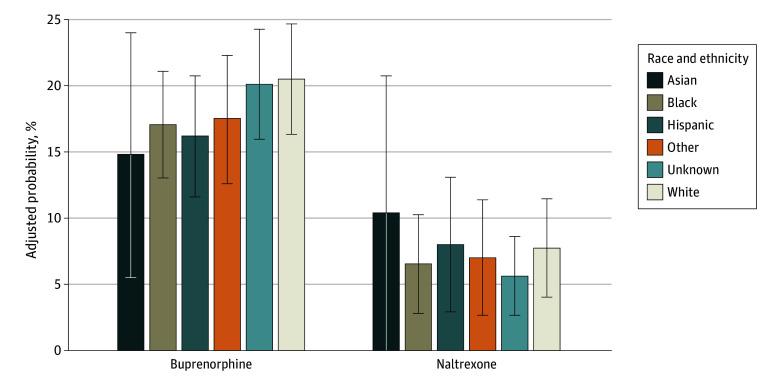
按种族、民族和保险类型划分的丁丙诺啡和纳曲酮用于阿片类物质使用障碍的情况
Receipt of Buprenorphine and Naltrexone for Opioid Use Disorder by Race and Ethnicity and Insurance Type.
作者信息
Khatri Utsha G, Lopez Christopher, Yen Yun-Ting, Ling Emilia J, Richardson Lynne D, Ngai Ka Ming
机构信息
Institute for Health Equity Research, Icahn School of Medicine at Mount Sinai, New York, New York.
Department of Population Health Science and Policy, Icahn School of Medicine at Mount Sinai, New York, New York.
出版信息
JAMA Netw Open. 2025 Jun 2;8(6):e2518493. doi: 10.1001/jamanetworkopen.2025.18493.
IMPORTANCE
Despite expanded efforts to improve treatment access, inequities exist in the receipt of medications for opioid use disorder by race and ethnicity and insurance type.
OBJECTIVE
To examine inequities in access to medications for opioid use disorder (MOUD)-specifically buprenorphine and naltrexone-by race and ethnicity and insurance type after opioid-related health care events.
DESIGN, SETTING, AND PARTICIPANTS: This retrospective cohort study used data from the Institute for Health Equity Research Multi-Payor Claims Database, which includes more than 130 million individuals across commercial, Medicaid, and Medicare Advantage insurance plans. The cohort consisted of patients aged 18 years or older with an opioid use disorder (OUD)-related health care event (opioid-related overdose, infection, or treatment event) that occurred between January 1, 2017, and December 31, 2022. Statistical analysis was conducted from October 2023 to December 2024.
EXPOSURE
Race and ethnicity and insurance type, including commercial insurance, Medicaid, and Medicare Advantage, were the primary exposures.
MAIN OUTCOMES AND MEASURES
The primary outcome was receipt of MOUD (buprenorphine or naltrexone) within 180 days of an OUD-related health care event. Logistic regression models were used to assess the associations of MOUD receipt with race and ethnicity and with insurance type, adjusting for demographic, clinical, time, and geographical covariates.
RESULTS
Among 176 997 index events involving 164 728 patients between 2017 and 2022, the mean (SD) patient age was 40.0 (13.1) years; 104 005 (58.8%) involved men; 1083 events (0.6%) were among Asian patients, 23 424 (13.2%) were among Black patients, 10 302 (5.8%) were among Hispanic patients, 90 124 (50.9%) were among White patients, and 4697 (2.7%) were among patients of other race and ethnicity; and 147 257 (83.2%) were covered by Medicaid. Black (adjusted estimated probability, 17.1% [95% CI, 13.0%-21.1%]) and Hispanic (adjusted estimated probability, 16.2% [95% CI, 11.6%-20.8%]) patients were significantly less likely than White patients (adjusted estimated probability, 20.5% [95% CI, 16.4%-24.7%]) to receive buprenorphine (Black patients: adjusted odds ratio [AOR], 0.75 [95% CI, 0.63-0.90]; adjusted risk difference [ARD], -3.4 percentage points [pp] [95% CI, -6.5 to -0.4 pp]; Hispanic patients: AOR, 0.69 [95% CI, 0.51-0.92]; ARD, -4.4 pp [95% CI, -9.1 to 0.4 pp]) but received naltrexone at similar rates. Patients with Medicaid (AOR, 1.39 [95% CI, 1.14-1.69]; ARD, 3.5 pp [95% CI, 0.9-6.1 pp]) or Medicare Advantage (AOR, 1.40 [95% CI, 1.05-1.86]; ARD, 3.6 pp [95% CI, -0.6 to 7.7 pp]) were more likely to receive buprenorphine compared with those with commercial insurance. Buprenorphine access improved incrementally from 2017 to 2022, reflecting recent clinical and policy changes; however, disparities persisted.
CONCLUSIONS AND RELEVANCE
In this cohort study of more than 17 600 opioid-related index health care events, race and ethnicity-based and insurance-based disparities in access to MOUD persisted despite efforts to expand treatment availability. These findings underscore the need for targeted interventions, including culturally tailored care, expanded access points, and policy reforms to address structural barriers and reduce inequities contributing to the overdose crisis.
重要性
尽管在扩大治疗可及性方面做出了更多努力,但在阿片类药物使用障碍药物的获取上,存在基于种族、族裔和保险类型的不平等现象。
目的
研究在与阿片类药物相关的医疗保健事件发生后,按种族、族裔和保险类型划分的阿片类药物使用障碍(MOUD)——特别是丁丙诺啡和纳曲酮——的获取不平等情况。
设计、背景和参与者:这项回顾性队列研究使用了健康公平研究所多支付方索赔数据库的数据,该数据库涵盖了超过1.3亿参加商业保险、医疗补助计划和医疗保险优势计划的个人。队列包括2017年1月1日至2022年12月31日期间发生与阿片类药物使用障碍(OUD)相关医疗保健事件(与阿片类药物相关的过量用药、感染或治疗事件)的18岁及以上患者。统计分析于2023年10月至2024年12月进行。
暴露因素
种族、族裔和保险类型,包括商业保险、医疗补助计划和医疗保险优势计划,是主要暴露因素。
主要结局和测量指标
主要结局是在与OUD相关的医疗保健事件发生后的180天内接受MOUD(丁丙诺啡或纳曲酮)治疗。使用逻辑回归模型评估接受MOUD治疗与种族、族裔以及保险类型之间的关联,并对人口统计学、临床、时间和地理协变量进行调整。
结果
在2017年至2022年期间涉及164728名患者的176997起索引事件中,患者的平均(标准差)年龄为40.0(13.1)岁;104005例(58.8%)涉及男性;1083起事件(0.6%)发生在亚洲患者中,23424起(13.2%)发生在黑人患者中,10302起(5.8%)发生在西班牙裔患者中,90124起(50.9%)发生在白人患者中,4697起(2.7%)发生在其他种族和族裔的患者中;147257例(83.2%)由医疗补助计划承保。黑人患者(调整后的估计概率为17.1%[95%置信区间,13.0%-21.1%])和西班牙裔患者(调整后的估计概率为16.2%[95%置信区间,11.6%-20.8%])接受丁丙诺啡治疗的可能性显著低于白人患者(调整后的估计概率为20.5%[95%置信区间,16.4%-24.7%])(黑人患者:调整后的优势比[AOR]为0.75[95%置信区间,0.63-0.90];调整后的风险差[ARD]为-3.4个百分点[pp][95%置信区间,-6.5至-0.4 pp];西班牙裔患者:AOR为0.69[95%置信区间,0.51-0.92];ARD为-4.4 pp[95%置信区间,-9.1至0.4 pp]),但接受纳曲酮治疗的比例相似。与商业保险患者相比,医疗补助计划患者(AOR为1.39[95%置信区间,1.14-1.69];ARD为3.5 pp[95%置信区间,0.9-6.1 pp])或医疗保险优势计划患者(AOR为1.40[95%置信区间,1.05-1.86];ARD为3.6 pp[95%置信区间,-0.6至7.7 pp])更有可能接受丁丙诺啡治疗。从2017年到2022年,丁丙诺啡的可及性逐渐改善,这反映了近期临床和政策的变化;然而,差距仍然存在。
结论和意义
在这项对超过17600起与阿片类药物相关的索引医疗保健事件的队列研究中,尽管努力扩大治疗可及性,但在获取MOUD方面基于种族、族裔和保险的差距仍然存在。这些发现强调了有针对性干预措施的必要性,包括文化上量身定制的护理、扩大获取途径以及政策改革,以消除结构性障碍并减少导致过量用药危机的不平等现象。

 Zotero 插件