
急诊科患者阿片类药物过量后治疗及转诊的差异
Disparities in Treatment and Referral After an Opioid Overdose Among Emergency Department Patients.
作者信息
Shastry Siri, Carpenter Joseph, Krotulski Alex, Brent Jeffrey, Wax Paul, Aldy Kim, Campleman Sharan, Culbreth Rachel, Falise Alyssa, Hughes Adrienne, Hendrickson Robert G, Amaducci Alexandra, Judge Bryan, Meaden Christopher, Calello Diane P, Buchanan Jennie, Shulman Joshua, Levine Michael, Schwarz Evan, Manini Alex F
机构信息
Icahn School of Medicine at Mount Sinai, New York, New York.
Emory University School of Medicine, Atlanta, Georgia.
出版信息
JAMA Netw Open. 2025 Jul 1;8(7):e2518569. doi: 10.1001/jamanetworkopen.2025.18569.
IMPORTANCE
There is a disproportionately high rate of overdose deaths immediately following an emergency department (ED) visit for opioid overdose. Thus, an improved understanding of disparities in ED treatment and referral is vital. Racial and ethnic disparities in access to naloxone and buprenorphine have been described in the outpatient setting but prevalence in the ED setting remains understudied.
OBJECTIVE
To examine racial and ethnic disparities in treatment referral rates in ED patients with opioid overdose.
DESIGN, SETTING, AND PARTICIPANTS: This is a secondary analysis of a prospective consecutive cohort from the Toxicology Investigators Consortium (TOXIC) Fentalog Study from September 21, 2020, to November 11, 2023. Ten hospital sites were a part of the TOXIC network and participants included ED patients in aged 18 years or older with opioid overdose. Data were analyzed from December 2022 to March 2025.
EXPOSURES
Patient race, ethnicity, sex, and other demographic and clinical factors of interest.
MAIN OUTCOMES AND MEASURES
Study outcomes included the proportion of patients receiving a referral to outpatient addiction care and the proportion receiving a naloxone kit or prescription or buprenorphine prescription at discharge. Descriptive statistics were tabulated, and χ2 and multivariable logistic regression analyses were used to evaluate for differences by race, ethnicity, sex, and other demographic and clinical variables.
RESULTS
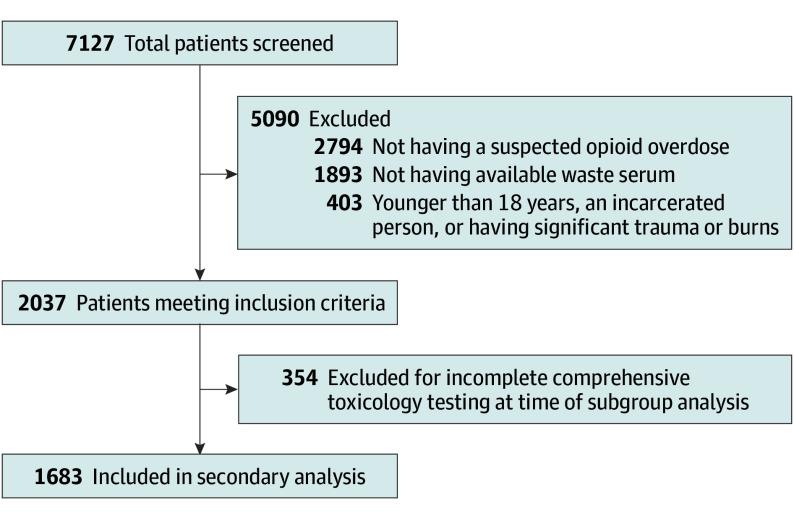
In this study, 1683 patients met all inclusion criteria (mean [SD] age, 42.5 [14.5] years; 1221 males [72.6%]; 461 females [27.4%]; 447 Black patients [26.6%]; 63 Hispanic patients [4.3%]; 867 White patients [51.5%]). Of the 1683 included patients, 299 (17.8%) received a referral for outpatient treatment, 713 (42.4%) received a naloxone kit or prescription, and 141 (8.4%) received a buprenorphine prescription. Compared with White patients, Black patients had a decreased adjusted odds ratio (aOR) of outpatient treatment referral (aOR, 0.67; 95% CI, 0.47-0.97). Hospital admission was also associated with increased adjusted odds of outpatient treatment referral (aOR, 3.13; 95% CI, 2.34-4.20). Geographic variation was associated with all primary and secondary outcomes.
CONCLUSIONS AND RELEVANCE
In this study, Black patients were less likely to receive outpatient referrals for OUD. These findings underscore the need for targeted interventions to address racial disparities in ED care for OUD, particularly in enhancing referral processes.
重要性
在因阿片类药物过量而到急诊科(ED)就诊后,立即发生的过量用药死亡发生率高得不成比例。因此,更好地了解急诊科治疗和转诊方面的差异至关重要。门诊环境中已描述了在获取纳洛酮和丁丙诺啡方面的种族和民族差异,但急诊科环境中的患病率仍研究不足。
目的
研究阿片类药物过量的急诊科患者治疗转诊率的种族和民族差异。
设计、地点和参与者:这是对2020年9月21日至2023年11月11日毒理学研究人员联盟(TOXIC)芬太尼研究的前瞻性连续队列进行的二次分析。10个医院地点是TOXIC网络的一部分,参与者包括18岁及以上因阿片类药物过量就诊的急诊科患者。数据于2022年12月至2025年3月进行分析。
暴露因素
患者的种族、民族、性别以及其他感兴趣的人口统计学和临床因素。
主要结局和测量指标
研究结局包括接受门诊成瘾护理转诊的患者比例,以及出院时接受纳洛酮试剂盒或处方或丁丙诺啡处方的患者比例。列出描述性统计数据,并使用χ2检验和多变量逻辑回归分析来评估种族、民族、性别以及其他人口统计学和临床变量之间的差异。
结果
在本研究中,1683名患者符合所有纳入标准(平均[标准差]年龄,42.5[14.5]岁;1221名男性[72.6%];461名女性[27.4%];447名黑人患者[26.6%];63名西班牙裔患者[4.3%];867名白人患者[51.5%])。在1683名纳入患者中,299名(17.8%)接受了门诊治疗转诊,713名(42.4%)接受了纳洛酮试剂盒或处方,141名(8.4%)接受了丁丙诺啡处方。与白人患者相比,黑人患者接受门诊治疗转诊的调整优势比(aOR)降低(aOR,0.67;95%CI,0.47 - 0.97)。住院也与门诊治疗转诊的调整优势增加相关(aOR,3.13;95%CI,2.34 - 4.20)。地理差异与所有主要和次要结局相关。
结论及意义
在本研究中,黑人患者接受门诊物质使用障碍转诊的可能性较小。这些发现强调了需要有针对性的干预措施来解决急诊科对物质使用障碍护理中的种族差异,特别是在加强转诊流程方面。
 Zotero 插件