
医疗补助计划逐步取消期间的覆盖范围和获得情况的变化。
Coverage and Access Changes During Medicaid Unwinding.
机构信息
Harvard University T.H. Chan School of Public Health, Department of Health Policy and Management, Boston, Massachusetts.
Harvard Medical School, Boston, Massachusetts.
出版信息
JAMA Health Forum. 2024 Jun 7;5(6):e242193. doi: 10.1001/jamahealthforum.2024.2193.
IMPORTANCE
States resumed Medicaid eligibility redeterminations, which had been paused during the COVID-19 public health emergency, in 2023. This unwinding of the pandemic continuous coverage provision raised concerns about the extent to which beneficiaries would lose Medicaid coverage and how that would affect access to care.
OBJECTIVE
To assess early changes in insurance and access to care during Medicaid unwinding among individuals with low incomes in 4 Southern states.
DESIGN, SETTING, AND PARTICIPANTS: This multimodal survey was conducted in Arkansas, Kentucky, Louisiana, and Texas from September to November 2023, used random-digit dialing and probabilistic address-based sampling, and included US citizens aged 19 to 64 years reporting 2022 incomes at or less than 138% of the federal poverty level.
EXPOSURE
Medicaid enrollment at any point since March 2020, when continuous coverage began.
MAIN OUTCOMES AND MEASURES
Self-reported disenrollment from Medicaid, insurance at the time of interview, and self-reported access to care. Using multivariate logistic regression, factors associated with Medicaid loss were evaluated. Access and affordability of care among respondents who exited Medicaid vs those who remained enrolled were compared, after multivariate adjustment.
RESULTS
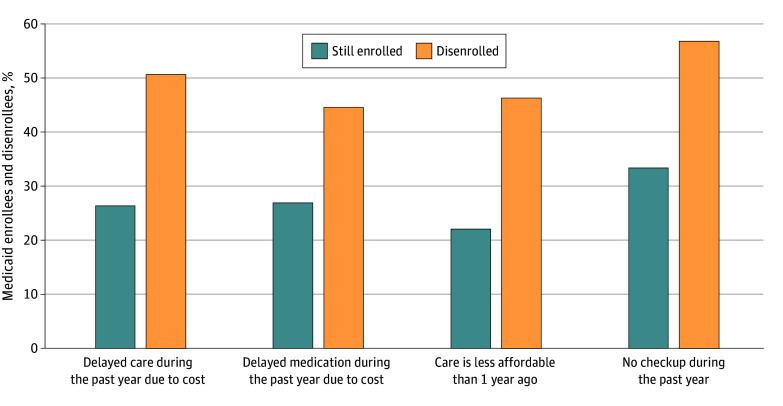
The sample contained 2210 adults (1282 women [58.0%]; 505 Black non-Hispanic individuals [22.9%], 393 Hispanic individuals [17.8%], and 1133 White non-Hispanic individuals [51.3%]) with 2022 household incomes less than 138% of the federal poverty line. On a survey-weighted basis, 1564 (70.8%) reported that they and/or a dependent child of theirs had Medicaid at some point since March 2020. Among adult respondents who had Medicaid, 179 (12.5%) were no longer enrolled in Medicaid at the time of the survey, with state estimates ranging from 7.0% (n = 19) in Kentucky to 16.2% (n = 82) in Arkansas. Fewer children who had Medicaid lost coverage (42 [5.4%]). Among adult respondents who left Medicaid since 2020 and reported coverage status at time of interview, 47.8% (n = 80) were uninsured, 27.0% (n = 45) had employer-sponsored insurance, and the remainder had other coverage as of fall 2023. Disenrollment was higher among younger adults, employed individuals, and rural residents but lower among non-Hispanic Black respondents (compared with non-Hispanic White respondents) and among those receiving Supplemental Nutrition Assistance Program benefits. Losing Medicaid was significantly associated with delaying care due to cost and worsening affordability of care.
CONCLUSIONS AND RELEVANCE
The results of this survey study indicated that 6 months into unwinding, 1 in 8 Medicaid beneficiaries reported exiting the program, with wide state variation. Roughly half who lost Medicaid coverage became uninsured. Among those moving to new coverage, many experienced coverage gaps. Adults exiting Medicaid reported more challenges accessing care than respondents who remained enrolled.
重要性
2023 年,各州恢复了医疗补助资格重新确定,该资格在 COVID-19 公共卫生紧急情况下暂停。这种大流行持续覆盖条款的取消引发了人们对受益人将在多大程度上失去医疗补助覆盖以及这将如何影响获得医疗服务的担忧。
目的
评估在四个南方州中,收入较低的人群在医疗补助取消过程中早期保险和获得医疗服务的变化情况。
设计、地点和参与者:这项多模式调查于 2023 年 9 月至 11 月在阿肯色州、肯塔基州、路易斯安那州和德克萨斯州进行,使用随机数字拨号和概率地址抽样,包括年龄在 19 至 64 岁之间的美国公民,报告 2022 年收入为联邦贫困水平的 138%或以下。
暴露
自 2020 年 3 月开始的任何时候都有医疗补助的参与,当时开始了持续覆盖。
主要结果和措施
自我报告的从医疗补助中退出、采访时的保险状况以及自我报告的获得医疗服务的情况。使用多变量逻辑回归,评估了与医疗补助损失相关的因素。在多变量调整后,比较了退出医疗补助的受访者与仍在注册的受访者的医疗服务的可及性和可负担性。
结果
样本包含 2210 名成年人(1282 名女性[58.0%];505 名非西班牙裔黑人[22.9%],393 名西班牙裔[17.8%]和 1133 名非西班牙裔白人[51.3%]),他们的 2022 年家庭收入低于联邦贫困线的 138%。根据调查加权,1564 人(70.8%)报告他们自己和/或他们的一个受抚养子女在 2020 年 3 月之后的某个时候有医疗补助。在有医疗补助的成年受访者中,有 179 人(12.5%)在调查时不再参加医疗补助,各州的估计值从肯塔基州的 7.0%(n=19)到阿肯色州的 16.2%(n=82)不等。较少的有医疗补助的儿童失去了保障(42[5.4%])。在自 2020 年以来退出医疗补助并在采访时报告了保险状况的成年受访者中,47.8%(n=80)没有保险,27.0%(n=45)有雇主赞助的保险,其余人在 2023 年秋季之前有其他保险。年轻成年人、受雇人员和农村居民的脱保率较高,但非西班牙裔黑人(与非西班牙裔白人相比)和接受补充营养援助计划(Supplemental Nutrition Assistance Program)福利的受访者的脱保率较低。失去医疗补助与因费用而推迟护理以及医疗服务负担能力恶化显著相关。
结论和相关性
这项调查研究的结果表明,在取消计划的 6 个月内,有 1/8 的医疗补助受益人报告退出了该计划,各州之间存在很大差异。大约一半失去医疗补助的人失去了医疗保险。在转向新保险的人群中,许多人经历了保险空白期。与仍在注册的受访者相比,退出医疗补助的成年人报告说在获得医疗服务方面面临更多挑战。


 Zotero 插件