
CECT 7894通过调节肠道微生物群和胆汁酸代谢提高英夫利昔单抗对葡聚糖硫酸钠诱导的结肠炎的疗效。
CECT 7894 Improves the Efficacy of Infliximab for DSS-Induced Colitis Regulating the Gut Microbiota and Bile Acid Metabolism.
作者信息
Xiao Fangfei, Dong Fang, Li Xiaolu, Li Youran, Yu Guangjun, Liu Zhanju, Wang Yizhong, Zhang Ting
机构信息
Department of Gastroenterology, Hepatology and Nutrition, Shanghai Children's Hospital, School of Medicine, Shanghai Jiao Tong University, Shanghai, China.
Gut Microbiota and Metabolic Research Center, Institute of Pediatric Infection, Immunity and Critical Care Medicine, School of Medicine, Shanghai Jiao Tong University, Shanghai, China.
出版信息
Front Pharmacol. 2022 Aug 1;13:902337. doi: 10.3389/fphar.2022.902337. eCollection 2022.
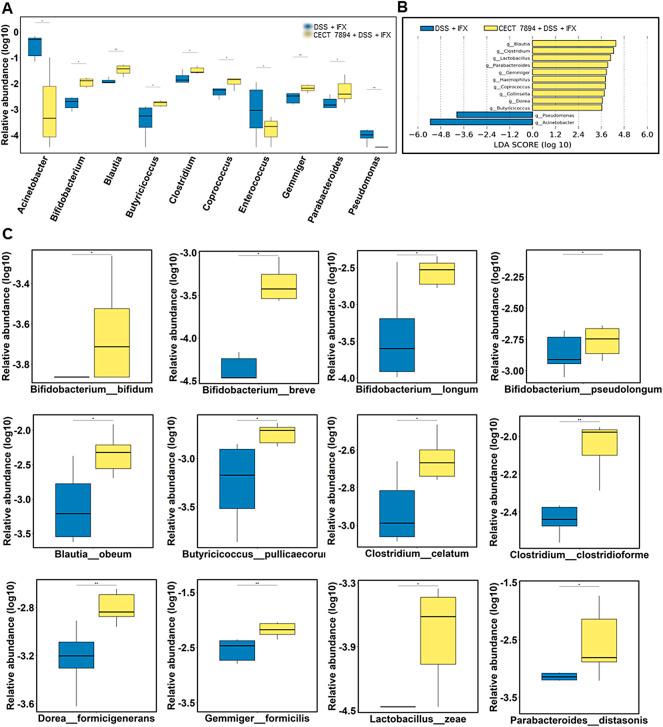
Recent evidence suggests that the changes in gut microbiota and its metabolites could predict the clinical response of anti-tumor necrosis factor (TNF) agents, such as infliximab (IFX). However, whether manipulation of the gut microbiota can enhance the efficacy of anti-TNF agents remains unclear. Here, we aim to evaluate the effect of a probiotic strain, () CECT 7894, on IFX efficacy for dextran sulfate sodium (DSS)-induced colitis in mice and attempt to explore the potential involved mechanisms. C57BL/6 mice were treated with phosphate-buffered saline (PBS) or CECT 7894 (5 × 10 CFU/day) once daily by gavage for 5 days and subsequently induced acute colitis by 3% (w/v) DSS in drinking water. The efficacies of IFX combined with or without CECT 7894 were assessed by weight loss, fecal consistency, colon length, and histopathological changes. Immunohistochemistry (IHC) was used to examine the expression of tight junction proteins (TJPs) in colonic tissues. The microbiota composition was characterized through 16 S rRNA gene sequencing. Fecal bile acids (BAs) levels were analyzed by targeted metabolomics. CECT 7894 improved the efficacy of IFX for DSS-induced colitis as evidenced by decreased weight loss, disease activity index (DAI) scores, colon length shortening, histological damage, increased ZO-1, and Occludin expressions as compared with mice that received IFX only. CECT 7894 modified the composition and structure of the gut microbiota community in DSS-induced colitis mice. CECT 7894 increased the relative abundances of genera , , , , , , and , and reduced the relative abundances of bacteria genera and . Furthermore, CECT 7894 changed the BAs metabolism by increasing the abundance of secondary BAs, such as -MCA, -MCA, LCA, CDCA, UDCA, HCA, isoLCA, isoalloLCA. The covariance analysis revealed the upregulated secondary BAs were positively associated with the increased abundance of bacteria that contained bile salt hydrolases (BSH) and 7α-dehydroxylases genes. CECT 7894 improved the efficacy of IFX for DSS-induced colitis regulating the gut microbiota composition and bile acid metabolism. Probiotics supplementation may provide a possibility to improve the clinical response of anti-TNF agents in IBD management.
近期证据表明,肠道微生物群及其代谢产物的变化可预测抗肿瘤坏死因子(TNF)药物(如英夫利昔单抗(IFX))的临床反应。然而,肠道微生物群的调控是否能增强抗TNF药物的疗效仍不明确。在此,我们旨在评估益生菌菌株()CECT 7894对IFX治疗葡聚糖硫酸钠(DSS)诱导的小鼠结肠炎疗效的影响,并试图探索潜在的相关机制。将C57BL/6小鼠每日一次经口灌胃给予磷酸盐缓冲盐水(PBS)或CECT 7894(5×10 CFU/天),持续5天,随后通过在饮用水中添加3%(w/v)DSS诱导急性结肠炎。通过体重减轻、粪便稠度、结肠长度和组织病理学变化评估IFX联合或不联合CECT 7894的疗效。采用免疫组织化学(IHC)检测结肠组织中紧密连接蛋白(TJPs)的表达。通过16S rRNA基因测序对微生物群组成进行表征。通过靶向代谢组学分析粪便胆汁酸(BAs)水平。与仅接受IFX的小鼠相比,CECT 7894提高了IFX对DSS诱导结肠炎的疗效,表现为体重减轻、疾病活动指数(DAI)评分降低、结肠长度缩短、组织学损伤减轻、ZO-1和闭合蛋白表达增加。CECT 7894改变了DSS诱导结肠炎小鼠肠道微生物群的组成和结构。CECT 7894增加了属、、、、、、和的相对丰度,降低了细菌属和的相对丰度。此外,CECT 7894通过增加次级胆汁酸(如-MCA、-MCA、LCA、CDCA、UDCA、HCA、isoLCA、isoalloLCA)的丰度改变了胆汁酸代谢。协方差分析显示,上调的次级胆汁酸与含有胆汁盐水解酶(BSH)和7α-脱羟基酶基因的细菌丰度增加呈正相关。CECT 7894通过调节肠道微生物群组成和胆汁酸代谢提高了IFX对DSS诱导结肠炎的疗效。补充益生菌可能为改善IBD管理中抗TNF药物的临床反应提供一种可能性。




 Zotero 插件