
组织蛋白酶 B 二肽基羧基肽酶和内肽酶活性在较宽的 pH 范围内均有表现。
Cathepsin B Dipeptidyl Carboxypeptidase and Endopeptidase Activities Demonstrated across a Broad pH Range.
机构信息
Skaggs School of Pharmacy and Pharmaceutical Sciences, University of California, San Diego, La Jolla, California 92093, United States.
Biomedical Sciences Graduate Program, University of California, San Diego, La Jolla, California 92093, United States.
出版信息
Biochemistry. 2022 Sep 6;61(17):1904-1914. doi: 10.1021/acs.biochem.2c00358. Epub 2022 Aug 18.
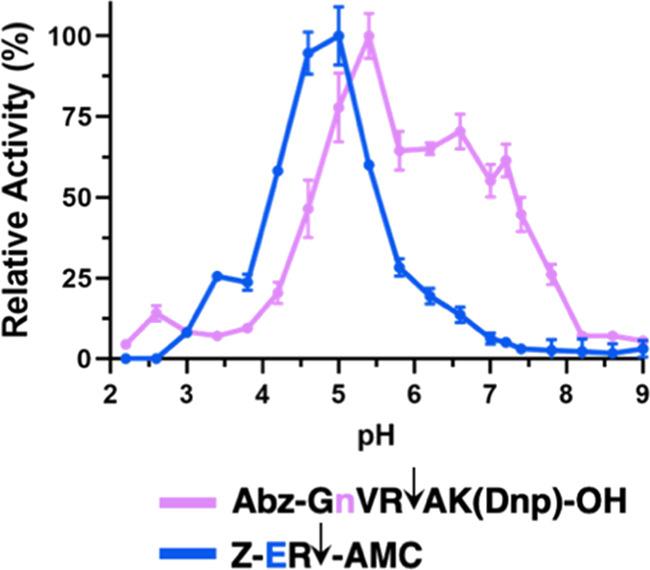
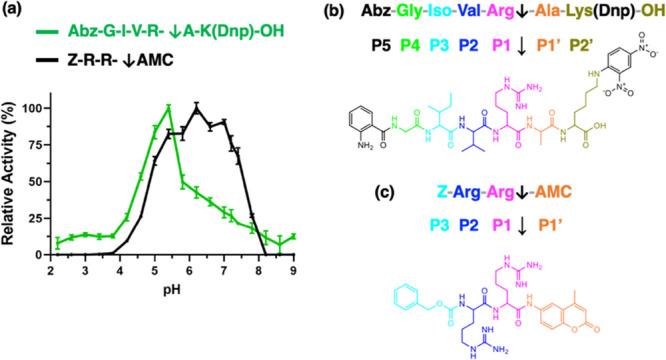
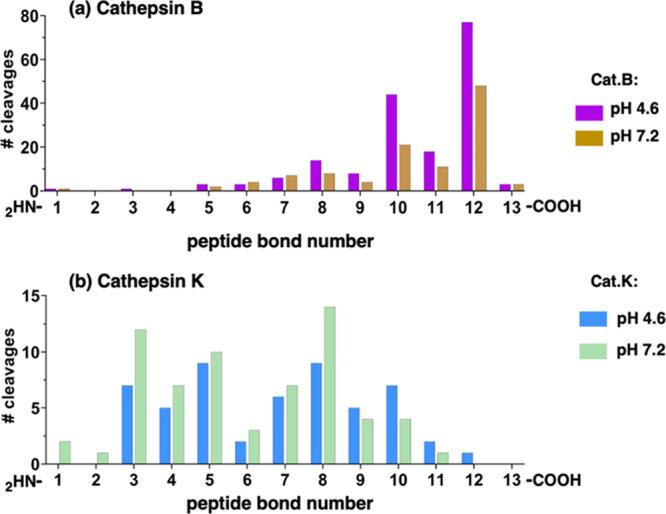
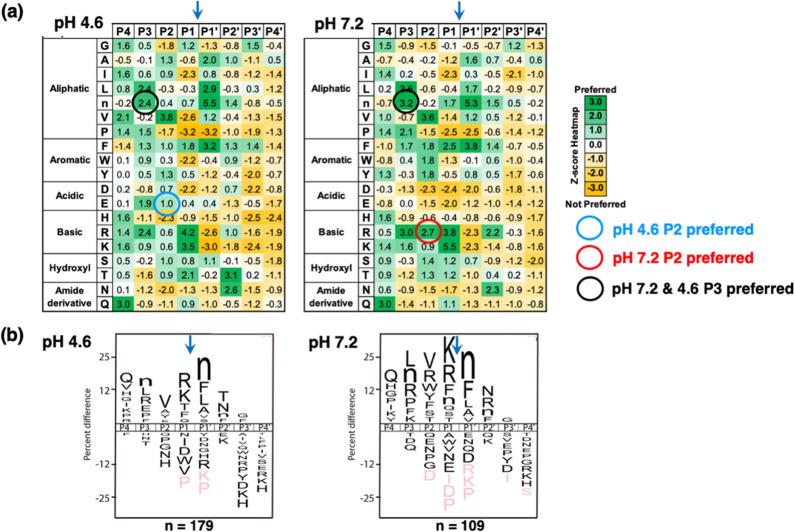
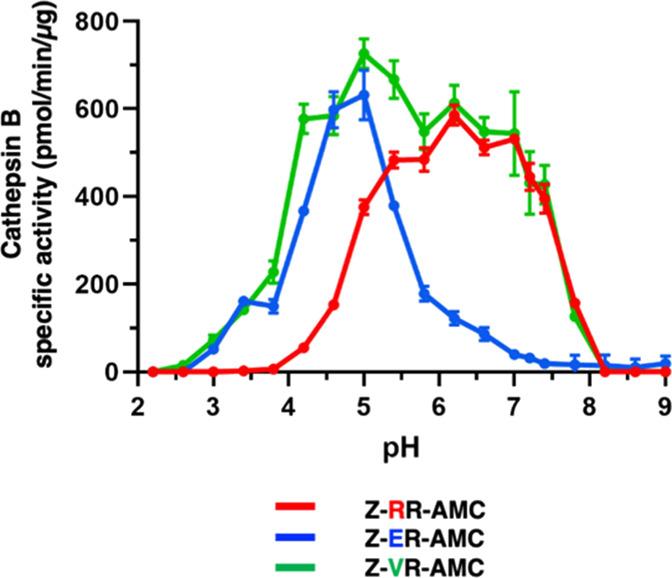
Cathepsin B is a lysosomal protease that participates in protein degradation. However, cathepsin B is also active under neutral pH conditions of the cytosol, nuclei, and extracellular locations. The dipeptidyl carboxypeptidase (DPCP) activity of cathepsin B, assayed with the Abz-GIVR↓AK(Dnp)-OH substrate, has been reported to display an acidic pH optimum. In contrast, the endopeptidase activity, monitored with Z-RR-↓AMC, has a neutral pH optimum. These observations raise the question of whether other substrates can demonstrate cathepsin B DPCP activity at neutral pH and endopeptidase activity at acidic pH. To address this question, global cleavage profiling of cathepsin B with a diverse peptide library was conducted under acidic and neutral pH conditions. Results revealed that cathepsin B has (1) major DPCP activity and modest endopeptidase activity under both acidic and neutral pH conditions and (2) distinct pH-dependent amino acid preferences adjacent to cleavage sites for both DPCP and endopeptidase activities. The pH-dependent cleavage preferences were utilized to design a new Abz-GVR↓AK(Dnp)-OH DPCP substrate, with norleucine (n) at the P3 position, having improved DPCP activity of cathepsin B at neutral pH compared to the original Abz-GIVR↓AK(Dnp)-OH substrate. The new Z-VR-AMC and Z-ER-AMC substrates displayed improved endopeptidase activity at acidic pH compared to the original Z-RR-AMC. These findings illustrate the new concept that cathepsin B possesses DPCP and endopeptidase activities at both acidic and neutral pH values. These results advance understanding of the pH-dependent cleavage properties of the dual DPCP and endopeptidase activities of cathepsin B that function under different cellular pH conditions.
组织蛋白酶 B 是一种溶酶体蛋白酶,参与蛋白质降解。然而,组织蛋白酶 B 在细胞质、核和细胞外位置的中性 pH 条件下也具有活性。用 Abz-GIVR↓AK(Dnp)-OH 底物测定的组织蛋白酶 B 的二肽羧肽酶 (DPCP) 活性已报道显示出酸性 pH 最佳值。相比之下,用 Z-RR-↓AMC 监测的内切酶活性具有中性 pH 最佳值。这些观察结果提出了一个问题,即其他底物是否可以在中性 pH 下显示组织蛋白酶 B 的 DPCP 活性,在酸性 pH 下显示内切酶活性。为了解决这个问题,用多种肽库对组织蛋白酶 B 进行了全局切割分析,分别在酸性和中性 pH 条件下进行。结果表明,组织蛋白酶 B 在(1)酸性和中性 pH 条件下均具有主要的 DPCP 活性和适度的内切酶活性,(2)具有不同的 pH 依赖性氨基酸偏好性,紧邻 DPCP 和内切酶活性的切割位点。pH 依赖性切割偏好被用于设计一种新的 Abz-GVR↓AK(Dnp)-OH DPCP 底物,其 P3 位为正亮氨酸 (n),与原始 Abz-GIVR↓AK(Dnp)-OH 底物相比,在中性 pH 下提高了组织蛋白酶 B 的 DPCP 活性。新的 Z-VR-AMC 和 Z-ER-AMC 底物在酸性 pH 下显示出比原始 Z-RR-AMC 更高的内切酶活性。这些发现说明了一个新的概念,即组织蛋白酶 B 在酸性和中性 pH 值下都具有 DPCP 和内切酶活性。这些结果提高了对组织蛋白酶 B 的双 DPCP 和内切酶活性在不同细胞 pH 条件下的 pH 依赖性切割特性的理解。


 Zotero 插件