
儿童金黄色葡萄球菌菌血症的感染性疾病咨询的影响。
The impact of infectious diseases consultation for children with Staphylococcus aureus bacteremia.
机构信息
Department of Pediatrics, Washington University School of Medicine, St. Louis, MO, USA.
Department of Medicine, Washington University School of Medicine, St. Louis, MO, USA.
出版信息
Pediatr Res. 2022 Dec;92(6):1598-1605. doi: 10.1038/s41390-022-02251-0. Epub 2022 Aug 18.
BACKGROUND
Despite clear benefit of improved outcomes in adults, the impact of infectious diseases (ID) consultation for Staphylococcus aureus bacteremia in children remains understudied.
METHODS
To assess the impact of pediatric ID consultation on management and outcomes, we conducted a cohort study of children with S. aureus bacteremia at St. Louis Children's Hospital from 2011 to 2018. We assessed adherence to six established quality-of-care indicators (QCIs). We applied propensity score methodology to examine the impact of ID consultation on risk of treatment failure, a composite of all-cause mortality or hospital readmission within 90 days.
RESULTS
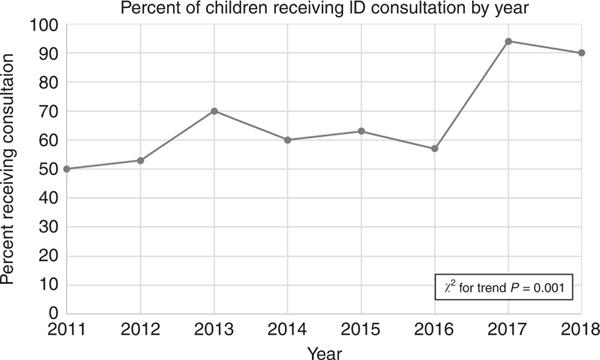
Of 306 patients with S. aureus bacteremia, 193 (63%) received ID consultation. ID consultation was associated with increased adherence to all QCIs, including proof-of-cure blood cultures, indicated laboratory studies, echocardiography, source control, targeted antibiotic therapy, and antibiotic duration. Obtaining proof-of-cure blood cultures and all indicated laboratory studies were associated with improved outcomes. In propensity score-weighted analyses, risk of treatment failure was similar among patients who did and did not receive ID consultation. However, the number of events was small and risk estimates were imprecise.
CONCLUSIONS
For children with S. aureus bacteremia, ID consultation improved adherence to QCIs, some of which were associated with improved clinical outcomes.
IMPACT
In children with Staphylococcus aureus bacteremia, consultation by an infectious diseases (ID) physician improved adherence to established quality-of-care indicators (QCIs). The current literature regarding ID consultation in pediatric S. aureus bacteremia is sparse. Three prior international studies demonstrated improved quality of care with ID consultation, though results were disparate regarding clinical outcomes. This article impacts the current literature by strengthening the evidence that ID consultation in children improves adherence to QCIs, and demonstrates that adherence to QCIs improves clinical outcomes.
背景
尽管成人患者的结局得到了明显改善,但传染病(ID)专家对儿童金黄色葡萄球菌菌血症的会诊对结局的影响仍研究不足。
方法
为了评估儿科 ID 专家会诊对治疗管理和结局的影响,我们对 2011 年至 2018 年期间在圣路易斯儿童医院就诊的金黄色葡萄球菌菌血症患儿进行了一项队列研究。我们评估了 6 项既定的质量护理指标(QCIs)的达标情况。我们应用倾向评分法来评估 ID 会诊对治疗失败风险的影响,治疗失败的复合终点为 90 天内的全因死亡率或再次住院。
结果
在 306 例金黄色葡萄球菌菌血症患儿中,193 例(63%)接受了 ID 会诊。ID 会诊与所有 QCIs 达标率的提高相关,包括治愈证明血培养、有指征的实验室检查、超声心动图、源头控制、靶向抗生素治疗和抗生素持续时间。获得治愈证明血培养和所有有指征的实验室检查与改善结局相关。在倾向评分加权分析中,接受和未接受 ID 会诊的患儿治疗失败风险相似。然而,事件数量较少且风险估计值不精确。
结论
对于金黄色葡萄球菌菌血症患儿,ID 会诊可提高 QCIs 的达标率,其中一些指标与临床结局的改善相关。
意义
对于金黄色葡萄球菌菌血症患儿,传染病(ID)医师的会诊可提高既定的质量护理指标(QCIs)的达标率。目前关于儿科金黄色葡萄球菌菌血症中 ID 会诊的文献较为缺乏。三项先前的国际研究表明 ID 会诊可改善治疗质量,但关于临床结局的结果存在差异。本文通过强化 ID 会诊可提高 QCIs 达标率且可改善临床结局的证据,为当前文献增添了新内容。

 Zotero 插件