
CD28 和趋化因子受体:免疫突触处的信号放大器。
CD28 and chemokine receptors: Signalling amplifiers at the immunological synapse.
机构信息
Pediatric Research Institute "Città della Speranza", Corso Stati Uniti, Padova, Italy.
Department of Biomedical Sciences, University of Padova, Padova, Italy.
出版信息
Front Immunol. 2022 Aug 2;13:938004. doi: 10.3389/fimmu.2022.938004. eCollection 2022.
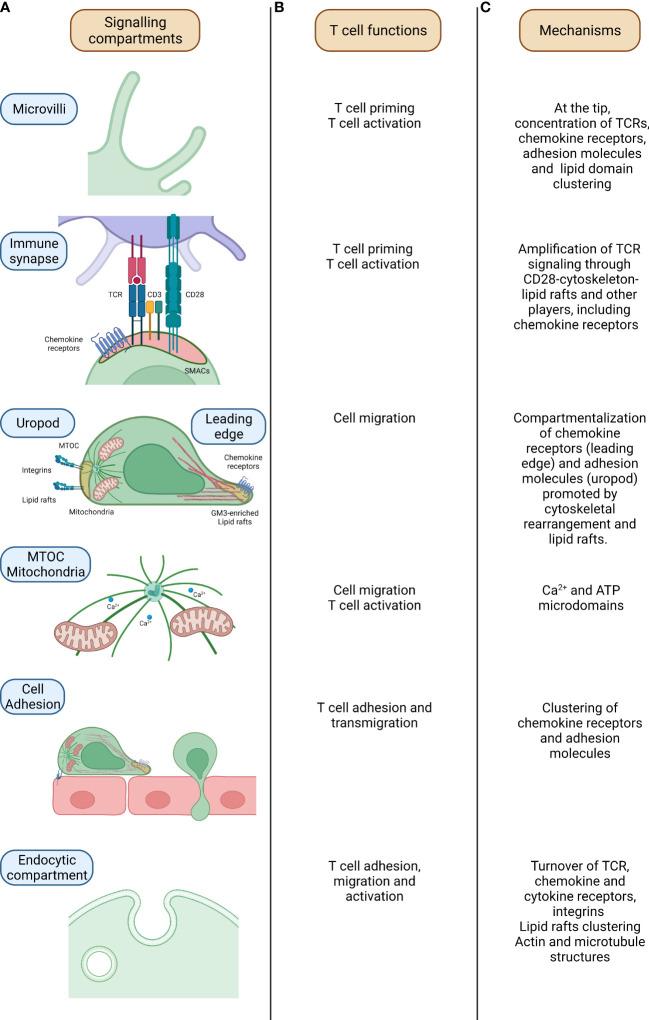
T cells are master regulators of the immune response tuning, among others, B cells, macrophages and NK cells. To exert their functions requiring high sensibility and specificity, T cells need to integrate different stimuli from the surrounding microenvironment. A finely tuned signalling compartmentalization orchestrated in dynamic platforms is an essential requirement for the proper and efficient response of these cells to distinct triggers. During years, several studies have depicted the pivotal role of the cytoskeleton and lipid microdomains in controlling signalling compartmentalization during T cell activation and functions. Here, we discuss mechanisms responsible for signalling amplification and compartmentalization in T cell activation, focusing on the role of CD28, chemokine receptors and the actin cytoskeleton. We also take into account the detrimental effect of mutations carried by distinct signalling proteins giving rise to syndromes characterized by defects in T cell functionality.
T 细胞是免疫反应的主要调节者,可调节 B 细胞、巨噬细胞和自然杀伤细胞等。为了发挥其功能,T 细胞需要整合来自周围微环境的不同刺激。在动态平台上协调的精细信号分区化是这些细胞对不同触发因素做出适当和有效反应的必要条件。多年来,多项研究描绘了细胞骨架和脂质微区在控制 T 细胞激活和功能过程中的信号分区化中的关键作用。在这里,我们讨论了负责 T 细胞激活中信号放大和分区化的机制,重点关注 CD28、趋化因子受体和肌动蛋白细胞骨架的作用。我们还考虑了不同信号蛋白携带的突变所带来的有害影响,这些突变导致以 T 细胞功能缺陷为特征的综合征。
 Zotero 插件