
通过CAR-CD19修饰或可溶性双特异性抗体博纳吐单抗增强细胞因子诱导的杀伤细胞的功能活性。
Functional Activity of Cytokine-Induced Killer Cells Enhanced by CAR-CD19 Modification or by Soluble Bispecific Antibody Blinatumomab.
作者信息
Zaninelli Silvia, Panna Silvia, Tettamanti Sarah, Melita Giusi, Doni Andrea, D'Autilia Francesca, Valgardsdottir Rut, Gotti Elisa, Rambaldi Alessandro, Golay Josée, Introna Martino
机构信息
Center of Cellular Therapy "G. Lanzani", Division of Hematology, ASST Papa Giovanni XXIII, 24122 Bergamo, Italy.
M. Tettamanti Center, Fondazione IRCCS San Gerardo dei Tintori, 20900 Monza, Italy.
出版信息
Antibodies (Basel). 2024 Aug 30;13(3):71. doi: 10.3390/antib13030071.
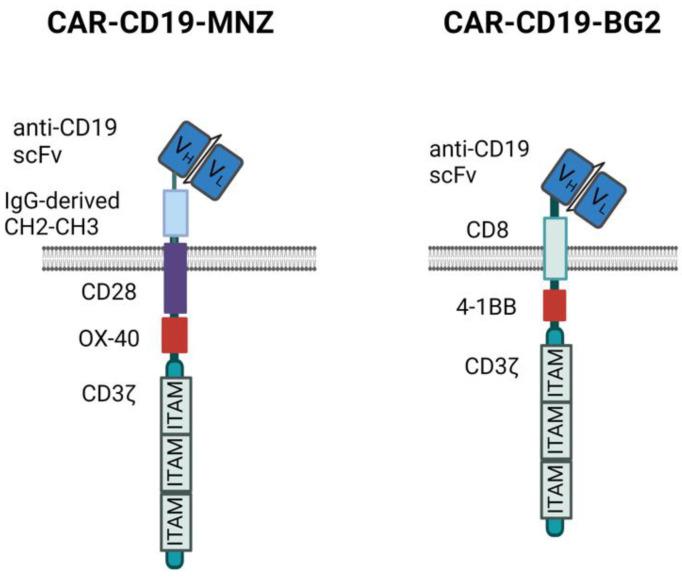
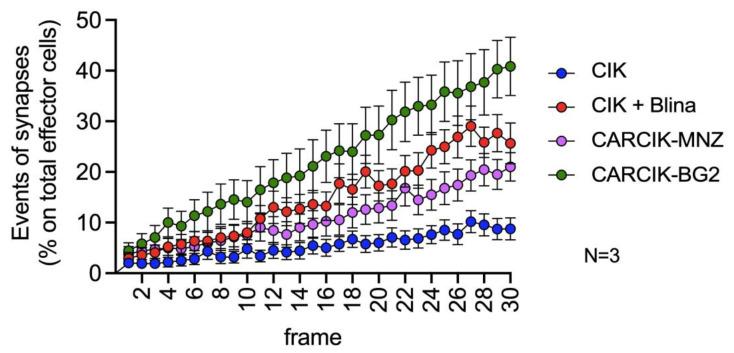
Strategies to increase the anti-tumor efficacy of cytokine-induced killer cells (CIKs) include genetic modification with chimeric antigen receptors (CARs) or the addition of soluble T-cell engaging bispecific antibodies (BsAbs). Here, CIKs were modified using a transposon system integrating two distinct anti-CD19 CARs (CAR-MNZ and CAR-BG2) or combined with soluble CD3xCD19 BsAb blinatumomab (CIK + Blina). CAR-MNZ bearing the CD28-OX40-CD3ζ signaling modules, and CAR-BG2, designed on the Tisagenlecleucel CAR sequence (Kymriah), carrying the 4-1BB and CD3ζ signaling elements, were employed. After transfection and CIK expansion, cells expressed CAR-CD19 to a similar extent (35.9% CAR-MNZ and 17.7% CAR-BG2). In vitro evaluations demonstrated robust proliferation and cytotoxicity (~50% cytotoxicity) of CARCIK-MNZ, CARCIK-BG2, and CIK + Blina against CD19 target cells, suggesting similar efficacy. All effectors formed an increased number of synapses, activated NFAT and NFkB, and secreted IL-2 and IFN-ɣ upon encountering targets. CIK + Blina displayed strongest NFAT and IFN-ɣ induction, whereas CARCIK-BG2 demonstrated superior synapse formation. All the effectors have shown therapeutic activity in vivo against the CD19 Daudi tumor model, with CARCIK cells showing a more durable response compared to CIK + Blina, likely due to the short half-life of Blina in this model.
提高细胞因子诱导的杀伤细胞(CIK)抗肿瘤疗效的策略包括用嵌合抗原受体(CAR)进行基因改造或添加可溶性T细胞结合双特异性抗体(BsAb)。在此,CIK细胞通过转座子系统进行改造,该系统整合了两种不同的抗CD19 CAR(CAR-MNZ和CAR-BG2),或者与可溶性CD3xCD19 BsAb贝林妥欧单抗(CIK + Blina)联合使用。使用了携带CD28-OX40-CD3ζ信号模块的CAR-MNZ,以及基于替沙格韦单抗CAR序列(Kymriah)设计、携带4-1BB和CD3ζ信号元件的CAR-BG2。转染和CIK扩增后,细胞表达CAR-CD19的程度相似(CAR-MNZ为35.9%,CAR-BG2为17.7%)。体外评估表明,CARCIK-MNZ、CARCIK-BG2和CIK + Blina对CD-19靶细胞具有强劲的增殖和细胞毒性(约50%的细胞毒性),提示疗效相似。所有效应细胞在遇到靶细胞时形成的突触数量增加,激活了NFAT和NFkB,并分泌IL-2和IFN-γ。CIK + Blina表现出最强的NFAT和IFN-γ诱导作用,而CARCIK-BG2表现出卓越的突触形成能力。所有效应细胞在体内对CD19达乌迪肿瘤模型均显示出治疗活性,与CIK + Blina相比,CARCIK细胞显示出更持久的反应,这可能是由于该模型中贝林妥欧单抗的半衰期较短。



 Zotero 插件