
神经退行性疾病中的核因子κB:来自人类遗传学的最新证据
NF-κB in neurodegenerative diseases: Recent evidence from human genetics.
作者信息
Kaltschmidt Barbara, Helweg Laureen P, Greiner Johannes F W, Kaltschmidt Christian
机构信息
Department of Molecular Neurobiology, Bielefeld University, Bielefeld, Germany.
Forschungsverbund BioMedizin Bielefeld, Ostwestfalen-Lippe (OWL) (FBMB E.V.), Bielefeld, Germany.
出版信息
Front Mol Neurosci. 2022 Aug 2;15:954541. doi: 10.3389/fnmol.2022.954541. eCollection 2022.
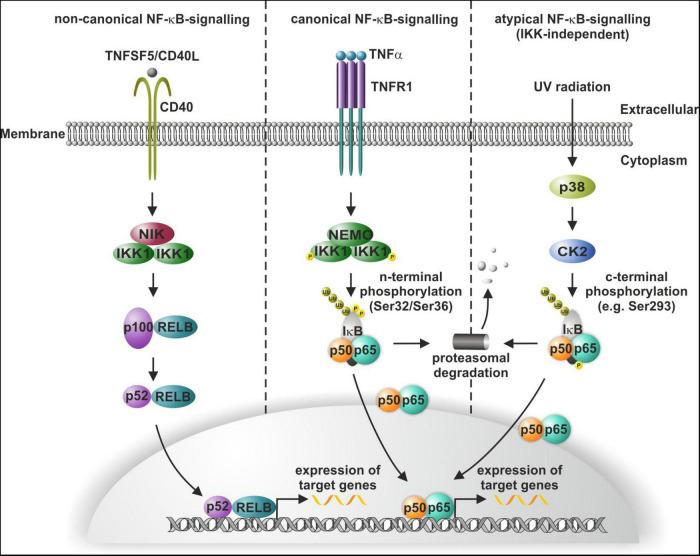
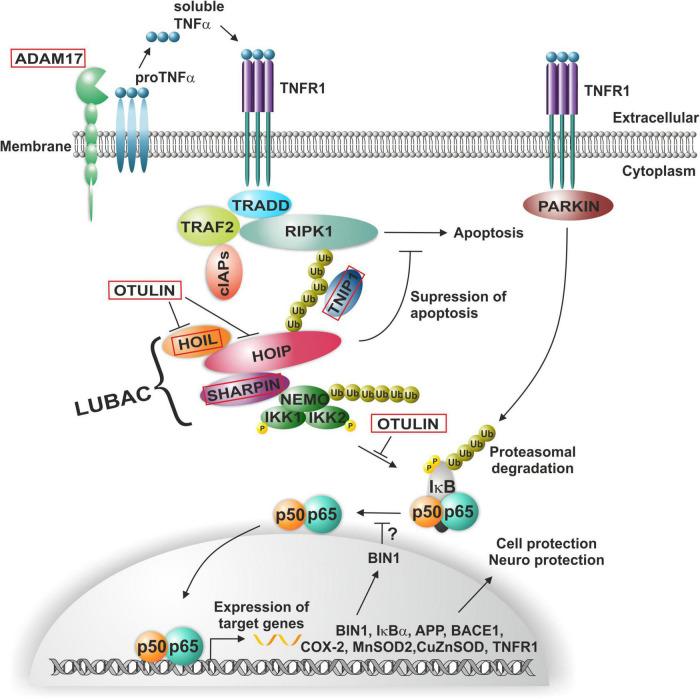
The transcription factor NF-κB is commonly known to drive inflammation and cancer progression, but is also a crucial regulator of a broad range of cellular processes within the mammalian nervous system. In the present review, we provide an overview on the role of NF-κB in the nervous system particularly including its constitutive activity within cortical and hippocampal regions, neuroprotection as well as learning and memory. Our discussion further emphasizes the increasing role of human genetics in neurodegenerative disorders, namely, germline mutations leading to defects in NF-κB-signaling. In particular, we propose that loss of function mutations upstream of NF-κB such as ADAM17, SHARPIN, HOIL, or OTULIN affect NF-κB-activity in Alzheimer's disease (AD) patients, in turn driving anatomical defects such as shrinkage of entorhinal cortex and the limbic system in early AD. Similarly, E3 type ubiquitin ligase PARKIN is positively involved in NF-κB signaling. PARKIN loss of function mutations are most frequently observed in Parkinson's disease patients. In contrast to AD, relying on germline mutations of week alleles and a disease development over decades, somatic mutations affecting NF-κB activation are commonly observed in cells derived from glioblastoma multiforme (GBM), the most common malignant primary brain tumor. Here, our present review particularly sheds light on the mutual exclusion of either the deletion of NFKBIA or amplification of epidermal growth factor receptor (EGFR) in GBM, both resulting in constitutive NF-κB-activity driving tumorigenesis. We also discuss emerging roles of long non-coding RNAs such as HOTAIR in suppressing phosphorylation of IκBα in the context of GBM. In summary, the recent progress in the genetic analysis of patients, particularly those suffering from AD, harbors the potential to open up new vistas for research and therapy based on TNFα/NF-κB pathway and neuroprotection.
转录因子NF-κB通常被认为会促进炎症和癌症进展,但它也是哺乳动物神经系统内广泛细胞过程的关键调节因子。在本综述中,我们概述了NF-κB在神经系统中的作用,特别是其在皮质和海马区域的组成性活性、神经保护以及学习和记忆方面的作用。我们的讨论进一步强调了人类遗传学在神经退行性疾病中的作用日益增加,即种系突变导致NF-κB信号传导缺陷。特别是,我们提出NF-κB上游的功能丧失突变,如ADAM17、SHARPIN、HOIL或OTULIN,会影响阿尔茨海默病(AD)患者的NF-κB活性,进而导致早期AD中内嗅皮质和边缘系统萎缩等解剖学缺陷。同样,E3型泛素连接酶PARKIN积极参与NF-κB信号传导。PARKIN功能丧失突变在帕金森病患者中最为常见。与AD不同,AD依赖于弱等位基因的种系突变和数十年的疾病发展,影响NF-κB激活的体细胞突变在多形性胶质母细胞瘤(GBM)(最常见的原发性恶性脑肿瘤)来源的细胞中普遍存在。在这里,我们的综述特别阐明了GBM中NFKBIA缺失或表皮生长因子受体(EGFR)扩增的相互排斥,这两者都会导致组成性NF-κB活性驱动肿瘤发生。我们还讨论了长链非编码RNA,如HOTAIR在GBM背景下抑制IκBα磷酸化的新作用。总之,患者遗传分析的最新进展,特别是那些患有AD的患者,有可能为基于TNFα/NF-κB途径和神经保护的研究和治疗开辟新的前景。


 Zotero 插件