
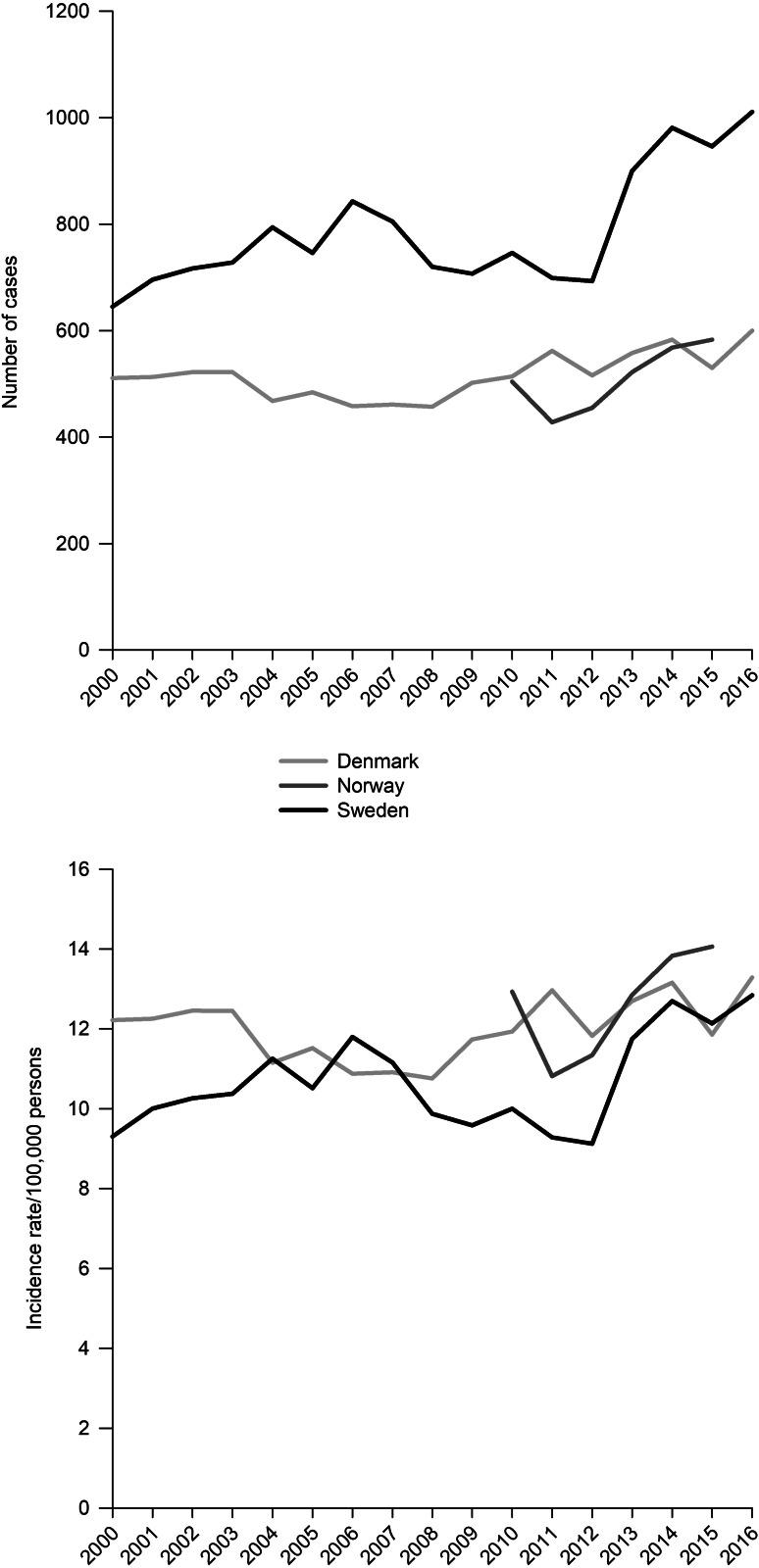
2000 年至 2016 年斯堪的纳维亚地区物质所致精神障碍的年发病率。
Annual incidence of substance-induced psychoses in Scandinavia from 2000 to 2016.
机构信息
Section for Clinical Addiction Research, Oslo University Hospital, Oslo, Norway.
Niuvanniemi Hospital, Kuopio, Finland.
出版信息
Psychol Med. 2023 Aug;53(11):5246-5255. doi: 10.1017/S003329172200229X. Epub 2022 Aug 19.
BACKGROUND
Substance-induced psychosis (SIP) is a serious condition and may predispose for schizophrenia. We know too little about SIP incidence over time and across countries, including substance-specific SIPs. We estimated annual incidence rate of SIP in Denmark, Norway, and Sweden according to substance, age, gender, and socioeconomic background.
METHODS
Data were drawn from registries covering the whole adult population in the countries. Annual incidence rate per 100 000 persons of SIPs was estimated for Denmark and Sweden from 2000 to 2016 and for Norway from 2010 to 2015.
RESULTS
The annual incidence rate of any SIP fluctuated between 9.3 and 14.1. The most commonly occurring SIPs were those induced by alcohol, cannabis, amphetamines, and multiple substances. There was a steady decrease in the incidence rate of alcohol-induced psychosis from the first to the last year of the observation period in Denmark (from 4.9 to 1.5) and Sweden (from 4.5 to 2.2). The incidence rate of cannabis-induced psychosis increased in all countries, from 2.6 to 5.6 in Denmark, from 0.8 to 2.7 in Sweden, and from 1.8 to 3.0 in Norway. Median age of any SIP decreased in Denmark (from 36 to 29 years) and Sweden (from 41 to 31 years). Incidence rates were higher in men and in individuals on disability pension, and increased more among those with high parental education.
CONCLUSIONS
We found similar and stable incidence rates of any SIP in all Scandinavian countries through the observation period. The incidence of alcohol-induced psychosis decreased. The incidence of cannabis-induced psychosis increased.
背景
物质所致精神障碍(SIP)是一种严重的疾病,可能会导致精神分裂症。我们对 SIP 在不同时间和不同国家的发病率知之甚少,包括特定物质所致 SIP。我们根据物质、年龄、性别和社会经济背景,估计了丹麦、挪威和瑞典的 SIP 年发病率。
方法
数据来自涵盖这些国家所有成年人口的登记处。我们估算了丹麦和瑞典 2000 年至 2016 年和挪威 2010 年至 2015 年期间 SIP 的年发病率,每 10 万人中 SIP 的发病率。
结果
任何 SIP 的年发病率波动在 9.3 至 14.1 之间。最常见的 SIP 是由酒精、大麻、安非他命和多种物质引起的。在丹麦和瑞典,从观察期的第一年到最后一年,酒精所致精神障碍的发病率稳步下降(从 4.9 降至 1.5,从 4.5 降至 2.2)。在所有国家,大麻所致精神障碍的发病率都有所增加,在丹麦从 2.6 增至 5.6,在瑞典从 0.8 增至 2.7,在挪威从 1.8 增至 3.0。任何 SIP 的中位数年龄在丹麦(从 36 岁降至 29 岁)和瑞典(从 41 岁降至 31 岁)都有所下降。在丹麦和瑞典,发病率在男性和残疾抚恤金领取者中较高,在父母教育程度较高的人群中发病率增加更多。
结论
在观察期间,我们在所有斯堪的纳维亚国家发现了相似且稳定的任何 SIP 发病率。酒精所致精神障碍的发病率下降,大麻所致精神障碍的发病率上升。



 Zotero 插件