
胃食管腺癌脑转移的结局和分子特征。
Outcomes and Molecular Features of Brain Metastasis in Gastroesophageal Adenocarcinoma.
机构信息
Department of Medicine, New York Presbyterian/Weill Cornell Medicine, New York, New York.
Department of Epidemiology and Biostatistics, Memorial Sloan Kettering Cancer Center, New York, New York.
出版信息
JAMA Netw Open. 2022 Aug 1;5(8):e2228083. doi: 10.1001/jamanetworkopen.2022.28083.
IMPORTANCE
Brain metastasis (BrM) in gastroesophageal adenocarcinoma (GEA) is a rare and poorly understood phenomenon associated with poor prognosis.
OBJECTIVES
To examine the clinical and genomic features of patients with BrM from GEA and evaluate factors associated with survival.
DESIGN, SETTING, AND PARTICIPANTS: In this single-institution retrospective cohort study, 68 patients with BrM from GEA diagnosed between January 1, 2008, and December 31, 2020, were identified via review of billing codes and imaging reports from the electronic medical record with follow-up through November 3, 2021. Genomic data were derived from the Memorial Sloan Kettering-Integrated Mutation Profiling of Actionable Cancer Targets clinical sequencing platform.
EXPOSURES
Treatment with BrM resection and/or radiotherapy.
MAIN OUTCOMES AND MEASURES
Overall survival after BrM diagnosis.
RESULTS
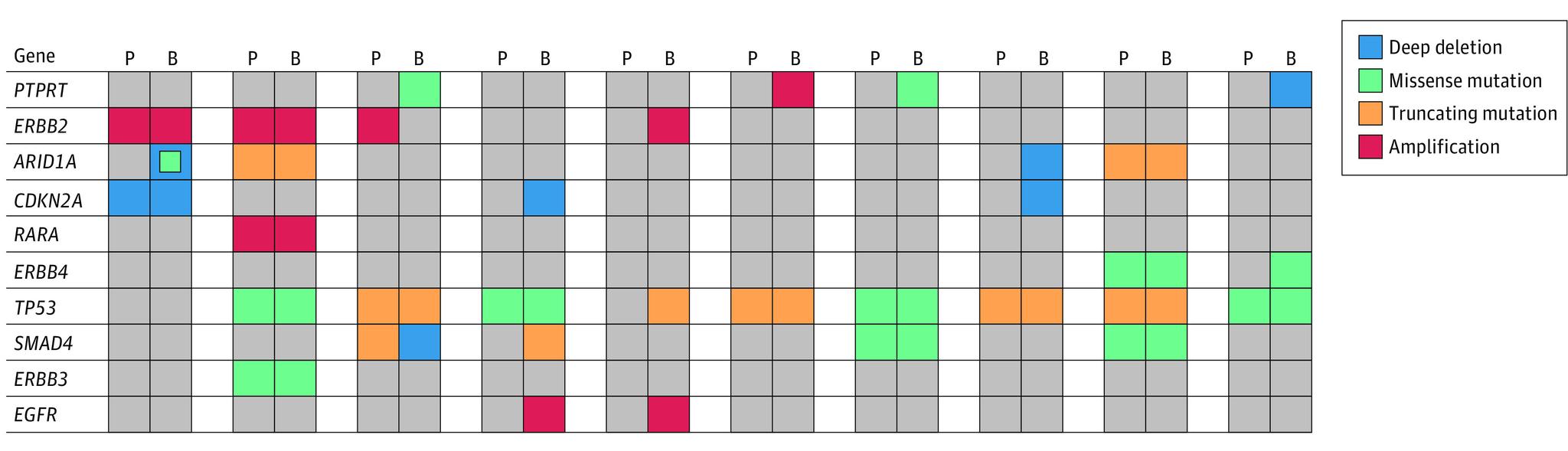
Sixty-eight patients (median age at diagnosis, 57.4 years [IQR, 49.8-66.4 years]; 59 [86.8%] male; 55 [85.9%] White) participated in the study. A total of 57 (83.8%) had primary tumors in the distal esophagus or gastroesophageal junction. Median time from initial diagnosis to BrM diagnosis was 16.9 months (IQR, 8.5-27.7 months). Median survival from BrM diagnosis was 8.7 months (95% CI, 5.5-11.5 months). Overall survival was 35% (95% CI, 25%-48%) at 1 year and 24% (95% CI, 16%-37%) at 2 years. In a multivariable analysis, an Eastern Cooperative Oncology Group performance status of 2 or greater (hazard ratio [HR], 4.66; 95% CI, 1.47-14.70; P = .009) and lack of surgical or radiotherapeutic intervention (HR, 7.71; 95% CI, 2.01-29.60; P = .003) were associated with increased risk of all-cause mortality, whereas 3 or more extracranial sites of disease (HR, 1.85; 95% CI, 0.64-5.29; P = .25) and 4 or more BrMs (HR, 2.15; 95% CI, 0.93-4.98; P = .07) were not statistically significant. A total of 31 patients (45.6%) had ERBB2 (formerly HER2 or HER2/neu)-positive tumors, and alterations in ERBB2 were enriched in BrM relative to primary tumors (8 [47.1%] vs 7 [20.6%], P = .05), as were alterations in PTPRT (7 [41.2%] vs 4 [11.8%], P = .03).
CONCLUSIONS AND RELEVANCE
This study suggests that that a notable proportion of patients with BrM from GEA achieve survival exceeding 1 and 2 years from BrM diagnosis, a more favorable prognosis than previously reported. Good performance status and treatment with combination surgery and radiotherapy were associated with the best outcomes. ERBB2 positivity and amplification as well as PTPRT alterations were enriched in BrM tissue compared with primary tumors; therefore, further study should be pursued to identify whether these variables represent genomic risk factors for BrM development.
重要性
胃食管腺癌(GEA)脑转移(BrM)是一种罕见且了解甚少的现象,与预后不良相关。
目的
研究来自 GEA 的 BrM 患者的临床和基因组特征,并评估与生存相关的因素。
设计、地点和参与者:在这项单机构回顾性队列研究中,通过审查电子病历中的计费代码和影像学报告,确定了 2008 年 1 月 1 日至 2020 年 12 月 31 日期间诊断为 GEA 伴 BrM 的 68 例患者,并通过 2021 年 11 月 3 日的随访进行随访。基因组数据源自 Memorial Sloan Kettering-Integrated Mutation Profiling of Actionable Cancer Targets 临床测序平台。
暴露
BrM 切除术和/或放疗治疗。
主要结果和测量
BrM 诊断后的总生存。
结果
68 例患者(诊断时的中位年龄,57.4 岁[四分位距,49.8-66.4 岁];59[86.8%]为男性;55[85.9%]为白人)参与了研究。共有 57 例(83.8%)患者的原发肿瘤位于食管下段或胃食管交界处。从初始诊断到 BrM 诊断的中位时间为 16.9 个月(四分位距,8.5-27.7 个月)。从 BrM 诊断到中位生存时间为 8.7 个月(95%CI,5.5-11.5 个月)。1 年时的总生存率为 35%(95%CI,25%-48%),2 年时为 24%(95%CI,16%-37%)。多变量分析显示,东部合作肿瘤组表现状态为 2 或更高(危险比[HR],4.66;95%CI,1.47-14.70;P=0.009)和缺乏手术或放射治疗干预(HR,7.71;95%CI,2.01-29.60;P=0.003)与全因死亡率增加相关,而 3 个或更多颅外部位疾病(HR,1.85;95%CI,0.64-5.29;P=0.25)和 4 个或更多 BrM(HR,2.15;95%CI,0.93-4.98;P=0.07)则无统计学意义。共有 31 例(45.6%)患者的肿瘤为 ERBB2(前 HER2 或 HER2/neu)阳性,与原发肿瘤相比,BrM 中 ERBB2 的改变更为丰富(8[47.1%]比 7[20.6%],P=0.05),PTPRT 的改变也是如此(7[41.2%]比 4[11.8%],P=0.03)。
结论和相关性
本研究表明,相当一部分来自 GEA 的 BrM 患者在 BrM 诊断后超过 1 年和 2 年的时间内实现了生存,预后优于先前报道。良好的表现状态和联合手术和放疗治疗与最佳结局相关。与原发肿瘤相比,BrM 组织中 ERBB2 阳性和扩增以及 PTPRT 改变更为丰富;因此,应进一步研究这些变量是否代表 BrM 发展的基因组危险因素。

 Zotero 插件