
脑转移瘤的预后因素分析及风险预测:一项基于监测、流行病学和最终结果(SEER)数据库人群的研究
Analysis of prognostic factors and risk prediction in brain metastases: a SEER population-based study.
作者信息
Ji Qiang, Yang Zixuan, Kang Xun, Zhou Lili, Chen Feng, Li Wenbin
机构信息
Department of Neuro-oncology, Cancer Center, China National Clinical Research Center for Neurological Diseases, Beijing Tiantan Hospital, Capital Medical University, Beijing, China.
National Institute for Data Science in Health and Medicine, Capital Medical University, Beijing, China.
出版信息
Front Oncol. 2025 May 21;15:1523069. doi: 10.3389/fonc.2025.1523069. eCollection 2025.
BACKGROUND
This study investigates survival disparities and prognostic factors in patients with brain metastases originating from various primary cancers to facilitate risk stratification and enhance precision in diagnosis and treatment.
METHODS
Patients diagnosed with brain metastases between 2010 and 2018 were identified from the SEER database for analysis. Overall survival (OS) was evaluated using Kaplan-Meier curves and log-rank tests, complemented by multivariate Cox regression analysis. The impact of age on the risk and survival of brain metastases was examined using Restricted Cubic Splines (RCS) in Cox regression models.
RESULTS
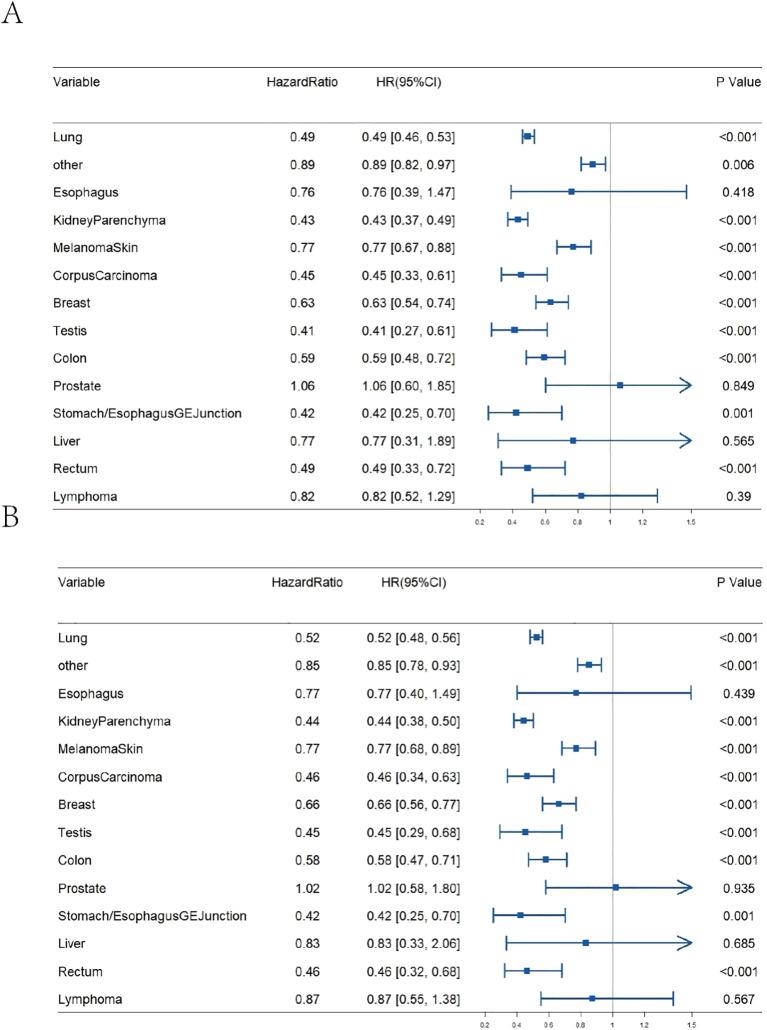
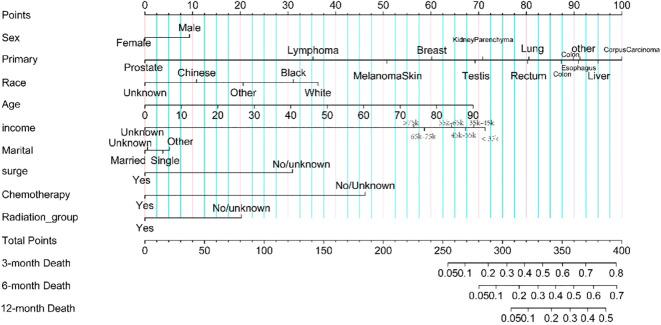
A total of 55,094 patients diagnosed with brain metastases between 2010 and 2018 were retrospectively identified from the SEER database for inclusion in this study. It was found that the median survival times were 2 months (95% CI: 2-3 months) for liver cancer, 3 months (95% CI: 3-4 months) for stomach cancer, and 5 months (95% CI: 4-5 months) for lung cancer. Survival was influenced by factors such as sex, age, primary cancer site, race, income, marital status, and treatment approaches. Surgical treatment notably decreased the mortality risk, with a hazard ratio (HR) of 0.49 (95% CI: 4-5 months) for lung cancer, 0.43 (95% CI:3-4 months) for kidney cancer, and 0.63 (95% CI: 5-7 months) for breast cancer. The predictive model created with these variables achieved a C-index of 0.723 and 0.722 in the training and test sets, respectively, indicating vital accuracy. Calibration curves displayed minimal errors, and the area under the curve (AUC) values showed excellent performance at 3 months (training: 0.83, test: 0.83), 6 months (training: 0.80, test: 0.80), and 12 months (training: 0.77, test: 0.76).
CONCLUSION
Brain metastases from liver, stomach, and lung cancers are linked to a poor prognosis. Surgical intervention significantly lowers mortality risk. The predictive model, which incorporates vital survival factors, demonstrates high accuracy and reliable performance, supporting the clinical management of patients with brain metastases.
SYSTEMATIC REVIEW REGISTRATION
https://www.crd.york.ac.uk/prospero, identifier CRD420251054176.
背景
本研究调查了源自各种原发性癌症的脑转移患者的生存差异和预后因素,以促进风险分层并提高诊断和治疗的精准度。
方法
从监测、流行病学与最终结果(SEER)数据库中识别出2010年至2018年间被诊断为脑转移的患者进行分析。使用Kaplan-Meier曲线和对数秩检验评估总生存期(OS),并辅以多变量Cox回归分析。在Cox回归模型中使用受限立方样条(RCS)检验年龄对脑转移风险和生存的影响。
结果
从SEER数据库中回顾性识别出2010年至2018年间共55,094例被诊断为脑转移的患者纳入本研究。发现肝癌患者的中位生存时间为2个月(95%置信区间:2 - 3个月),胃癌患者为3个月(95%置信区间:3 - 4个月),肺癌患者为5个月(95%置信区间:4 - 5个月)。生存受性别、年龄、原发癌部位、种族、收入、婚姻状况和治疗方法等因素影响。手术治疗显著降低了死亡风险,肺癌的风险比(HR)为0.49(95%置信区间:4 - 5个月),肾癌为0.43(95%置信区间:3 - 4个月),乳腺癌为0.63(95%置信区间:5 - 7个月)。用这些变量创建的预测模型在训练集和测试集中的C指数分别为0.723和0.722,表明具有重要的准确性。校准曲线显示误差极小,曲线下面积(AUC)值在3个月(训练集:0.83,测试集:0.83)、6个月(训练集:0.80,测试集:0.80)和12个月(训练集:0.77,测试集:0.76)时表现优异。
结论
肝癌、胃癌和肺癌的脑转移与预后不良相关。手术干预显著降低死亡风险。纳入重要生存因素的预测模型显示出高准确性和可靠性能,支持脑转移患者的临床管理。
系统评价注册


 Zotero 插件