
预处理 FDG PET/CT 衍生机器学习模型在经典霍奇金淋巴瘤预后预测中的应用。
Utility of pre-treatment FDG PET/CT-derived machine learning models for outcome prediction in classical Hodgkin lymphoma.
机构信息
Department of Nuclear Medicine, Leeds Teaching Hospitals NHS Trust, Leeds, UK.
Department of Radiology, Leeds Teaching Hospitals NHS Trust, Leeds, UK.
出版信息
Eur Radiol. 2022 Oct;32(10):7237-7247. doi: 10.1007/s00330-022-09039-0. Epub 2022 Aug 25.
OBJECTIVES
Relapse occurs in ~20% of patients with classical Hodgkin lymphoma (cHL) despite treatment adaption based on 2-deoxy-2-[F]fluoro-D-glucose positron emission tomography/computed tomography response. The objective was to evaluate pre-treatment FDG PET/CT-derived machine learning (ML) models for predicting outcome in patients with cHL.
METHODS
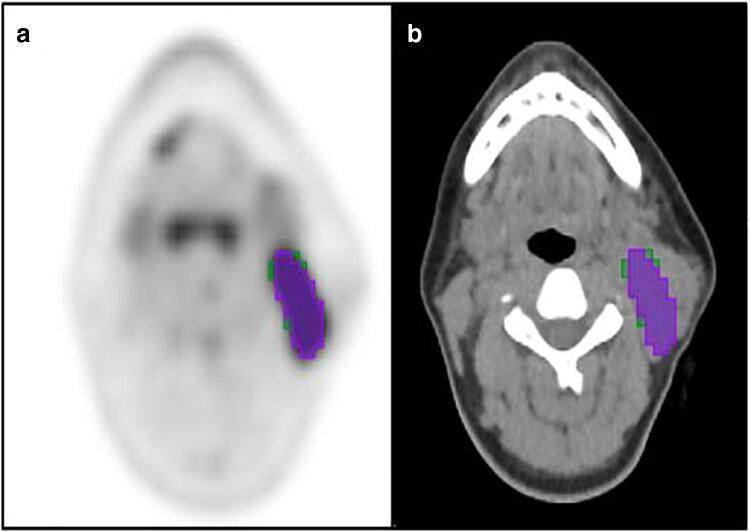
All cHL patients undergoing pre-treatment PET/CT at our institution between 2008 and 2018 were retrospectively identified. A 1.5 × mean liver standardised uptake value (SUV) and a fixed 4.0 SUV threshold were used to segment PET/CT data. Feature extraction was performed using PyRadiomics with ComBat harmonisation. Training (80%) and test (20%) cohorts stratified around 2-year event-free survival (EFS), age, sex, ethnicity and disease stage were defined. Seven ML models were trained and hyperparameters tuned using stratified 5-fold cross-validation. Area under the curve (AUC) from receiver operator characteristic analysis was used to assess performance.
RESULTS
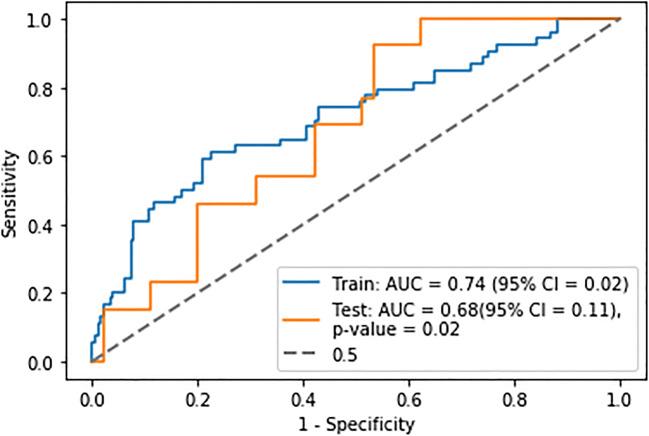
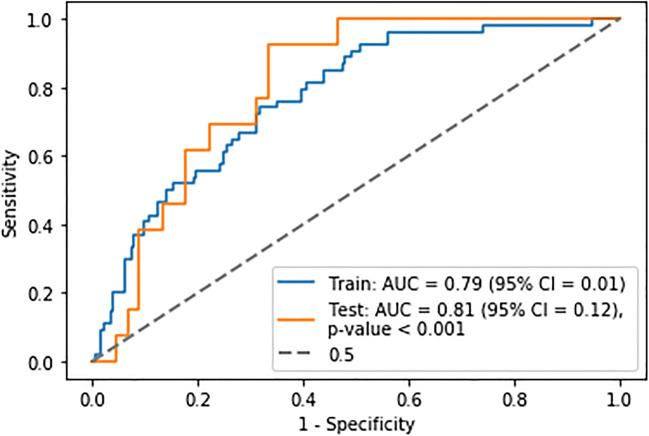
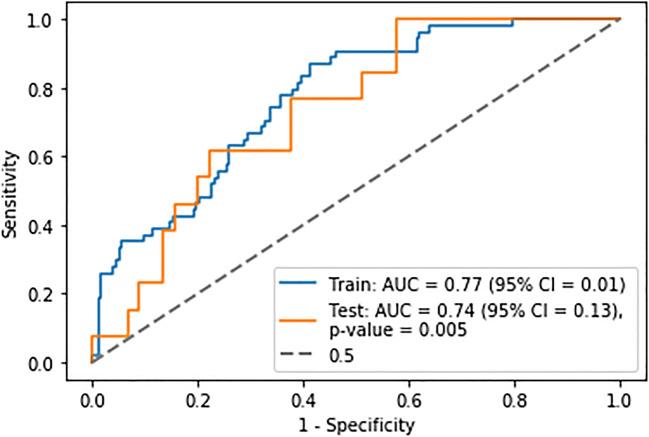
A total of 289 patients (153 males), median age 36 (range 16-88 years), were included. There was no significant difference between training (n = 231) and test cohorts (n = 58) (p value > 0.05). A ridge regression model using a 1.5 × mean liver SUV segmentation had the highest performance, with mean training, validation and test AUCs of 0.82 ± 0.002, 0.79 ± 0.01 and 0.81 ± 0.12. However, there was no significant difference between a logistic model derived from metabolic tumour volume and clinical features or the highest performing radiomic model.
CONCLUSIONS
Outcome prediction using pre-treatment FDG PET/CT-derived ML models is feasible in cHL patients. Further work is needed to determine optimum predictive thresholds for clinical use.
KEY POINTS
• A fixed threshold segmentation method led to more robust radiomic features. • A radiomic-based model for predicting 2-year event-free survival in classical Hodgkin lymphoma patients is feasible. • A predictive model based on ridge regression was the best performing model on our dataset.
目的
尽管根据 2-脱氧-2-[F]氟-D-葡萄糖正电子发射断层扫描/计算机断层扫描(FDG PET/CT)的反应进行了治疗调整,但仍有 20%的经典霍奇金淋巴瘤(cHL)患者发生复发。本研究旨在评估治疗前 FDG PET/CT 衍生的机器学习(ML)模型在预测 cHL 患者结局方面的价值。
方法
回顾性分析了 2008 年至 2018 年期间在我院接受治疗前 PET/CT 的所有 cHL 患者。使用 1.5×平均肝脏标准化摄取值(SUV)和固定的 4.0 SUV 阈值对 PET/CT 数据进行分割。使用 PyRadiomics 结合 ComBat 均衡化进行特征提取。根据 2 年无事件生存(EFS)、年龄、性别、种族和疾病分期,将患者分为训练(80%)和测试(20%)队列。使用分层 5 折交叉验证训练和调优 7 个 ML 模型。使用受试者工作特征分析的曲线下面积(AUC)评估性能。
结果
共纳入 289 例患者(153 例男性),中位年龄为 36 岁(16-88 岁)。训练队列(n=231)和测试队列(n=58)之间无显著差异(p值>0.05)。使用 1.5×平均肝脏 SUV 分割的岭回归模型具有最高的性能,其训练、验证和测试 AUC 值分别为 0.82±0.002、0.79±0.01 和 0.81±0.12。然而,基于代谢肿瘤体积和临床特征的逻辑模型或性能最高的放射组学模型之间没有显著差异。
结论
使用治疗前 FDG PET/CT 衍生的 ML 模型预测 cHL 患者的结局是可行的。还需要进一步的研究来确定最佳的预测阈值,以便于临床应用。
关键点
• 固定阈值分割方法导致更稳健的放射组学特征。• 在经典霍奇金淋巴瘤患者中,预测 2 年无事件生存的基于放射组学的模型是可行的。• 在我们的数据集上,基于岭回归的预测模型是表现最好的模型。

 Zotero 插件