
肯尼亚一个城市非正规住区中循环的伤寒沙门氏菌菌株的分子特征。
Molecular characterization of circulating Salmonella Typhi strains in an urban informal settlement in Kenya.
机构信息
Kenya Medical Research Institute, Centre for Global Health Research, Kisumu, Kenya.
Centers for Disease Control and Prevention, Atlanta, Georgia, United States of America.
出版信息
PLoS Negl Trop Dis. 2022 Aug 25;16(8):e0010704. doi: 10.1371/journal.pntd.0010704. eCollection 2022 Aug.
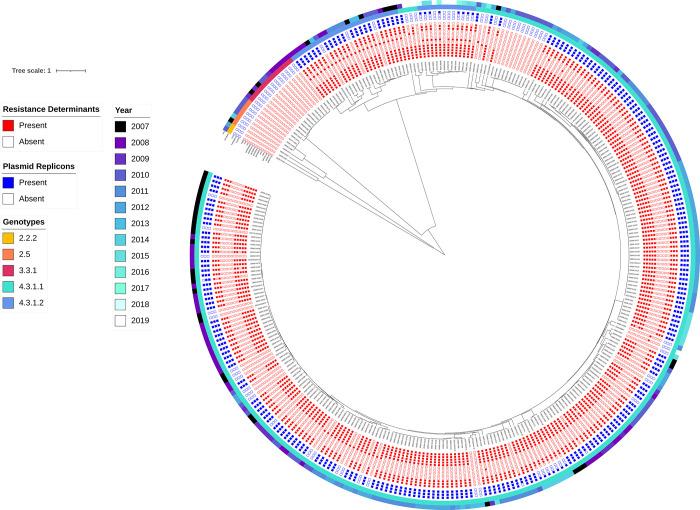
A high burden of Salmonella enterica subspecies enterica serovar Typhi (S. Typhi) bacteremia has been reported from urban informal settlements in sub-Saharan Africa, yet little is known about the introduction of these strains to the region. Understanding regional differences in the predominant strains of S. Typhi can provide insight into the genomic epidemiology. We genetically characterized 310 S. Typhi isolates from typhoid fever surveillance conducted over a 12-year period (2007-2019) in Kibera, an urban informal settlement in Nairobi, Kenya, to assess the circulating strains, their antimicrobial resistance attributes, and how they relate to global S. Typhi isolates. Whole genome multi-locus sequence typing (wgMLST) identified 4 clades, with up to 303 pairwise allelic differences. The identified genotypes correlated with wgMLST clades. The predominant clade contained 290 (93.5%) isolates with a median of 14 allele differences (range 0-52) and consisted entirely of genotypes 4.3.1.1 and 4.3.1.2. Resistance determinants were identified exclusively in the predominant clade. Determinants associated with resistance to aminoglycosides were observed in 245 isolates (79.0%), sulphonamide in 243 isolates (78.4%), trimethoprim in 247 isolates (79.7%), tetracycline in 224 isolates (72.3%), chloramphenicol in 247 isolates (79.6%), β-lactams in 239 isolates (77.1%) and quinolones in 62 isolates (20.0%). Multidrug resistance (MDR) determinants (defined as determinants conferring resistance to ampicillin, chloramphenicol and cotrimoxazole) were found in 235 (75.8%) isolates. The prevalence of MDR associated genes was similar throughout the study period (2007-2012: 203, 76.3% vs 2013-2019: 32, 72.7%; Fisher's Exact Test: P = 0.5478, while the proportion of isolates harboring quinolone resistance determinants increased (2007-2012: 42, 15.8% and 2013-2019: 20, 45.5%; Fisher's Exact Test: P<0.0001) following a decline in S. Typhi in Kibera. Some isolates (49, 15.8%) harbored both MDR and quinolone resistance determinants. There were no determinants associated with resistance to cephalosporins or azithromycin detected among the isolates sequenced in this study. Plasmid markers were only identified in the main clade including IncHI1A and IncHI1B(R27) in 226 (72.9%) isolates, and IncQ1 in 238 (76.8%) isolates. Molecular clock analysis of global typhoid isolates and isolates from Kibera suggests that genotype 4.3.1 has been introduced multiple times in Kibera. Several genomes from Kibera formed a clade with genomes from Kenya, Malawi, South Africa, and Tanzania. The most recent common ancestor (MRCA) for these isolates was from around 1997. Another isolate from Kibera grouped with several isolates from Uganda, sharing a common ancestor from around 2009. In summary, S. Typhi in Kibera belong to four wgMLST clades one of which is frequently associated with MDR genes and this poses a challenge in treatment and control.
高负担的沙门氏菌肠亚种肠血清型 Typhi(S. Typhi)菌血症已从撒哈拉以南非洲的城市非正规住区报告,但对这些菌株引入该地区的情况知之甚少。了解 S. Typhi 主要菌株在区域上的差异可以深入了解基因组流行病学。我们对来自肯尼亚内罗毕基贝拉(Kibera)的伤寒监测中采集的 310 株 S. Typhi 分离株进行了遗传特征分析,该监测在 12 年期间(2007-2019 年)进行,以评估循环菌株、其抗菌药物耐药属性以及它们与全球 S. Typhi 分离株的关系。全基因组多位点序列分型(wgMLST)确定了 4 个枝,最多有 303 个等位基因差异。鉴定的基因型与 wgMLST 枝相关。主要枝包含 290 株(93.5%)分离株,中位数为 14 个等位基因差异(范围 0-52),且完全由基因型 4.3.1.1 和 4.3.1.2 组成。仅在主要枝中发现耐药决定因素。在 245 株(79.0%)分离株中观察到与氨基糖苷类药物耐药相关的决定因素,在 243 株(78.4%)、247 株(79.7%)、224 株(72.3%)、247 株(79.6%)、239 株(77.1%)和 62 株(20.0%)分离株中观察到与磺胺类药物、甲氧苄啶、四环素、氯霉素、β-内酰胺类药物和喹诺酮类药物耐药相关的决定因素。在 235 株(75.8%)分离株中发现了多药耐药(MDR)决定因素(定义为对氨苄西林、氯霉素和复方磺胺甲噁唑耐药的决定因素)。在整个研究期间,MDR 相关基因的流行率相似(2007-2012 年:203 株,76.3% vs 2013-2019 年:32 株,72.7%;Fisher 精确检验:P = 0.5478),而基贝拉 S. Typhi 数量下降后,携带喹诺酮类药物耐药决定因素的分离株比例增加(2007-2012 年:42 株,15.8%和 2013-2019 年:20 株,45.5%;Fisher 精确检验:P<0.0001)。一些分离株(49 株,15.8%)同时携带 MDR 和喹诺酮类药物耐药决定因素。在所测序的分离株中未发现与头孢菌素或阿奇霉素耐药相关的决定因素。仅在主要枝中鉴定出质粒标记,包括 226 株(72.9%)分离株中的 IncHI1A 和 IncHI1B(R27)和 238 株(76.8%)分离株中的 IncQ1。对全球伤寒分离株和基贝拉分离株的分子钟分析表明,基因型 4.3.1 已多次引入基贝拉。来自基贝拉的几个基因组与来自肯尼亚、马拉维、南非和坦桑尼亚的基因组形成了一个枝。这些分离株的最近共同祖先(MRCA)约在 1997 年。来自基贝拉的另一个分离株与来自乌干达的几个分离株聚集在一起,共同祖先约在 2009 年。综上所述,基贝拉的 S. Typhi 属于四个 wgMLST 枝,其中一个枝经常与 MDR 基因相关,这在治疗和控制方面构成了挑战。


 Zotero 插件