
肯尼亚内罗毕穆库里定居点的伤寒沙门氏菌基因多样性、聚类识别和抗生素耐药决定因素。
Salmonella Typhi genotypic diversity, cluster identification and antimicrobial resistance determinants in Mukuru settlement, Nairobi Kenya.
机构信息
Centre for Microbiology Research, Kenya Medical Research Institute, Nairobi, Kenya.
Jomo Kenyatta University of Agriculture and Technology, JKUAT, Nairobi, Kenya.
出版信息
BMC Infect Dis. 2024 Jul 24;24(1):727. doi: 10.1186/s12879-024-09635-z.
BACKGROUND
Understanding the source of typhoid infections and the genetic relatedness of Salmonella Typhi (S. Typhi) by cluster identification in endemic settings is critical for establishing coordinated public health responses for typhoid fever management. This study investigated the genotypic diversity, antibiotic resistance mechanisms, and clustering of 35 S.Typhi strains isolated from cases and carriers in the Mukuru Informal Settlement.
METHODS
We studied 35 S.Typhi isolates, including 32 from cases and 3 from carriers, from study participants in the informal settlement of Mukuru, Nairobi, Kenya. Genomic DNA was extracted, and whole-genome sequencing (WGS) was performed to determine the phylogenetic relatedness of strains and detect antimicrobial resistance determinants (AMR). WGS data were analyzed using bioinformatics tools available at the Center for Genomic Epidemiology and Pathogenwatch platforms.
RESULTS
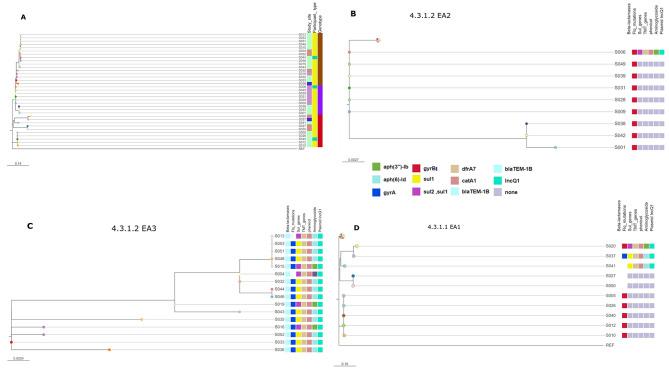
Genotype 4.3.1.2 EA3 was found to be dominant at 46% (16/35), followed by 4.3.1.2 EA2 at 28% (10/35), and 4.3.1.1 EA1 at 27% (9/35). A comparison of the isolates with global strains from Pathogenwatch identified close clustering with strains from Uganda, Tanzania, Rwanda, and India. Three isolates (9%) distributed in each cluster were isolated from carriers. All genotype 4.3.1.2 EA3 isolates were genotypically multidrug-resistant to ampicillin, chloramphenicol, and trimethoprim-sulfamethoxazole. Single mutations in the quinolone resistance-determining region were identified in the gyrA (S83Y) and gyrB (S464F) genes. All isolates associated with multidrug resistance showed the presence of the IncQ1 plasmid with the following genes: blaTEM-1B, catA1, sul1, sul2, and dfrA7.
CONCLUSION
The close phylogenetic relatedness between antimicrobial-resistant case isolates and carriage isolates indicates that typhoid carriage is a possible source of infection in the community. Comparative analysis with global isolates revealed that the Kenyan isolates share common lineages with strains from neighboring East African countries and India, suggesting regional dissemination of specific MDR clones. AMR was a major feature of the isolates. Surveillance and testing for antimicrobial susceptibility should inform options for the management of cases.
背景
在地方性流行地区,通过聚类识别了解伤寒感染源和伤寒沙门氏菌(S. Typhi)的遗传相关性,对于制定协调一致的公共卫生应对措施来管理伤寒非常重要。本研究调查了从肯尼亚内罗毕 Mukuru 非正规住区的病例和携带者中分离出的 35 株 S.Typhi 的基因型多样性、抗生素耐药机制和聚类情况。
方法
我们研究了来自 Mukuru 非正规住区研究参与者的 35 株 S.Typhi 分离株,包括 32 株来自病例,3 株来自携带者。提取基因组 DNA,进行全基因组测序(WGS)以确定菌株的系统发育关系并检测抗菌药物耐药决定因素(AMR)。使用基因组流行病学中心和 Pathogenwatch 平台上提供的生物信息学工具分析 WGS 数据。
结果
发现基因型 4.3.1.2 EA3 占 46%(16/35),其次是基因型 4.3.1.2 EA2 占 28%(10/35),基因型 4.3.1.1 EA1 占 27%(9/35)。将分离株与 Pathogenwatch 中的全球株进行比较,发现与来自乌干达、坦桑尼亚、卢旺达和印度的菌株密切聚类。每个聚类中分布的 3 株分离株均来自携带者。基因型 4.3.1.2 EA3 所有分离株对氨苄西林、氯霉素和复方磺胺甲噁唑呈基因型多药耐药。在 gyrA(S83Y)和 gyrB(S464F)基因中发现喹诺酮耐药决定区的单个突变。所有与多药耐药相关的分离株均携带 IncQ1 质粒,该质粒具有以下基因:blaTEM-1B、catA1、sul1、sul2 和 dfrA7。
结论
耐药性病例分离株与携带分离株之间的密切系统发育关系表明,伤寒携带可能是社区感染的一个来源。与全球分离株的比较分析表明,肯尼亚分离株与来自东非邻国和印度的菌株具有共同的谱系,表明特定 MDR 克隆在该地区传播。AMR 是分离株的主要特征。抗菌药物敏感性监测和检测应告知病例管理方案的选择。

 Zotero 插件