
胆固醇酯转移蛋白抑制剂通过降低载脂蛋白 B 水平降低主要不良心血管事件。
Cholesteryl Ester Transfer Protein Inhibition Reduces Major Adverse Cardiovascular Events by Lowering Apolipoprotein B Levels.
机构信息
Victorian Heart Institute, Monash University, Clayton, VIC 3800, Australia.
Mike and Valeria Rosenbloom Centre for Cardiovascular Prevention, Department of Medicine, McGill University Health Centre, Montreal, QC H4A 3J1, Canada.
出版信息
Int J Mol Sci. 2022 Aug 20;23(16):9417. doi: 10.3390/ijms23169417.
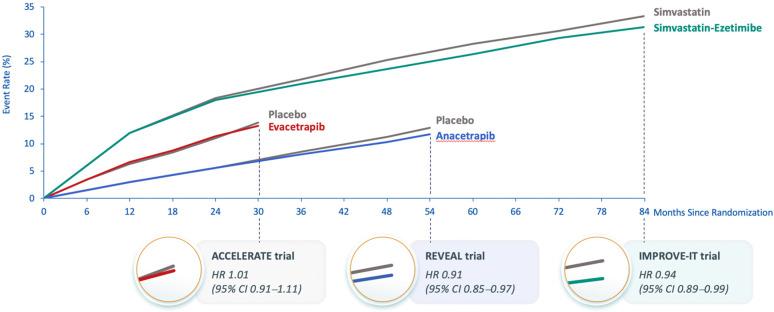
Cholesteryl ester transfer protein (CETP) facilitates the exchange of cholesteryl esters and triglycerides (TG) between high-density lipoprotein (HDL) particles and TG-rich, apolipoprotein (apo) B-containing particles. Initially, these compounds were developed to raise plasma HDL cholesterol (HDL-C) levels, a mechanism that was previously thought to lower the risk of atherosclerotic cardiovascular disease (ASCVD). More recently, the focus changed and the use of pharmacologic CETP inhibitors to reduce low-density lipoprotein cholesterol (LDL-C), non-HDL-C and apoB concentrations became supported by several lines of evidence from animal models, observational investigations, randomized controlled trials and Mendelian randomization studies. Furthermore, a cardiovascular outcome trial of anacetrapib demonstrated that CETP inhibition significantly reduced the risk of major coronary events in patients with ASCVD in a manner directly proportional to the substantial reduction in LDL-C and apoB. These data have dramatically shifted the attention on CETP away from raising HDL-C instead to lowering apoB-containing lipoproteins, which is relevant since the newest CETP inhibitor, obicetrapib, reduces LDL-C by up to 51% and apoB by up to 30% when taken in combination with a high-intensity statin. An ongoing cardiovascular outcome trial of obicetrapib in patients with ASCVD is expected to provide further evidence of the ability of CETP inhibitors to reduce major adverse cardiovascular events by lowering apoB. The purpose of the present review is to provide an up-to-date understanding of CETP inhibition and its relationship to ASCVD risk reduction.
胆固醇酯转移蛋白(CETP)促进了高密度脂蛋白(HDL)颗粒与富含甘油三酯(TG)和载脂蛋白(apo)B 的颗粒之间的胆固醇酯和 TG 的交换。最初,这些化合物被开发出来是为了提高血浆高密度脂蛋白胆固醇(HDL-C)水平,这一机制以前被认为可以降低动脉粥样硬化性心血管疾病(ASCVD)的风险。最近,人们的关注点发生了变化,几种证据表明,使用药物性 CETP 抑制剂来降低低密度脂蛋白胆固醇(LDL-C)、非高密度脂蛋白胆固醇(non-HDL-C)和 apoB 浓度,得到了动物模型、观察性研究、随机对照试验和孟德尔随机化研究的支持。此外,一项对 anacetrapib 的心血管结局试验表明,CETP 抑制显著降低了 ASCVD 患者主要心血管事件的风险,这种降低与 LDL-C 和 apoB 的大幅降低成正比。这些数据极大地改变了人们对 CETP 的关注,从提高 HDL-C 转移到降低载 apoB 的脂蛋白,这是相关的,因为最新的 CETP 抑制剂,obicetrapib,与高强度他汀类药物联合使用时,可使 LDL-C 降低高达 51%,apoB 降低高达 30%。一项正在进行的 obicetrapib 治疗 ASCVD 患者的心血管结局试验预计将提供进一步的证据,证明 CETP 抑制剂通过降低 apoB 降低主要不良心血管事件的能力。本综述的目的是提供对 CETP 抑制及其与 ASCVD 风险降低的关系的最新理解。

 Zotero 插件