
用于递送抗A组链球菌疫苗的聚(疏水氨基酸)和脂质体
Poly(hydrophobic Amino Acids) and Liposomes for Delivery of Vaccine against Group A Streptococcus.
作者信息
Azuar Armira, Madge Harrison Y R, Boer Jennifer C, Gonzalez Cruz Jazmina L, Wang Jingwen, Khalil Zeinab G, Deceneux Cyril, Goodchild Georgia, Yang Jieru, Koirala Prashamsa, Hussein Waleed M, Capon Robert J, Plebanski Magdalena, Toth Istvan, Skwarczynski Mariusz
机构信息
School of Chemistry and Molecular Biosciences, The University of Queensland, St. Lucia, QLD 4072, Australia.
School of Health and Biomedical Sciences, RMIT University, Bundoora West, VIC 3083, Australia.
出版信息
Vaccines (Basel). 2022 Jul 29;10(8):1212. doi: 10.3390/vaccines10081212.
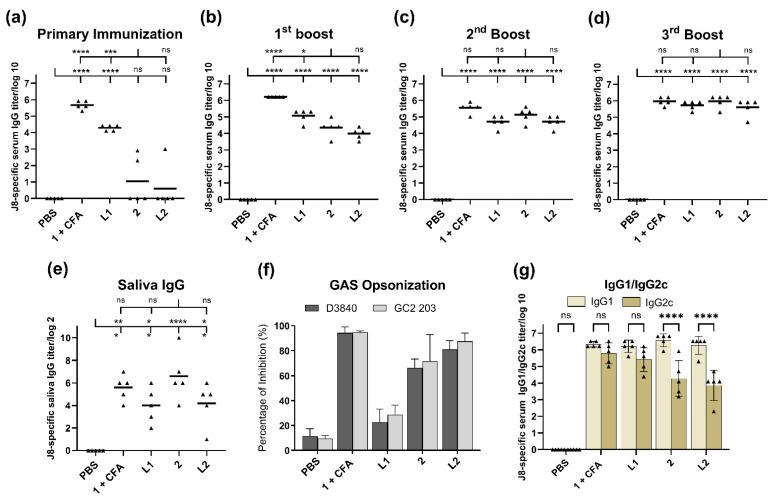
Adjuvants and delivery systems are essential components of vaccines to increase immunogenicity against target antigens, particularly for peptide epitopes (poor immunogens). Emulsions, nanoparticles, and liposomes are commonly used as a delivery system for peptide-based vaccines. A Poly(hydrophobic amino acids) delivery system was previously conjugated to Group A Streptococcus (GAS)-derived peptide epitopes, allowing the conjugates to self-assemble into nanoparticles with self adjuvanting ability. Their hydrophobic amino acid tail also serves as an anchoring moiety for the peptide epitope, enabling it to be integrated into the liposome bilayer, to further boost the immunological responses. Polyleucine-based conjugates were anchored to cationic liposomes using the film hydration method and administered to mice subcutaneously. The polyleucine-peptide conjugate, its liposomal formulation, and simple liposomal encapsulation of GAS peptide epitope induced mucosal (saliva IgG) and systemic (serum IgG, IgG1 and IgG2c) immunity in mice. Polyleucine acted as a potent liposome anchoring portion, which stimulated the production of highly opsonic antibodies. The absence of polyleucine in the liposomal formulation (encapsulated GAS peptide) induced high levels of antibody titers, but with poor opsonic ability against GAS bacteria. However, the liposomal formulation of the conjugated vaccine was no more effective than conjugates alone self-assembled into nanoparticles.
佐剂和递送系统是疫苗的重要组成部分,可增强针对靶抗原的免疫原性,尤其是对于肽表位(弱免疫原)。乳液、纳米颗粒和脂质体通常用作基于肽的疫苗的递送系统。一种聚(疏水氨基酸)递送系统先前已与A组链球菌(GAS)衍生的肽表位偶联,使偶联物能够自组装成具有自佐剂能力的纳米颗粒。它们的疏水氨基酸尾部还作为肽表位的锚定部分,使其能够整合到脂质体双层中,以进一步增强免疫反应。基于聚亮氨酸的偶联物通过薄膜水化法锚定到阳离子脂质体上,并皮下注射给小鼠。聚亮氨酸 - 肽偶联物及其脂质体制剂,以及GAS肽表位的简单脂质体包封在小鼠中诱导了粘膜(唾液IgG)和全身(血清IgG、IgG1和IgG2c)免疫。聚亮氨酸作为一种有效的脂质体锚定部分,刺激了高效调理抗体的产生。脂质体制剂(包封GAS肽)中缺乏聚亮氨酸会诱导高水平的抗体滴度,但对GAS细菌的调理能力较差。然而,偶联疫苗的脂质体制剂并不比单独自组装成纳米颗粒的偶联物更有效。

 Zotero 插件