
超氧化物歧化酶2改善Leber遗传性视神经病变患者皮肤成纤维细胞中的线粒体功能障碍。
Superoxide dismutase 2 ameliorates mitochondrial dysfunction in skin fibroblasts of Leber's hereditary optic neuropathy patients.
作者信息
Zhou Qingru, Yao Shun, Yang Mingzhu, Guo Qingge, Li Ya, Li Lei, Lei Bo
机构信息
Henan Provincial People's Hospital, Zhengzhou University People's Hospital, Zhengzhou, China.
Henan Eye Hospital, Henan Provincial People's Hospital, Henan Eye Institute, Zhengzhou, China.
出版信息
Front Neurosci. 2022 Aug 9;16:917348. doi: 10.3389/fnins.2022.917348. eCollection 2022.
BACKGROUND
In Leber's hereditary optic neuropathy (LHON), mtDNA mutations mediate mitochondrial dysfunction and apoptosis of retinal ganglion cells. Mitochondrial superoxide dismutase 2 (SOD2) is a crucial antioxidase against reactive oxygen species (ROS). This study aims to investigate whether SOD2 could ameliorate mtDNA mutation mediated mitochondrial dysfunction in skin fibroblasts of LHON patients and explore the underlying mechanisms.
METHODS
The skin of normal healthy subjects and severe LHON patients harboring m.11778G > A mutation was taken to prepare immortalized skin fibroblast cell lines (control-iFB and LHON-iFB). LHON-iFB cells were transfected with SOD2 plasmid or negative control plasmid, respectively. In addition, human neuroblastoma SH-SY5Y cells and human primary retinal pigmental epithelium (hRPE) cells were stimulated by HO after gene transfection. The oxygen consumption rate (OCR) was measured with a Seahorse extracellular flux analyzer. The level of ATP production, mitochondrial membrane potential, ROS and malondialdehyde (MDA) were measured separately with the corresponding assay kits. The expression level of SOD2, inflammatory cytokines and p-IκBα/IκBα was evaluated by western-blot. Assessment of apoptosis was performed by TUNEL assay.
RESULTS
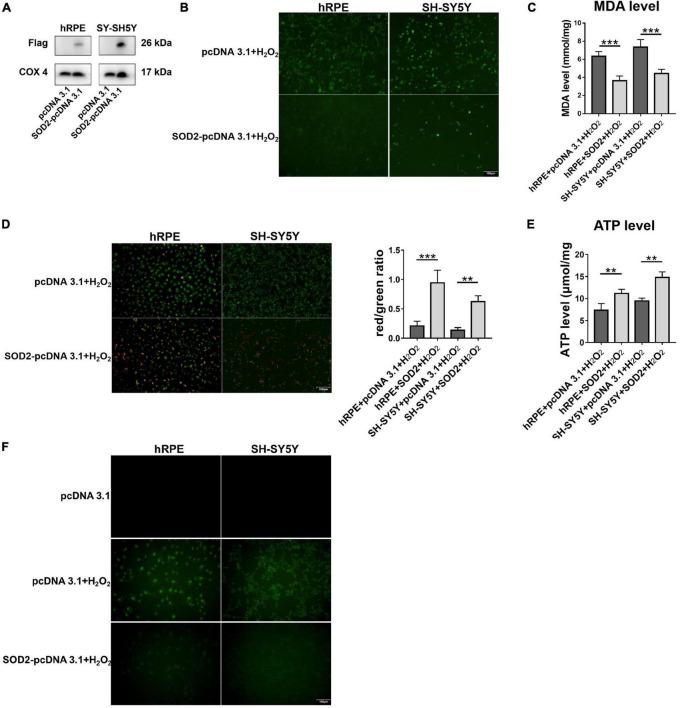
LHON-iFB exhibited lower OCR, ATP production, mitochondrial membrane potential but higher level of ROS and MDA than control-iFB. Western-blot revealed a significantly increased expression of IL-6 and p-IκBα/IκBα in LHON-iFB. Compared with the negative control, SOD2 overexpression increased OCR, ATP production and elevated mitochondrial membrane potential, but impaired ROS and MDA production. Besides, western-blot demonstrated exogenous SOD2 reduced the protein level of IL-6 and p-IκBα/IκBα. TUNEL assays suggested SOD2 inhibited cells apoptosis. Analogously, in SH-SY5Y and hRPE cells, SOD2 overexpression increased ATP production and mitochondrial membrane potential, but decreased ROS, MDA levels and suppressed apoptosis.
CONCLUSION
SOD2 upregulation inhibited cells apoptosis through ameliorating mitochondrial dysfunction and reducing NF-κB associated inflammatory response. This study further support exogenous SOD2 may be a promising therapy for the treatment of LHON.
背景
在Leber遗传性视神经病变(LHON)中,线粒体DNA(mtDNA)突变介导视网膜神经节细胞的线粒体功能障碍和凋亡。线粒体超氧化物歧化酶2(SOD2)是对抗活性氧(ROS)的关键抗氧化酶。本研究旨在探讨SOD2是否能改善LHON患者皮肤成纤维细胞中mtDNA突变介导的线粒体功能障碍,并探索其潜在机制。
方法
采集正常健康受试者及携带m.11778G>A突变的严重LHON患者的皮肤,制备永生化皮肤成纤维细胞系(对照-iFB和LHON-iFB)。LHON-iFB细胞分别用SOD2质粒或阴性对照质粒转染。此外,基因转染后,用HO刺激人神经母细胞瘤SH-SY5Y细胞和人原代视网膜色素上皮(hRPE)细胞。用海马细胞外通量分析仪测量氧消耗率(OCR)。分别用相应的检测试剂盒测量ATP生成水平、线粒体膜电位、ROS和丙二醛(MDA)水平。通过蛋白质印迹法评估SOD2、炎性细胞因子和p-IκBα/IκBα的表达水平。通过TUNEL检测进行凋亡评估。
结果
与对照-iFB相比,LHON-iFB表现出较低的OCR、ATP生成、线粒体膜电位,但ROS和MDA水平较高。蛋白质印迹法显示LHON-iFB中IL-6和p-IκBα/IκBα的表达显著增加。与阴性对照相比,SOD2过表达增加了OCR、ATP生成并提高了线粒体膜电位,但降低了ROS和MDA生成。此外,蛋白质印迹法表明外源性SOD2降低了IL-6和p-IκBα/IκBα的蛋白水平。TUNEL检测表明SOD2抑制细胞凋亡。类似地,在SH-SY5Y和hRPE细胞中,SOD2过表达增加了ATP生成和线粒体膜电位,但降低了ROS、MDA水平并抑制了凋亡。
结论
SOD2上调通过改善线粒体功能障碍和减少NF-κB相关的炎症反应来抑制细胞凋亡。本研究进一步支持外源性SOD2可能是治疗LHON的一种有前景的疗法。


 Zotero 插件