
两个新的 SLC4A11 变异体在先天性遗传性血管内皮营养不良患者中的致病性和功能分析。
Pathogenicity and Function Analysis of Two Novel SLC4A11 Variants in Patients With Congenital Hereditary Endothelial Dystrophy.
机构信息
Henan University People's Hospital, Henan Provincial People's Hospital, Zhengzhou, China.
Henan Branch of National Clinical Research Center for Ocular Diseases, Henan Eye Institute/Henan Eye Hospital, People's Hospital of Zhengzhou University, Henan Provincial People's Hospital, Zhengzhou, China.
出版信息
Transl Vis Sci Technol. 2023 Oct 3;12(10):1. doi: 10.1167/tvst.12.10.1.
PURPOSE
The purpose of this study was to explore the pathogenicity and function of two novel SLC4A11 variants associated with congenital hereditary endothelial dystrophy (CHED) and to study the function of a SLC4A11 (K263R) mutant in vitro.
METHODS
Ophthalmic examinations were performed on a 28-year-old male proband with CHED. Whole-exome and Sanger sequencing were applied for mutation screening. Bioinformatics and pathogenicity analysis were performed. HEK293T cells were transfected with the plasmids of empty vector, wild-type SLC4A11, and SLC4A11 (K263R) mutant. The transfected cells were treated with SkQ1. Oxygen consumption, cellular reactive oxygen species (ROS) level, mitochondrial membrane potential, and apoptosis rate were measured.
RESULTS
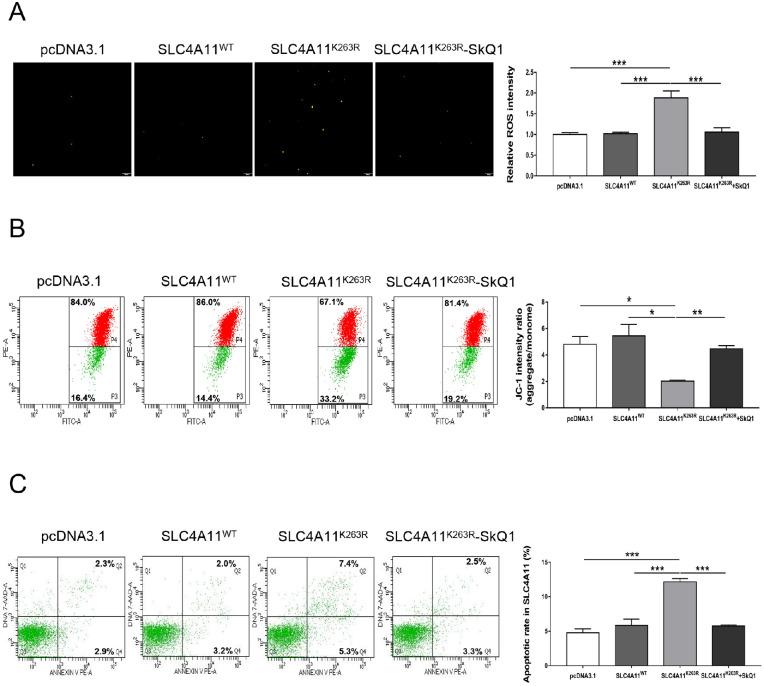
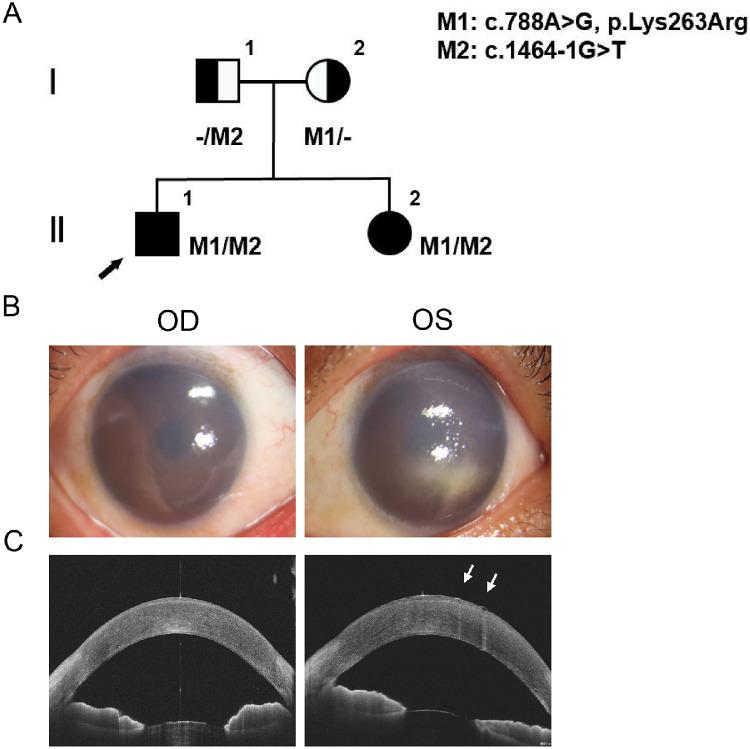
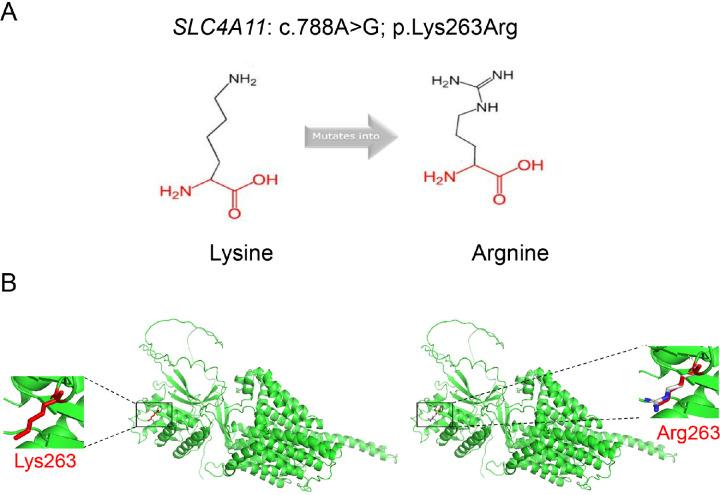
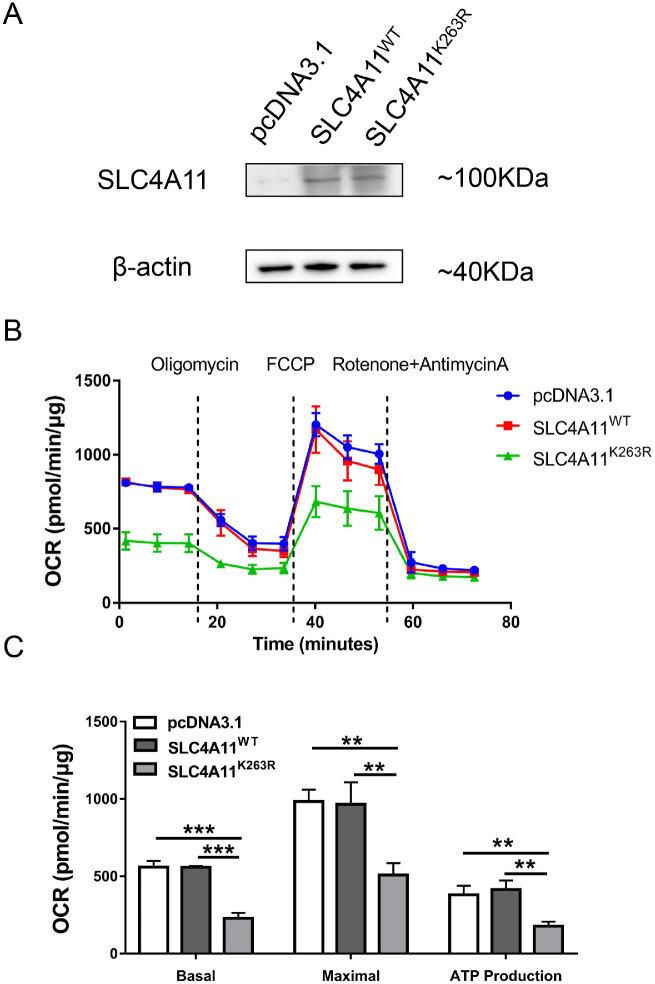
The proband had poor visual acuity with nystagmus since childhood. Corneal foggy opacity was evident in both eyes. Two novel SLC4A11 variants were detected. Sanger sequencing showed that the proband's father and sister carried c.1464-1G>T variant, and the proband's mother and sister carried c.788A>G (p.Lys263Arg) variant. Based on the American College of Medical Genetics (ACMG) guidelines, SLC4A11 c.1464-1G>T was pathogenic, whereas c.788A>G, p.K263R was a variant of undetermined significance. In vitro, SLC4A11 (K263R) variant increased ROS level and apoptosis rate. Decrease in mitochondrial membrane potential and oxygen consumption rate were remarkable. Furthermore, SkQ1 decreased ROS levels and apoptosis rate but increased mitochondrial membrane potential in the transfected cells.
CONCLUSIONS
Two novel heterozygous pathogenic variants of the SLC4A11 gene were identified in a family with CHED. The missense variant SLC4A11 (K263R) caused mitochondrial dysfunction and increased apoptosis in mutant transfected cells. In addition, SkQ1 presented a protective effect suggesting the anti-oxidant might be a novel therapeutic drug.
TRANSLATIONAL RELEVANCE
This study verified the pathogenicity of 2 novel variants in the SLC4A11 gene in a CHED family and found an anti-oxidant might be a new drug.
目的
本研究旨在探讨与先天性遗传性内皮营养不良(CHED)相关的两种新型 SLC4A11 变体的致病机制和功能,并研究 SLC4A11(K263R)突变体在体外的功能。
方法
对 1 例 28 岁男性 CHED 先证者进行眼科检查。应用外显子组和 Sanger 测序进行突变筛查。进行生物信息学和致病性分析。用空载体、野生型 SLC4A11 和 SLC4A11(K263R)突变体的质粒转染 HEK293T 细胞。用 SkQ1 处理转染细胞。测量耗氧量、细胞内活性氧(ROS)水平、线粒体膜电位和细胞凋亡率。
结果
先证者自幼视力不佳,伴眼球震颤。双眼角膜混浊。发现两种新型 SLC4A11 变体。Sanger 测序显示,先证者的父亲和姐姐携带 c.1464-1G>T 变异,先证者的母亲和姐姐携带 c.788A>G(p.Lys263Arg)变异。根据美国医学遗传学学院(ACMG)指南,SLC4A11 c.1464-1G>T 为致病性变异,而 c.788A>G,p.K263R 为意义未明的变异。体外,SLC4A11(K263R)变体增加了 ROS 水平和细胞凋亡率。线粒体膜电位和耗氧量显著降低。此外,SkQ1 降低了转染细胞中的 ROS 水平和细胞凋亡率,但增加了线粒体膜电位。
结论
在一个患有 CHED 的家族中发现了 SLC4A11 基因的 2 种新型杂合致病性变体。错义变体 SLC4A11(K263R)导致突变转染细胞中线粒体功能障碍和细胞凋亡增加。此外,SkQ1 具有保护作用,表明抗氧化剂可能是一种新的治疗药物。
翻译后的内容保留了原文的医学术语,同时也保留了英文缩写。

 Zotero 插件