
在马达加斯加偏远高地社区,绵羊和牛中隐孢子虫物种感染呈聚集性,但儿童中没有这种聚集性。
Clustering of Cryptosporidium species infections among sheep and cattle but not children in remote highland communities of Madagascar.
机构信息
Department of Infectious Disease Epidemiology, Bernhard Nocht Institute for Tropical Medicine, 20359, Hamburg, Germany.
German Center for Infection Research (DZIF), Partner Site Hamburg-Lübeck-Borstel-Riems, Hamburg, Germany.
出版信息
Parasit Vectors. 2022 Aug 28;15(1):304. doi: 10.1186/s13071-022-05434-0.
BACKGROUND
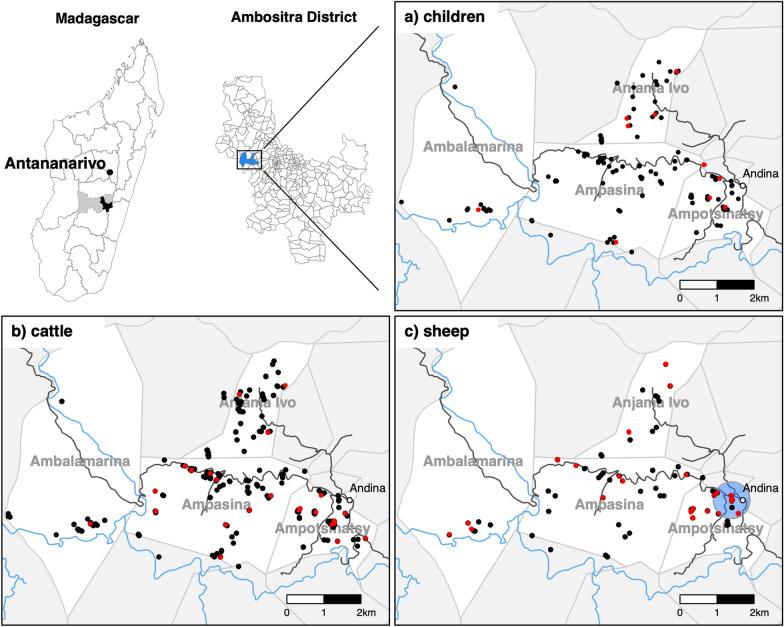
The aim of this study was to identify local transmission patterns of Cryptosporidium spp. infections among livestock and humans in four extremely rural and remote highland communities in Madagascar.
METHODS
In this cross-sectional study, households were randomly sampled throughout a 1-year study period, with one feces sample collected from each child (≤ 5 years old), sheep and cattle. Cryptosporidium spp. were identified using a nested PCR assay targeting the 18S ribosomal RNA gene. All samples positive for Cryptosporidium hominis were further subtyped by sequencing the 60-kDa glycoprotein gene (gp60). Spatial clustering methods were applied to analyze potential transmission patterns.
RESULTS
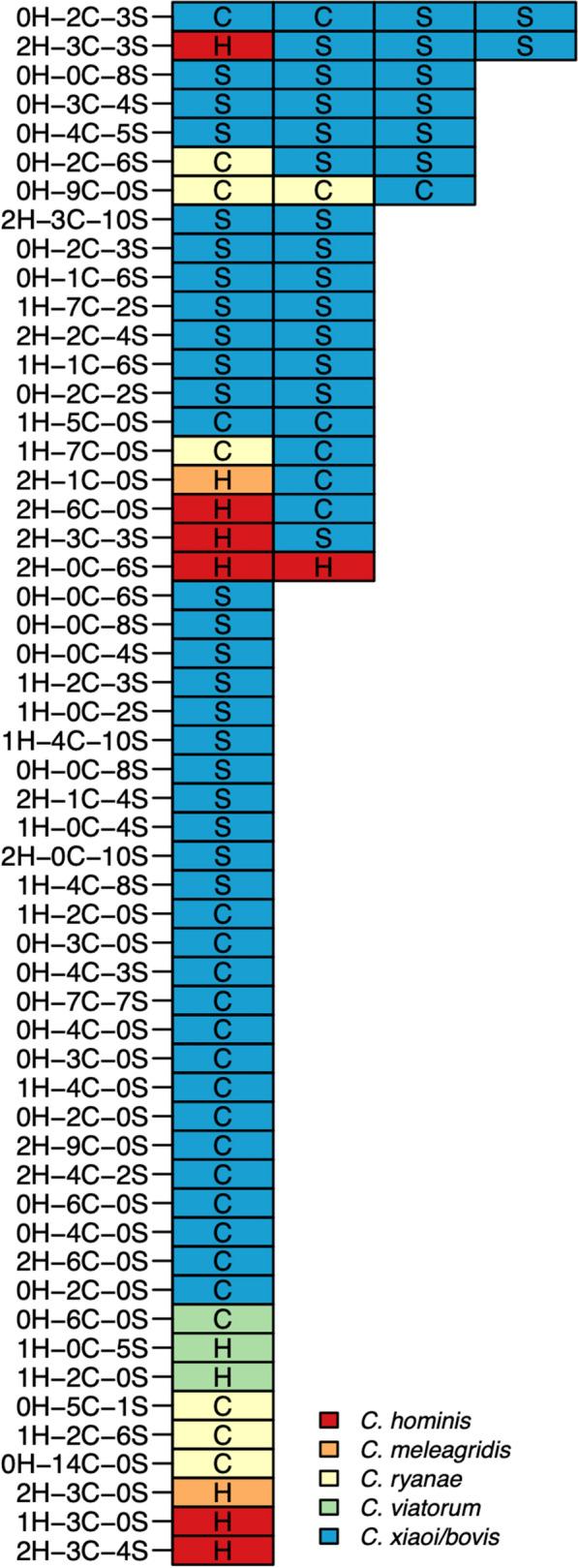
In total, 252 households participated in the study, and samples from 197 children, 862 cattle and 334 sheep were collected and included in the study. Of the samples collected, 11 (5.6%) from children, 30 (3.5%) from cattle and 42 (12.6%) from sheep tested positive for Cryptosporidium spp. Very little overlap in the species distribution between human and animal infections was found. Global (overall) and local (spatially defined) clustering was observed for Cryptosporidium spp. infections in sheep and for Cryptosporidium xiaoi/bovis infections among sheep and cattle.
DISCUSSION
The results of this analysis do not support the occurrence of defined disease outbreaks, rather they point to a continuous series of transmission events that are spatially aggregated. Despite the close coexistence between humans, sheep and cattle in the study area, mutual transmission was not observed. Hence, the study underlines the importance of sustained sanitation and hygiene measures to prevent cryptosporidiosis transmission among infants, since asymptomatic children serve as an infection reservoir. Similarly, the study highlights the importance of improving hygiene to reduce the transmission of Cryptosporidium spp. in livestock, an infection with serious consequences, especially in newborn calves.
背景
本研究旨在鉴定马达加斯加四个极度偏远高地农村社区中家畜和人类中隐孢子虫属感染的本地传播模式。
方法
在这项横断面研究中,在为期 1 年的研究期间,通过随机抽样选择家庭,从每个孩子(≤ 5 岁)、绵羊和牛中采集一份粪便样本。使用针对 18S 核糖体 RNA 基因的巢式 PCR 检测鉴定隐孢子虫属。对所有检测出人隐孢子虫阳性的样本,通过测序 60-kDa 糖蛋白基因(gp60)进行进一步的亚型分析。应用空间聚类方法分析潜在的传播模式。
结果
共有 252 户家庭参与了这项研究,采集了 197 名儿童、862 头牛和 334 只羊的样本,并将其纳入研究。采集的样本中,11 份(5.6%)来自儿童,30 份(3.5%)来自牛,42 份(12.6%)来自羊,检测出隐孢子虫属阳性。在人类和动物感染之间,发现了物种分布的很少重叠。在绵羊中的隐孢子虫属感染以及绵羊和牛中的小隐孢子虫/牛隐孢子虫感染中观察到了全球(总体)和局部(空间定义)聚类。
讨论
该分析结果不支持明确的疾病爆发发生,而是指向空间聚集的连续传播事件系列。尽管在研究区域内人类、绵羊和牛密切共存,但没有观察到相互传播。因此,该研究强调了持续卫生和卫生措施对预防婴幼儿隐孢子虫病传播的重要性,因为无症状儿童是感染的储存库。同样,该研究强调了改善卫生以减少家畜中隐孢子虫属感染传播的重要性,因为这种感染对新生牛犊有严重影响。


 Zotero 插件