
核磁共振光谱法聚焦新冠疫苗接种诱导的免疫原性,以减轻未来的健康担忧。
NMR spectroscopy spotlighting immunogenicity induced by COVID-19 vaccination to mitigate future health concerns.
作者信息
Ali Sher, Nedvědová Štěpánka, Badshah Gul, Afridi Muhammad S, Dutra Lívia M, Ali Umar, Faria Samara G, Soares Frederico L F, Rahman Rafi U, Cançado Fernando A C Q, Aoyanagi Micheli M C C, Freire Lucas G D, Santos Alan D C, Barison Andersson, Oliveira Carlos A F
机构信息
Department of Chemistry, Federal University of Paraná, CEP 81530-900, Curitiba, PR, Brazil.
Department of Food Engineering, School of Animal Science and Food Engineering, University of São Paulo, CEP13635-900, Pirassununga, SP, Brazil.
出版信息
Curr Res Immunol. 2022;3:199-214. doi: 10.1016/j.crimmu.2022.08.006. Epub 2022 Aug 22.
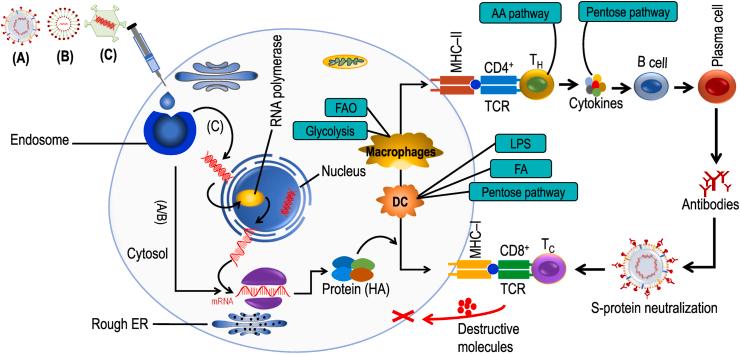
In this review, the disease and immunogenicity affected by COVID-19 vaccination at the metabolic level are described considering the use of nuclear magnetic resonance (NMR) spectroscopy for the analysis of different biological samples. Consistently, we explain how different biomarkers can be examined in the saliva, blood plasma/serum, bronchoalveolar-lavage fluid (BALF), semen, feces, urine, cerebrospinal fluid (CSF) and breast milk. For example, the proposed approach for the given samples can allow one to detect molecular biomarkers that can be relevant to disease and/or vaccine interference in a system metabolome. The analysis of the given biomaterials by NMR often produces complex chemical data which can be elucidated by multivariate statistical tools, such as PCA and PLS-DA/OPLS-DA methods. Moreover, this approach may aid to improve strategies that can be helpful in disease control and treatment management in the future.
在本综述中,考虑使用核磁共振(NMR)光谱法分析不同生物样品,描述了新冠病毒疫苗接种在代谢水平上对疾病和免疫原性的影响。同时,我们解释了如何在唾液、血浆/血清、支气管肺泡灌洗液(BALF)、精液、粪便、尿液、脑脊液(CSF)和母乳中检测不同的生物标志物。例如,针对给定样品的提议方法可以使人们检测出与系统代谢组中疾病和/或疫苗干扰相关的分子生物标志物。通过NMR对给定生物材料进行分析通常会产生复杂的化学数据,这些数据可以通过多元统计工具(如主成分分析(PCA)和偏最小二乘判别分析/正交偏最小二乘判别分析(PLS-DA/OPLS-DA)方法)来阐明。此外,这种方法可能有助于改进未来对疾病控制和治疗管理有帮助的策略。

 Zotero 插件