
通过数字液滴PCR对游离循环肿瘤DNA进行定量分析在儿童和青少年尤因肉瘤监测中的临床应用
Clinical implementation of plasma cell-free circulating tumor DNA quantification by digital droplet PCR for the monitoring of Ewing sarcoma in children and adolescents.
作者信息
Seidel Markus G, Kashofer Karl, Moser Tina, Thueringer Andrea, Liegl-Atzwanger Bernadette, Leithner Andreas, Szkandera Joanna, Benesch Martin, El-Heliebi Amin, Heitzer Ellen
机构信息
Division for Pediatric Hematology-Oncology, Department of Pediatrics and Adolescent Medicine, Medical University of Graz, Graz, Austria.
Diagnostic and Research Center for Molecular BioMedicine, Diagnostic and Research Institute of Pathology, Medical University of Graz, Graz, Austria.
出版信息
Front Pediatr. 2022 Aug 15;10:926405. doi: 10.3389/fped.2022.926405. eCollection 2022.
BACKGROUND
Treatment stratification and response assessment in pediatric sarcomas has relied on imaging studies and surgical/histopathological evidence of vital tumor cells. Such studies and evidence collection processes often involve radiation and/or general anesthesia in children. Cell-free circulating tumor DNA (ctDNA) detection in blood plasma is one available method of so-called liquid biopsies that has been shown to correlate qualitatively and quantitatively with the existence of vital tumor cells in the body. Our clinical observational study focused on the utility and feasibility of ctDNA detection in pediatric Ewing sarcoma (EWS) as a marker of minimal residual disease (MRD).
PATIENTS AND METHODS
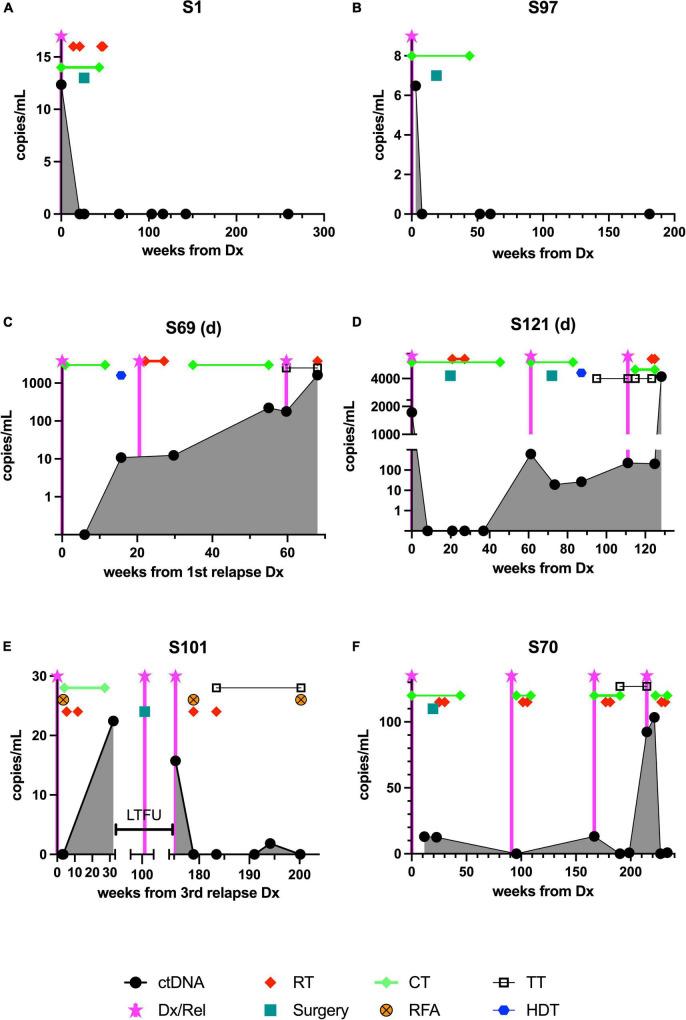
We performed whole genome sequencing (WGS) to identify the exact breakpoints in tumors known to carry the fusion gene. Patient-specific fusion breakpoints were tracked in peripheral blood plasma using digital droplet PCR (ddPCR) before, during, and after therapy in six children and young adults with EWS. Presence and levels of fusion breakpoints were correlated with clinical disease courses.
RESULTS
We show that the detection of ctDNA in the peripheral blood of EWS patients (i) is feasible in the clinical routine and (ii) allows for the longitudinal real-time monitoring of MRD activity in children and young adults. Although changing ctDNA levels correlated well with clinical outcome within patients, between patients, a high variability was observed (inter-individually).
CONCLUSION
ctDNA detection by ddPCR is a highly sensitive, specific, feasible, and highly accurate method that can be applied in EWS for follow-up assessments as an additional surrogate parameter for clinical MRD monitoring and, potentially, also for treatment stratification in the near future.
背景
小儿肉瘤的治疗分层和疗效评估依赖于影像学研究以及存活肿瘤细胞的手术/组织病理学证据。此类研究和证据收集过程通常涉及儿童的辐射和/或全身麻醉。血浆中无细胞循环肿瘤DNA(ctDNA)检测是一种所谓的液体活检方法,已被证明在定性和定量上与体内存活肿瘤细胞的存在相关。我们的临床观察性研究聚焦于ctDNA检测在小儿尤因肉瘤(EWS)中作为微小残留病(MRD)标志物的实用性和可行性。
患者与方法
我们进行了全基因组测序(WGS)以确定已知携带融合基因的肿瘤中的精确断点。在6例EWS儿童和青年患者的治疗前、治疗期间和治疗后,使用数字液滴PCR(ddPCR)在外周血浆中追踪患者特异性融合断点。融合断点的存在和水平与临床病程相关。
结果
我们表明,EWS患者外周血中ctDNA的检测(i)在临床常规中是可行的,并且(ii)能够对儿童和青年患者的MRD活性进行纵向实时监测。尽管患者体内ctDNA水平的变化与临床结果密切相关,但在患者之间观察到了高度变异性(个体间)。
结论
通过ddPCR检测ctDNA是一种高度灵敏、特异、可行且高度准确的方法,可应用于EWS的随访评估,作为临床MRD监测的额外替代参数,并且在不久的将来可能也用于治疗分层。

 Zotero 插件