
关于雷茨(Retz)不同药理学观点的全面综述。
A comprehensive review on the diverse pharmacological perspectives of Retz.
作者信息
Hassan Bulbul Md Rakibul, Uddin Chowdhury Mohammad Nizam, Naima Taslima Anjum, Sami Saad Ahmed, Imtiaj Md Shakil, Huda Nazmul, Uddin Md Giash
机构信息
Institute for Developing Science and Health Initiatives, Mohakhali, Dhaka, 1212, Bangladesh.
Department of Pharmacy, Faculty of Biological Sciences, University of Chittagong, Chittagong, 4331, Bangladesh.
出版信息
Heliyon. 2022 Aug 14;8(8):e10220. doi: 10.1016/j.heliyon.2022.e10220. eCollection 2022 Aug.
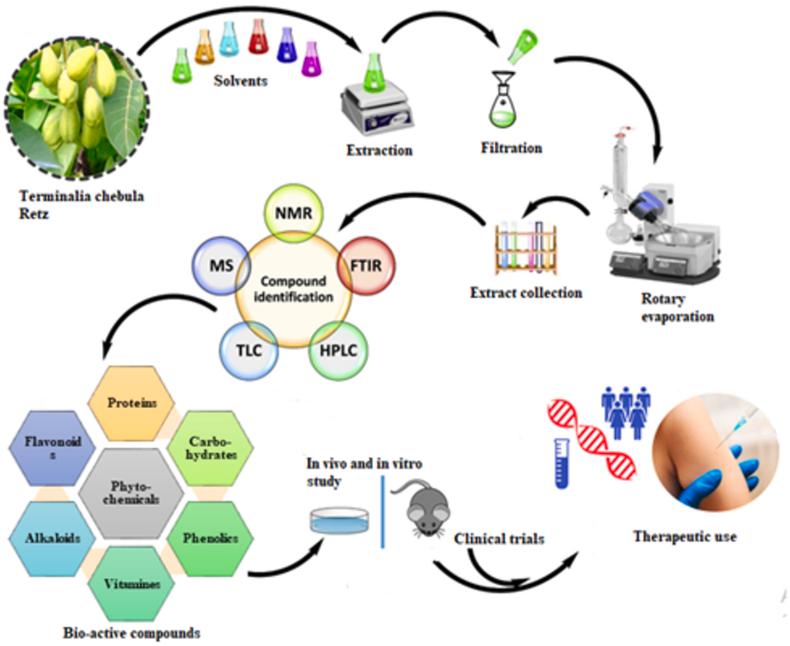
Retz, commonly known as 'Haritaki/Myrobalan,' has been utilised as a traditional medicine for a long time. It has been extensively exercised in various indigenous medicine practices like Unani, Tibb, Ayurveda, and Siddha to remedy human ailments such as bleeding, carminative, dysentery, liver tonic, digestive, antidiarrheal, analgesic, anthelmintic, antibacterial and helpful in skin disorders. Studies on the pharmacological effects of and its phytoconstituents documented between January, 1996 and December, 2021 were explored using various electronic databases. During the time mentioned above, several laboratory approaches revealed the biological properties of , including antioxidative, antiproliferative, anti-microbial, proapoptotic, anti-diabetic, anti-ageing, hepatoprotective, anti-inflammatory, and antiepileptic. It is also beneficial in glucose and lipid metabolism and prevents atherogenesis and endothelial dysfunction. Different parts of such as fruits, seeds, galls, barks extracted with various solvent systems (aqueous, ethanol, methanol, chloroform, ethyl-acetate) revealed major bioactive compounds like chebulic acid, chebulinic acid, and chebulaginic acid, which in turn proved to have valuable pharmacological properties through broad scientific investigations. There is a common link between chebulagic acid and chebulanin with its antioxidant property, antiaging activity, antiinflammatory, antidiabetic activity, and cardioprotective activity. The actions may be through neutralizing the free radicals responsible for producing tissue damage alongside interconnecting many other diseases. The current review summarises the scientifically documented literature on pharmacological potentials and chemical compositions of , which is expected to investigate further studies on this subject.
诃子,通常被称为“诃梨勒/余甘子”,长期以来一直被用作传统药物。它已在各种传统医学实践中广泛应用,如尤那尼医学、提比医学、阿育吠陀医学和悉达医学,用于治疗人类疾病,如止血、驱风、痢疾、肝脏滋补、消化、止泻、止痛、驱虫、抗菌以及对皮肤疾病有帮助。利用各种电子数据库对1996年1月至2021年12月期间记录的诃子及其植物成分的药理作用进行了研究。在上述时间段内,几种实验室方法揭示了诃子的生物学特性,包括抗氧化、抗增殖、抗菌、促凋亡、抗糖尿病、抗衰老、保肝、抗炎和抗癫痫。它在葡萄糖和脂质代谢中也有益处,并可预防动脉粥样硬化和内皮功能障碍。诃子的不同部位,如果实、种子、虫瘿、树皮,用各种溶剂系统(水、乙醇、甲醇、氯仿、乙酸乙酯)提取,揭示了主要的生物活性化合物,如诃子酸、诃子次酸和诃子鞣酸,通过广泛的科学研究,这些化合物被证明具有有价值的药理特性。诃子鞣酸和诃子宁之间存在共同联系,具有抗氧化特性、抗衰老活性、抗炎、抗糖尿病活性和心脏保护活性。这些作用可能是通过中和导致组织损伤的自由基以及与许多其他疾病相互关联来实现的。本综述总结了关于诃子药理潜力和化学成分的科学文献记录,有望对该主题进行进一步研究。


 Zotero 插件