
COVID-19 疫苗接种时的妊娠状况与严重急性呼吸综合征冠状病毒 2 感染的发生率。
Pregnancy Status at the Time of Coronavirus Disease 2019 Vaccination and Incidence of Severe Acute Respiratory Syndrome Coronavirus 2 Infection.
机构信息
Centre for Fertility and Health, Norwegian Institute of Public Health, Oslo, Norway.
Public Health Ontario, Toronto, Canada.
出版信息
Clin Infect Dis. 2023 Jan 6;76(1):57-65. doi: 10.1093/cid/ciac739.
BACKGROUND
Pregnant women are recommended to receive coronavirus disease 2019 (COVID-19) vaccines; however, relative effectiveness of vaccination by pregnancy status is unclear.
METHODS
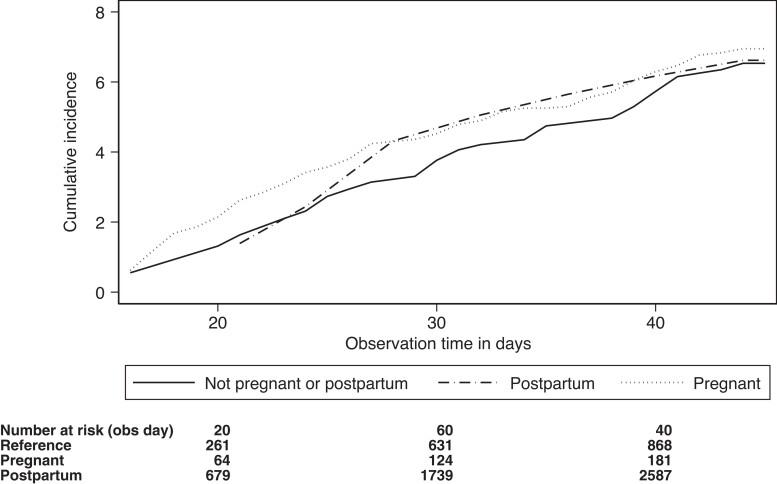
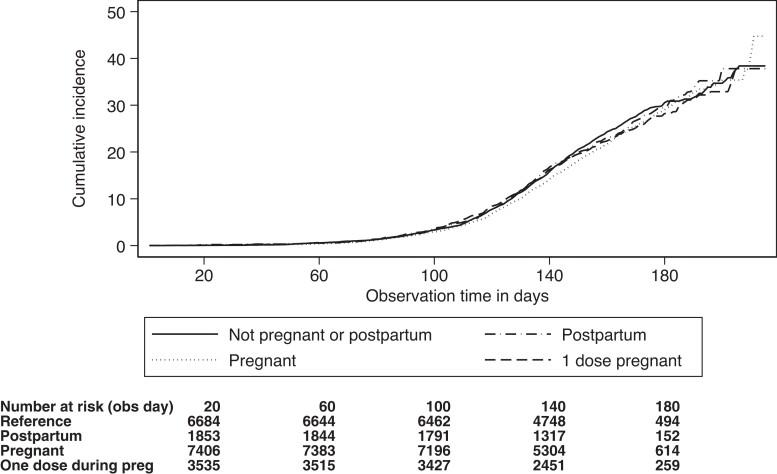
We compared the relative effectiveness of messenger RNA (mRNA) COVID-19 vaccines according to whether women received both doses while pregnant (n = 7412), 1 dose while pregnant (n = 3538), both doses while postpartum (n = 1856), or both doses while neither pregnant nor postpartum (n = 6687). We estimated risk of severe acute respiratory syndrome coronavirus 2 (SARS-CoV-2) infection starting 14 days after the second dose using Cox regression, reporting hazard ratios (HRs) and 95% confidence intervals (CIs). Second, we examined relative effectiveness of a third (booster) dose while pregnant compared to outside pregnancy. The major circulating variant during the study period was the Delta variant.
RESULTS
Fifty-four percent of women received 2 doses of the BNT162b2 vaccine, 16% received 2 doses of the mRNA-1273 vaccine, while 30% received 1 dose of both vaccines. Compared to women who received both doses while neither pregnant nor postpartum, the adjusted HR for a positive SARS-CoV-2 polymerase chain reaction test was similar if the woman received both doses while pregnant (1.04 [95% CI, .94-1.17]), 1 dose while pregnant and 1 dose before or after pregnancy (1.03 [95% CI, .93-1.14]), or both doses while postpartum (0.99 [95% CI, .92-1.07]). The findings were similar for BNT162b2 (Pfizer-BioNTech Comirnaty) and mRNA-1273 (Moderna Spikevax), and during Delta- and Omicron-dominant periods. We observed no differences in the relative effectiveness of the booster dose according to pregnancy status.
CONCLUSIONS
We observed similar effectiveness of mRNA vaccines against SARS-CoV-2 infection among women regardless of pregnancy status at the time of vaccination.
背景
建议孕妇接种 2019 年冠状病毒病(COVID-19)疫苗;然而,妊娠状态下疫苗接种的相对效果尚不清楚。
方法
我们比较了信使 RNA(mRNA)COVID-19 疫苗的相对有效性,根据女性在怀孕期间接种两剂(n=7412)、一剂(n=3538)、产后两剂(n=1856)或既不在怀孕期间也不在产后两剂(n=6687)的情况。我们使用 Cox 回归估计第二剂后 14 天严重急性呼吸综合征冠状病毒 2(SARS-CoV-2)感染的风险,报告风险比(HR)和 95%置信区间(CI)。其次,我们研究了怀孕期间接种第三剂(加强针)与不在怀孕期间接种的相对效果。研究期间主要流行的变异株是 Delta 变异株。
结果
54%的女性接种了 2 剂 BNT162b2 疫苗,16%接种了 2 剂 mRNA-1273 疫苗,30%接种了 2 剂疫苗中的 1 剂。与既不在怀孕期间也不在产后接种两剂疫苗的女性相比,如果女性在怀孕期间接种两剂疫苗(1.04 [95%CI,0.94-1.17])、在怀孕期间接种一剂疫苗且在怀孕前或怀孕后接种一剂疫苗(1.03 [95%CI,0.93-1.14])或在产后接种两剂疫苗(0.99 [95%CI,0.92-1.07]),SARS-CoV-2 聚合酶链反应检测阳性的调整 HR 相似。BNT162b2(辉瑞-BioNTech Comirnaty)和 mRNA-1273(Moderna Spikevax)的结果相似,且在 Delta 和奥密克戎主导时期也相似。我们没有观察到根据妊娠状态,加强针的相对有效性存在差异。
结论
我们观察到,无论女性在接种疫苗时的妊娠状态如何,mRNA 疫苗对 SARS-CoV-2 感染的有效性相似。

 Zotero 插件