
受体酪氨酸激酶FLT3中的激活突变与犬肥大细胞瘤的临床病理相关性
Activating Mutation in the Receptor Tyrosine Kinase FLT3 with Clinicopathological Relevance in Canine Mast Cell Tumors.
作者信息
Manachai Nawin, Rattanapinyopituk Kasem, Fonghem Piyanoot, Phoomvuthisarn Panrawee, Nakahata Shingo, Morishita Kazuhiro, Rungsipipat Anudep
机构信息
Center of Excellence for Companion Animal Cancer, Department of Veterinary Pathology, Faculty of Veterinary Science, Chulalongkorn University, Bangkok 10330, Thailand.
Department of Companion Animals, Faculty of Veterinary Medicine, Chiang Mai University, Mae Hia, Muang, Chiang Mai 50100, Thailand.
出版信息
Vet Med Int. 2022 Aug 28;2022:9509900. doi: 10.1155/2022/9509900. eCollection 2022.
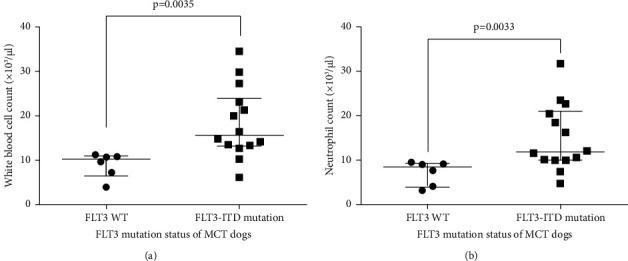
Recent research has focused on the receptor tyrosine kinase (RTK) KIT which is involved in the pathogenesis of canine mast cell tumors (MCT). However, the role of other RTKs in this neoplasm remains unclear. The present study aimed to determine the frequency of FLT3 mutations and to evaluate the mutational status and clinicopathological relevance of canine MCT patients. There were a total of 20 cases that were cytologically and histopathological diagnosed as canine MCTs; genomic polymerase chain reaction (PCR) and Sanger sequencing were used to identify mutations. For the juxtamembrane (JM) domain, the FLT3 14/15 primer pair was used to investigate exon 14/15 loci. Based on genomic PCR amplification of exon 14/15 and 20 of the FLT3 gene and Sanger sequencing of 20 cases of canine MCTs, the overall frequency of FLT3 mutation in canine MCTs was 75%. The majority of FLT3 mutations (70%) were internal tandem duplications (ITD) of the JM domain, while one case arose from deletion mutations of the tyrosine kinase domain (TKD). However, double mutations were not observed in this study. Furthermore, there is also clinicopathological relevance to MCT dogs carrying FLT3-ITD mutations, showing a tendency toward leukocytosis due to neutrophilia, and resembling human acute myeloid leukemia (AML) with FLT3-ITD mutations. A subset of MCTs with FLT3-ITD mutations, showing an enhanced signal of phosphorylated ERK1/2 identified by immunoblotting, suggests that an activating mutation may be driven by a distinct signal of the ERK pathway. Our results indicate that FLT3-ITD mutation is an oncogenic driver of canine MCTs, and that it shares some clinicopathologic features with human AML. These findings may offer new opportunities for further studies on canine mast cell tumorigenesis and a novel therapeutic target for canine MCT cases harboring FLT3-ITD mutations.
近期研究聚焦于参与犬肥大细胞瘤(MCT)发病机制的受体酪氨酸激酶(RTK)KIT。然而,其他RTK在这种肿瘤中的作用仍不明确。本研究旨在确定FLT3突变的频率,并评估犬MCT患者的突变状态及临床病理相关性。共有20例经细胞学和组织病理学诊断为犬MCT的病例;采用基因组聚合酶链反应(PCR)和桑格测序法鉴定突变。对于近膜(JM)结构域,使用FLT3 14/15引物对研究外显子14/15位点。基于对20例犬MCT的FLT3基因外显子14/15和20的基因组PCR扩增及桑格测序,犬MCT中FLT3突变的总体频率为75%。大多数FLT3突变(70%)为JM结构域的内部串联重复(ITD),而1例源于酪氨酸激酶结构域(TKD)的缺失突变。然而,本研究未观察到双突变。此外,携带FLT3-ITD突变的MCT犬也具有临床病理相关性,表现为因中性粒细胞增多导致白细胞增多的倾向,且类似于携带FLT3-ITD突变的人类急性髓系白血病(AML)。一部分具有FLT3-ITD突变的MCT,通过免疫印迹法鉴定显示磷酸化ERK1/2信号增强,提示激活突变可能由ERK途径的独特信号驱动。我们的结果表明,FLT3-ITD突变是犬MCT的致癌驱动因素,且与人类AML具有一些临床病理特征。这些发现可能为犬肥大细胞瘤发生的进一步研究提供新机会,并为携带FLT3-ITD突变的犬MCT病例提供新的治疗靶点。



 Zotero 插件