
全基因组测序与宏基因组学在微生物诊断中的联合应用。
Combination of Whole Genome Sequencing and Metagenomics for Microbiological Diagnostics.
机构信息
Applied Microbiology Research, Department of Biomedicine, University of Basel, 4031 Basel, Switzerland.
Institute of Medical Microbiology, University of Zurich, 8006 Zurich, Switzerland.
出版信息
Int J Mol Sci. 2022 Aug 30;23(17):9834. doi: 10.3390/ijms23179834.
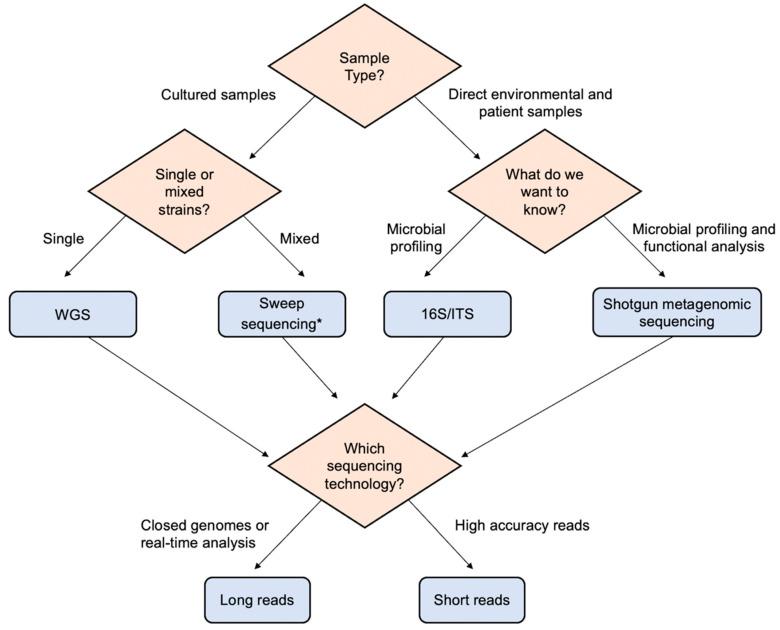
Whole genome sequencing (WGS) provides the highest resolution for genome-based species identification and can provide insight into the antimicrobial resistance and virulence potential of a single microbiological isolate during the diagnostic process. In contrast, metagenomic sequencing allows the analysis of DNA segments from multiple microorganisms within a community, either using an amplicon- or shotgun-based approach. However, WGS and shotgun metagenomic data are rarely combined, although such an approach may generate additive or synergistic information, critical for, e.g., patient management, infection control, and pathogen surveillance. To produce a combined workflow with actionable outputs, we need to understand the pre-to-post analytical process of both technologies. This will require specific databases storing interlinked sequencing and metadata, and also involves customized bioinformatic analytical pipelines. This review article will provide an overview of the critical steps and potential clinical application of combining WGS and metagenomics together for microbiological diagnosis.
全基因组测序 (WGS) 为基于基因组的物种鉴定提供了最高分辨率,并且可以在诊断过程中深入了解单个微生物分离物的抗菌药物耐药性和毒力潜力。相比之下,宏基因组测序允许分析群落中多个微生物的 DNA 片段,无论是使用扩增子还是鸟枪法。然而,WGS 和 shotgun 宏基因组数据很少结合使用,尽管这种方法可能会产生附加或协同信息,对于例如患者管理、感染控制和病原体监测至关重要。为了生成具有可操作输出的组合工作流程,我们需要了解这两种技术的分析前和分析后的过程。这将需要特定的数据库来存储相互关联的测序和元数据,并且还涉及定制的生物信息学分析管道。这篇综述文章将概述将 WGS 和宏基因组学结合用于微生物诊断的关键步骤和潜在临床应用。
 Zotero 插件