
重新审视肿瘤细胞中的瓦博格效应对代谢控制和癌症重编程的影响。
Revisited Metabolic Control and Reprogramming Cancers by Means of the Warburg Effect in Tumor Cells.
机构信息
Department of Biological Sciences, College of Science, Sungkyunkwan University, Seoburo 2066, Suwon 16419, Korea.
Department of Biomedicine Imaging and Radiological Science, National Yang Ming Chiao Tung University, Taipei 112, Taiwan.
出版信息
Int J Mol Sci. 2022 Sep 2;23(17):10037. doi: 10.3390/ijms231710037.
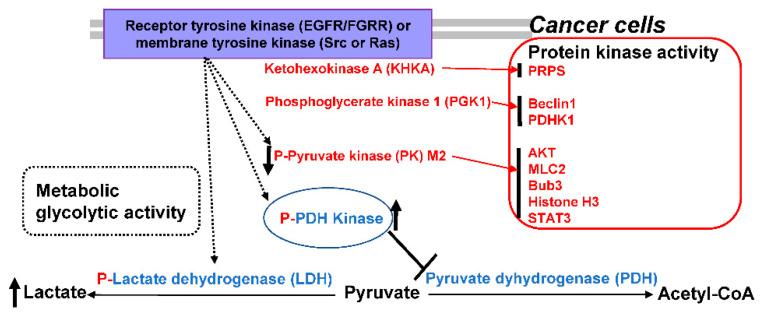
Aerobic glycolysis is an emerging hallmark of many human cancers, as cancer cells are defined as a "metabolically abnormal system". Carbohydrates are metabolically reprogrammed by its metabolizing and catabolizing enzymes in such abnormal cancer cells. Normal cells acquire their energy from oxidative phosphorylation, while cancer cells acquire their energy from oxidative glycolysis, known as the "Warburg effect". Energy-metabolic differences are easily found in the growth, invasion, immune escape and anti-tumor drug resistance of cancer cells. The glycolysis pathway is carried out in multiple enzymatic steps and yields two pyruvate molecules from one glucose (Glc) molecule by orchestral reaction of enzymes. Uncontrolled glycolysis or abnormally activated glycolysis is easily observed in the metabolism of cancer cells with enhanced levels of glycolytic proteins and enzymatic activities. In the "Warburg effect", tumor cells utilize energy supplied from lactic acid-based fermentative glycolysis operated by glycolysis-specific enzymes of hexokinase (HK), keto-HK-A, Glc-6-phosphate isomerase, 6-phosphofructo-2-kinase/fructose-2,6-biphosphatase, phosphofructokinase (PFK), phosphor-Glc isomerase (PGI), fructose-bisphosphate aldolase, phosphoglycerate (PG) kinase (PGK)1, triose phosphate isomerase, PG mutase (PGAM), glyceraldehyde-3-phosphate dehydrogenase, enolase, pyruvate kinase isozyme type M2 (PKM2), pyruvate dehydrogenase (PDH), PDH kinase and lactate dehydrogenase. They are related to glycolytic flux. The key enzymes involved in glycolysis are directly linked to oncogenesis and drug resistance. Among the metabolic enzymes, PKM2, PGK1, HK, keto-HK-A and nucleoside diphosphate kinase also have protein kinase activities. Because glycolysis-generated energy is not enough, the cancer cell-favored glycolysis to produce low ATP level seems to be non-efficient for cancer growth and self-protection. Thus, the Warburg effect is still an attractive phenomenon to understand the metabolic glycolysis favored in cancer. If the basic properties of the Warburg effect, including genetic mutations and signaling shifts are considered, anti-cancer therapeutic targets can be raised. Specific therapeutics targeting metabolic enzymes in aerobic glycolysis and hypoxic microenvironments have been developed to kill tumor cells. The present review deals with the tumor-specific Warburg effect with the revisited viewpoint of recent progress.
有氧糖酵解是许多人类癌症的新兴标志,因为癌细胞被定义为“代谢异常系统”。在这种异常癌细胞中,其代谢和分解代谢酶对碳水化合物进行代谢重编程。正常细胞从氧化磷酸化中获取能量,而癌细胞从氧化糖酵解中获取能量,即“Warburg 效应”。在癌细胞的生长、侵袭、免疫逃逸和抗肿瘤药物耐药性中,很容易发现能量代谢的差异。糖酵解途径在多个酶步骤中进行,通过酶的协调反应,从一个葡萄糖(Glc)分子中产生两个丙酮酸分子。在糖酵解蛋白水平升高和酶活性异常激活的癌细胞代谢中,很容易观察到不受控制的糖酵解或异常激活的糖酵解。在“Warburg 效应”中,肿瘤细胞利用由糖酵解特异性酶己糖激酶(HK)、酮己糖激酶-A、葡萄糖-6-磷酸异构酶、6-磷酸果糖-2-激酶/果糖-2,6-二磷酸酶、磷酸果糖激酶(PFK)、磷酸葡糖异构酶(PGI)、果糖二磷酸醛缩酶、磷酸甘油酸(PG)激酶(PGK)1、磷酸丙糖异构酶、PG 变位酶(PGAM)、甘油醛-3-磷酸脱氢酶、烯醇酶、丙酮酸激酶同工酶 M2(PKM2)、丙酮酸脱氢酶(PDH)、PDH 激酶和乳酸脱氢酶驱动的乳酸发酵来提供能量。它们与糖酵解通量有关。参与糖酵解的关键酶与致癌和耐药性直接相关。在代谢酶中,PKM2、PGK1、HK、酮己糖激酶-A 和核苷二磷酸激酶也具有蛋白激酶活性。由于糖酵解产生的能量不足,癌细胞倾向于产生低 ATP 水平的糖酵解似乎对癌症的生长和自我保护没有效率。因此,Warburg 效应仍然是理解癌症中糖酵解偏好的一个有吸引力的现象。如果考虑 Warburg 效应的基本特性,包括遗传突变和信号转导变化,可以提出抗癌治疗靶点。已经开发了针对有氧糖酵解和缺氧微环境中的代谢酶的特异性治疗方法来杀死肿瘤细胞。本综述从最近进展的角度重新讨论了肿瘤特异性 Warburg 效应。

 Zotero 插件