
糖酵解酶 TPI1 的核定位升高促进肺腺癌并增强化疗耐药性。
Elevated nuclear localization of glycolytic enzyme TPI1 promotes lung adenocarcinoma and enhances chemoresistance.
机构信息
The Fifth People's Hospital of Shanghai and the Molecular and Cell Biology Research Lab of the Institutes of Biomedical Sciences, Fudan University, Shanghai, China.
Department of Gastroenterology and Hepatology, Zhongshan Hospital, Fudan University, Shanghai, China.
出版信息
Cell Death Dis. 2022 Mar 4;13(3):205. doi: 10.1038/s41419-022-04655-6.
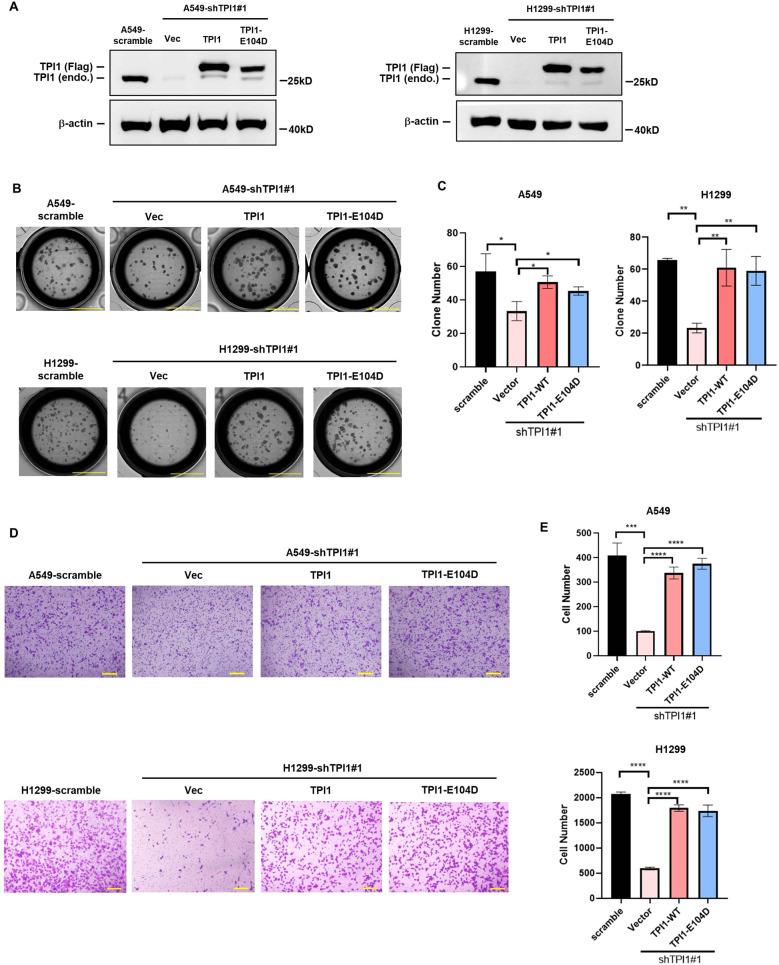
Increased glycolysis is a hallmark of tumor, which can provide tumor cells with energy and building blocks to promote cell proliferation. Recent studies have shown that not only the expression of glycolytic genes but also their subcellular localization undergoes a variety of changes to promote development of different types of tumors. In this study, we performed a comprehensive analysis of glycolysis and gluconeogenesis genes based on data from TCGA to identify those with significant tumor-promoting potential across 14 types of tumors. This analysis not only confirms genes that are known to be involved in tumorigenesis, but also reveals a significant correlation of triosephosphate isomerase 1 (TPI1) with poor prognosis, especially in lung adenocarcinoma (LUAD). TPI1 is a glycolytic enzyme that interconverts dihydroxyacetone phosphate (DHAP) to glyceraldehyde 3-phosphate (GAP). We confirm the upregulation of TPI1 expression in clinical LUAD samples and an inverse correlation with the overall patient survival. Knocking down of TPI1 in lung cancer cells significantly reduced cell migration, colony formation, and xenograft tumor growth. Surprisingly, we found that the oncogenic function of TPI1 depends on its translocation to cell nucleus rather than its catalytic activity. Significant accumulation of TPI1 in cell nucleus was observed in LUAD tumor tissues compared with the cytoplasm localization in adjacent normal tissues. Moreover, nuclear translocation of TPI1 is induced by extracellular stress (such as chemotherapy agents and peroxide), which facilitates the chemoresistance of cancer cells. Our study uncovers a novel function of the glycolytic enzyme TPI1 in the LUAD.
糖酵解增加是肿瘤的一个标志,它可以为肿瘤细胞提供能量和构建块,促进细胞增殖。最近的研究表明,不仅糖酵解基因的表达,而且它们的亚细胞定位也发生了各种变化,以促进不同类型肿瘤的发展。在这项研究中,我们基于 TCGA 数据对糖酵解和糖异生基因进行了全面分析,以确定在 14 种肿瘤中具有显著促瘤潜力的基因。这种分析不仅证实了已知参与肿瘤发生的基因,而且还揭示了三磷酸甘油醛异构酶 1 (TPI1) 与不良预后,尤其是在肺腺癌 (LUAD) 中具有显著相关性。TPI1 是一种糖酵解酶,可将二羟丙酮磷酸 (DHAP) 转化为甘油醛 3-磷酸 (GAP)。我们在临床 LUAD 样本中证实了 TPI1 表达的上调,并且与总患者生存率呈负相关。在肺癌细胞中敲低 TPI1 显著降低了细胞迁移、集落形成和异种移植肿瘤生长。令人惊讶的是,我们发现 TPI1 的致癌功能取决于其向细胞核的易位,而不是其催化活性。与相邻正常组织中的细胞质定位相比,在 LUAD 肿瘤组织中观察到 TPI1 在细胞核中的显著积累。此外,细胞外应激(如化疗药物和过氧化物)诱导 TPI1 的核易位,从而促进癌细胞的化疗耐药性。我们的研究揭示了糖酵解酶 TPI1 在 LUAD 中的一个新功能。




 Zotero 插件