
磷酸丙糖异构酶 1 可能是喉鳞状细胞癌的风险预测因子:一项整合了 bulk RNA、单细胞 RNA 和蛋白免疫组化的多中心研究。
Triosephosphate isomerase 1 may be a risk predictor in laryngeal squamous cell carcinoma: a multi-centered study integrating bulk RNA, single-cell RNA, and protein immunohistochemistry.
机构信息
Department of Pathology, The First Affiliated Hospital of Guangxi Medical University, Guangxi Zhuang Autonomous Region, Shuangyong Road 6, Nanning, 530021, People's Republic of China.
Guangxi Zhuang Autonomous Region Engineering Research Center for Artificial Intelligence Analysis of Multimodal Tumor Images, The First Affiliated Hospital of Guangxi Medical University, Guangxi Zhuang Autonomous Region, Shuangyong Road 6, Nanning, 530021, People's Republic of China.
出版信息
Eur J Med Res. 2023 Dec 15;28(1):591. doi: 10.1186/s40001-023-01568-8.
BACKGROUND
Although great progress has been made in anti-cancer therapy, the prognosis of laryngeal squamous cell carcinoma (LSCC) patients remains unsatisfied. Quantities of studies demonstrate that glycolytic reprograming is essential for the progression of cancers, where triosephosphate isomerase 1 (TPI1) serves as a catalytic enzyme. However, the clinicopathological significance and potential biological functions of TPI1 underlying LSCC remains obscure.
METHODS
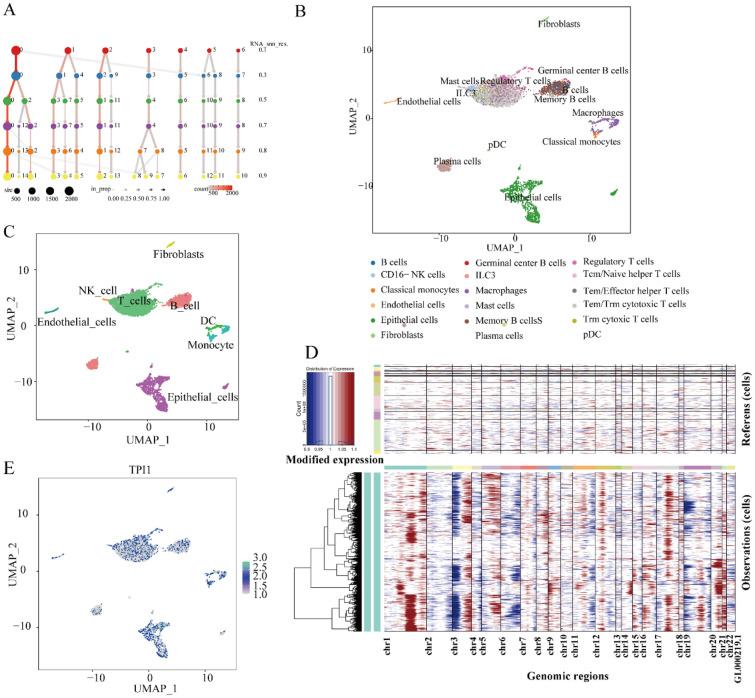
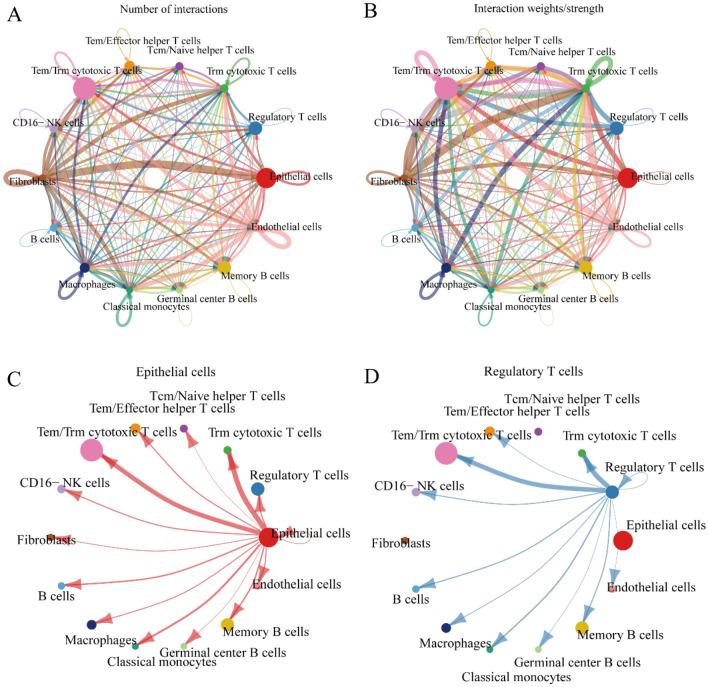
We collected in-house 82 LSCC tissue specimens and 56 non-tumor tissue specimens. Tissue microarrays (TMA) and immunohistochemical (IHC) experiments were performed. External LSCC microarrays and bulk RNA sequencing data were integrated to evaluate the expression of TPI1. We used a log-rank test and the CIBERSORT algorithm to assess the prognostic value of TPI1 and its association with the LSCC microenvironment. Malignant laryngeal epithelial cells and immune-stromal cells were identified using inferCNV and CellTypist. We conducted a comprehensive analysis to elucidate the molecular functions of TPI1 in LSCC tissue and single cells using Pearson correlation analysis, high dimensional weighted gene co-expression analysis, gene set enrichment analysis, and clustered regularly interspaced short palindromic repeats (CRISPR) screen. We explored intercellular communication patterns between LSCC single cells and immune-stromal cells and predicted several therapeutic agents targeting TPI1.
RESULTS
Based on the in-house TMA and IHC analysis, TPI1 protein was found to have a strong positive expression in the nucleus of LSCC cells but only weakly positive activity in the cytoplasm of normal laryngeal cells (p < 0.0001). Further confirmation of elevated TPI1 mRNA expression was obtained from external datasets, comparing 251 LSCC tissue samples to 136 non-LSCC tissue samples (standardized mean difference = 1.06). The upregulated TPI1 mRNA demonstrated a high discriminative ability between LSCC and non-LSCC tissue (area under the curve = 0.91; sensitivity = 0.87; specificity = 0.79), suggesting its potential as a predictive marker for poor prognosis (p = 0.037). Lower infiltration abundance was found for plasma cells, naïve B cells, monocytes, and neutrophils in TPI-high expression LSCC tissue. Glycolysis and cell cycle were significantly enriched pathways for both LSCC tissue and single cells, where heat shock protein family B member 1, TPI1, and enolase 1 occupied a central position. Four outgoing communication patterns and two incoming communication patterns were identified from the intercellular communication networks. TPI1 was predicted as an oncogene in LSCC, with CRISPR scores less than -1 across 71.43% of the LSCC cell lines. TPI1 was positively correlated with the half maximal inhibitory concentration of gemcitabine and cladribine.
CONCLUSIONS
TPI1 is dramatically overexpressed in LSCC than in normal tissue, and the high expression of TPI1 may promote LSCC deterioration through its metabolic and non-metabolic functions. This study contributes to advancing our knowledge of LSCC pathogenesis and may have implications for the development of targeted therapies in the future.
背景
尽管在抗癌治疗方面取得了巨大进展,但喉鳞状细胞癌(LSCC)患者的预后仍不令人满意。大量研究表明,糖酵解重编程对于癌症的进展至关重要,其中三磷酸甘油醛异构酶 1(TPI1)作为一种催化酶发挥作用。然而,TPI1 在 LSCC 中的临床病理意义和潜在生物学功能仍不清楚。
方法
我们收集了 82 例 LSCC 组织标本和 56 例非肿瘤组织标本。进行组织微阵列(TMA)和免疫组织化学(IHC)实验。整合外部 LSCC 微阵列和批量 RNA 测序数据,评估 TPI1 的表达情况。我们使用对数秩检验和 CIBERSORT 算法评估 TPI1 的预后价值及其与 LSCC 微环境的关联。使用 inferCNV 和 CellTypist 鉴定恶性喉上皮细胞和免疫基质细胞。我们使用 Pearson 相关分析、高维加权基因共表达分析、基因集富集分析和聚类规则间隔短回文重复(CRISPR)筛选,对 LSCC 组织和单细胞中 TPI1 的分子功能进行了全面分析。我们探索了 LSCC 单细胞与免疫基质细胞之间的细胞间通讯模式,并预测了几种针对 TPI1 的治疗药物。
结果
基于内部 TMA 和 IHC 分析,发现 TPI1 蛋白在 LSCC 细胞的核内有强烈的阳性表达,但在正常喉细胞的细胞质内仅有弱阳性活性(p<0.0001)。进一步通过比较 251 例 LSCC 组织样本与 136 例非 LSCC 组织样本,从外部数据集中得到了 TPI1 mRNA 表达升高的进一步证实(标准化均数差=1.06)。上调的 TPI1 mRNA 在 LSCC 和非 LSCC 组织之间具有较高的区分能力(曲线下面积=0.91;敏感性=0.87;特异性=0.79),表明其可能是预后不良的预测标志物(p=0.037)。TPI1 高表达的 LSCC 组织中,浆细胞、幼稚 B 细胞、单核细胞和中性粒细胞的浸润丰度较低。糖酵解和细胞周期是 LSCC 组织和单细胞中显著富集的途径,其中热休克蛋白家族 B 成员 1、TPI1 和烯醇酶 1 占据中心位置。从细胞间通讯网络中鉴定出四个传出通讯模式和两个传入通讯模式。TPI1 被预测为 LSCC 的致癌基因,在 71.43%的 LSCC 细胞系中 CRISPR 评分低于-1。TPI1 与吉西他滨和克拉屈滨的半最大抑制浓度呈正相关。
结论
TPI1 在 LSCC 中的表达明显高于正常组织,TPI1 的高表达可能通过其代谢和非代谢功能促进 LSCC 恶化。本研究有助于推进我们对 LSCC 发病机制的认识,并可能对未来靶向治疗的发展产生影响。






 Zotero 插件