
每日休息时间和睡眠时间与工人健康和生产力的联合协会:日本日间工人的横断面网络调查。
The Joint Association of Daily Rest Periods and Sleep Duration with Worker Health and Productivity: A Cross-Sectional Web Survey of Japanese Daytime Workers.
机构信息
National Institute of Occupational Safety and Health, Japan Organization of Occupational Health and Safety, Kawasaki 214-8585, Japan.
Department of Psychology, Faculty of Letters, Chuo University, Tokyo 192-0393, Japan.
出版信息
Int J Environ Res Public Health. 2022 Sep 5;19(17):11143. doi: 10.3390/ijerph191711143.
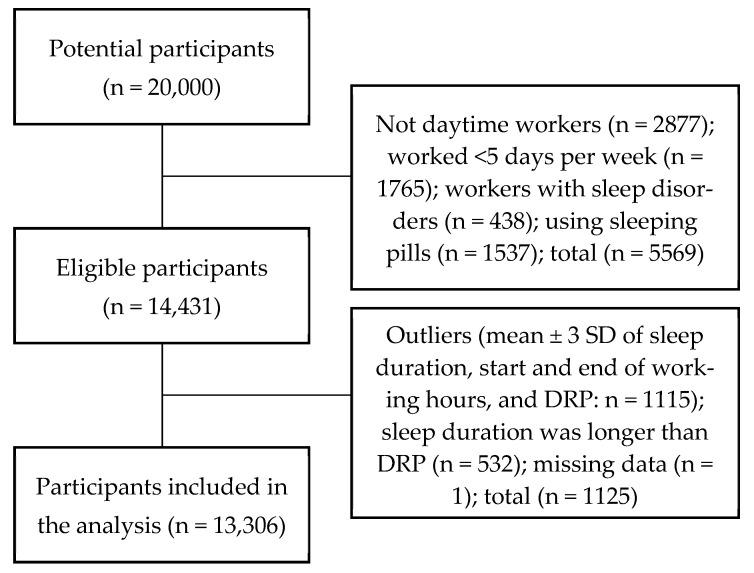
A daily rest period (DRP) is a daily inter-work interval that contains sleep opportunity. This study investigates the joint association of DRP and sleep duration with worker health and productivity. A total of 13,306 Japanese daytime workers participated in this web-based cross-sectional survey. Participants reported on their DRPs and sleep duration; moreover, sleep difficulties, mental health, and presenteeism were assessed by the standardized questionnaires. The participants were divided into 10 groups based on their DRPs and sleep duration. Logistic regression analyses showed that the combination of quick return (QR: DRP of <11 h) and short sleep duration (<6 h) was found to be significantly associated with sleep difficulties (odds ratio [OR] = 4.45, 95% confidence interval [CI] = 2.83-7.01), poor mental health (OR = 3.04, 95% CI = 1.79-5.15), and presenteeism (OR = 2.35, 95% CI = 1.47-3.77) compared with the reference group (the combination of adequate DRP [15 h] and a normal sleep duration [≥6 h]). The combination of QR and normal sleep duration or adequate DRP and short sleep duration was significantly associated with high ORs for the outcomes. QR, short sleep duration, or both negatively affect worker health and productivity.
工间休息期(DRP)是包含睡眠机会的每日工作间隔。本研究调查了 DRP 和睡眠时间与工人健康和生产力的联合关联。共有 13306 名日本白班工人参与了这项基于网络的横断面调查。参与者报告了他们的 DRP 和睡眠时间;此外,通过标准化问卷评估了睡眠困难、心理健康和工作出勤情况。根据他们的 DRP 和睡眠时间,参与者被分为 10 组。逻辑回归分析显示,快速返回(QR:DRP<11 小时)和短睡眠时间(<6 小时)的组合与睡眠困难(比值比[OR] = 4.45,95%置信区间[CI] = 2.83-7.01)、心理健康状况差(OR = 3.04,95%CI = 1.79-5.15)和工作出勤情况(OR = 2.35,95%CI = 1.47-3.77)显著相关,与参考组(DRP 充足[15 小时]和正常睡眠时间[≥6 小时]的组合)相比。QR 和正常睡眠时间的组合或充足的 DRP 和短睡眠时间的组合与这些结果的高比值比显著相关。QR、短睡眠时间或两者都对工人的健康和生产力产生负面影响。
 Zotero 插件