
生姜及其成分对疼痛的影响。
The Effect of Ginger and Its Sub-Components on Pain.
作者信息
Kim Suyong, Cheon Chunhoo, Kim Bonglee, Kim Woojin
机构信息
Department of Physiology, College of Korean Medicine, Kyung Hee University, Seoul 02447, Korea.
Cancer Preventive Material Development Research Center, College of Korean Medicine, Kyung Hee University, Seoul 02447, Korea.
出版信息
Plants (Basel). 2022 Sep 2;11(17):2296. doi: 10.3390/plants11172296.
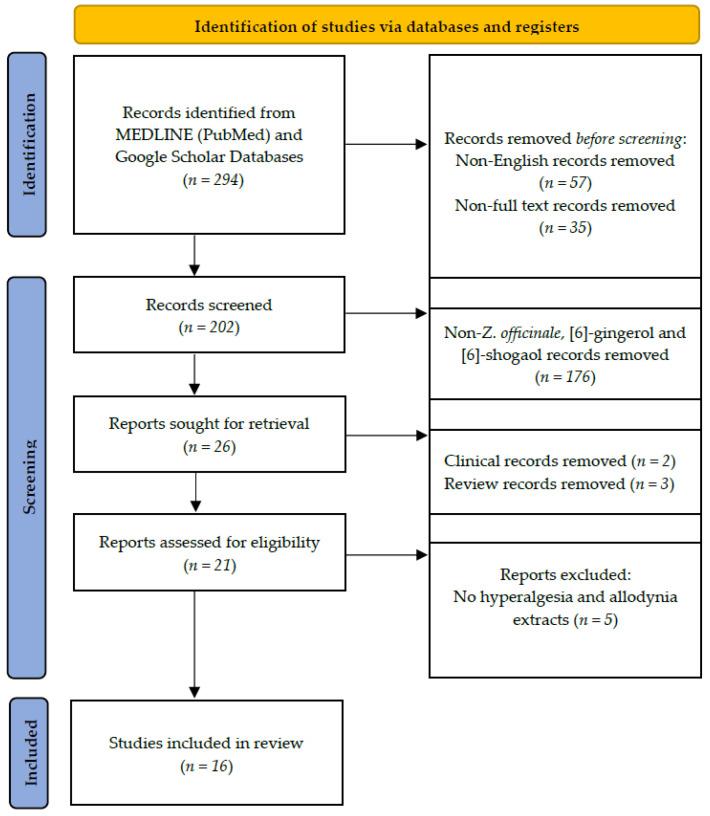
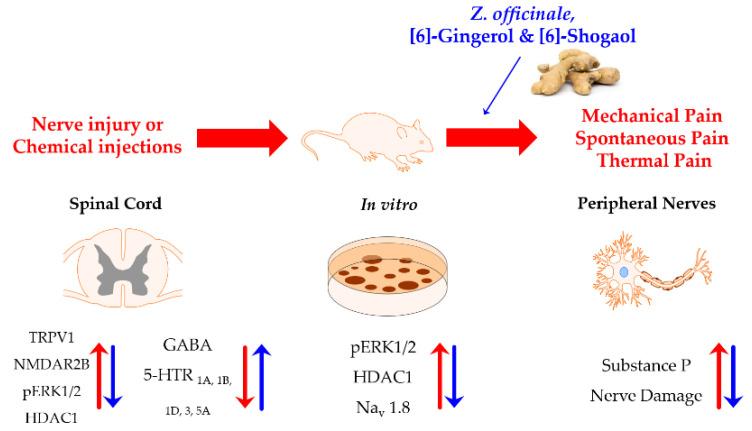
Roscoe (ginger) has long been used as an herbal medicine to treat various diseases, and its main sub-components, [6]-gingerol and [6]-shogaol, were also reported to have anti-inflammatory, anti-oxidant, and anti-tumor effects. However, their effects on various types of pain and their underlying mechanisms of action have not been clearly analyzed and understood yet. Thus, in this review, by analyzing 16 studies that used , [6]-gingerol, and [6]-shogaol on mechanical, spontaneous and thermal pain, their effects and mechanisms of action have been analyzed. Pain was induced by either nerve injury or chemical injections in rodents. Nine studies analyzed the analgesic effect of , and four and three studies focused on [6]-gingerol and [6]-shogaol, respectively. Seven papers have demonstrated the underlying mechanism of action of their analgesic effects. Studies have focused on the spinal cord and one on the dorsal root ganglion (DRG) neurons. Involvement and change in the function of serotonergic receptors (5-HT, , , and ), transient receptor potential vanilloid 1 (TRPV1), N-methyl-D-aspartate (NMDA) receptors, phosphorylated extracellular signal-regulated kinase 1/2 (pERK1/2), histone deacetylase 1 (HDAC1), voltage-gated sodium channel 1.8 (Na1.8), substance P (SP), and sciatic nerve's morphology have been observed.
姜黄(姜)长期以来一直被用作治疗各种疾病的草药,其主要亚成分[6]-姜酚和[6]-姜烯酚也被报道具有抗炎、抗氧化和抗肿瘤作用。然而,它们对各种类型疼痛的影响及其潜在作用机制尚未得到清晰的分析和理解。因此,在本综述中,通过分析16项使用[6]-姜酚、[6]-姜烯酚治疗机械性、自发性和热痛的研究,对它们的作用效果和作用机制进行了分析。在啮齿动物中,疼痛是由神经损伤或化学注射诱导的。9项研究分析了[6]-姜酚的镇痛作用,4项和3项研究分别聚焦于[6]-姜酚和[6]-姜烯酚。7篇论文阐述了其镇痛作用的潜在机制。研究主要集中在脊髓,有1项研究关注背根神经节(DRG)神经元。观察到了血清素能受体(5-HT、 、 、 )、瞬时受体电位香草酸受体1(TRPV1)、N-甲基-D-天冬氨酸(NMDA)受体、磷酸化细胞外信号调节激酶1/2(pERK1/2)、组蛋白去乙酰化酶1(HDAC1)、电压门控钠通道1.8(Na1.8)、P物质(SP)的功能参与和变化以及坐骨神经的形态。

 Zotero 插件