
医学生申请者的反原住民偏见:一项横断面研究。
Anti-Indigenous bias of medical school applicants: a cross-sectional study.
机构信息
Department of Family Medicine, Cumming School of Medicine, University of Calgary, Calgary, AB, Canada.
Cumming School of Medicine, University of Calgary, Calgary, AB, Canada.
出版信息
BMC Med Educ. 2022 Sep 19;22(1):683. doi: 10.1186/s12909-022-03739-3.
BACKGROUND
Structural and interpersonal anti-Indigenous racism is prevalent in Canadian healthcare. The Truth and Reconciliation Commission calls on medical schools to address anti-Indigenous bias in students. We measured the prevalence of interpersonal anti-Indigenous bias among medical school applicants to understand how the medical school selection process selects for or against students with high levels of bias.
METHODS
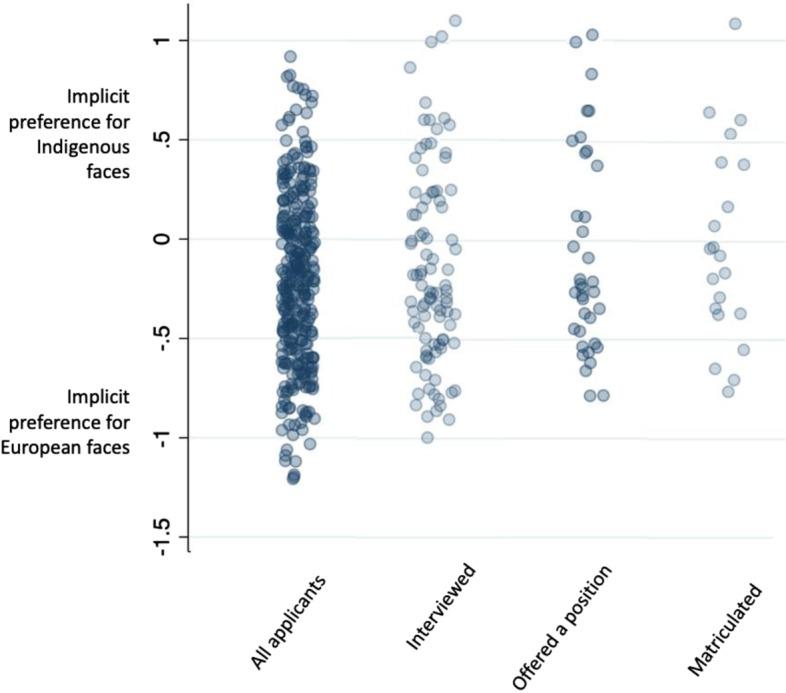
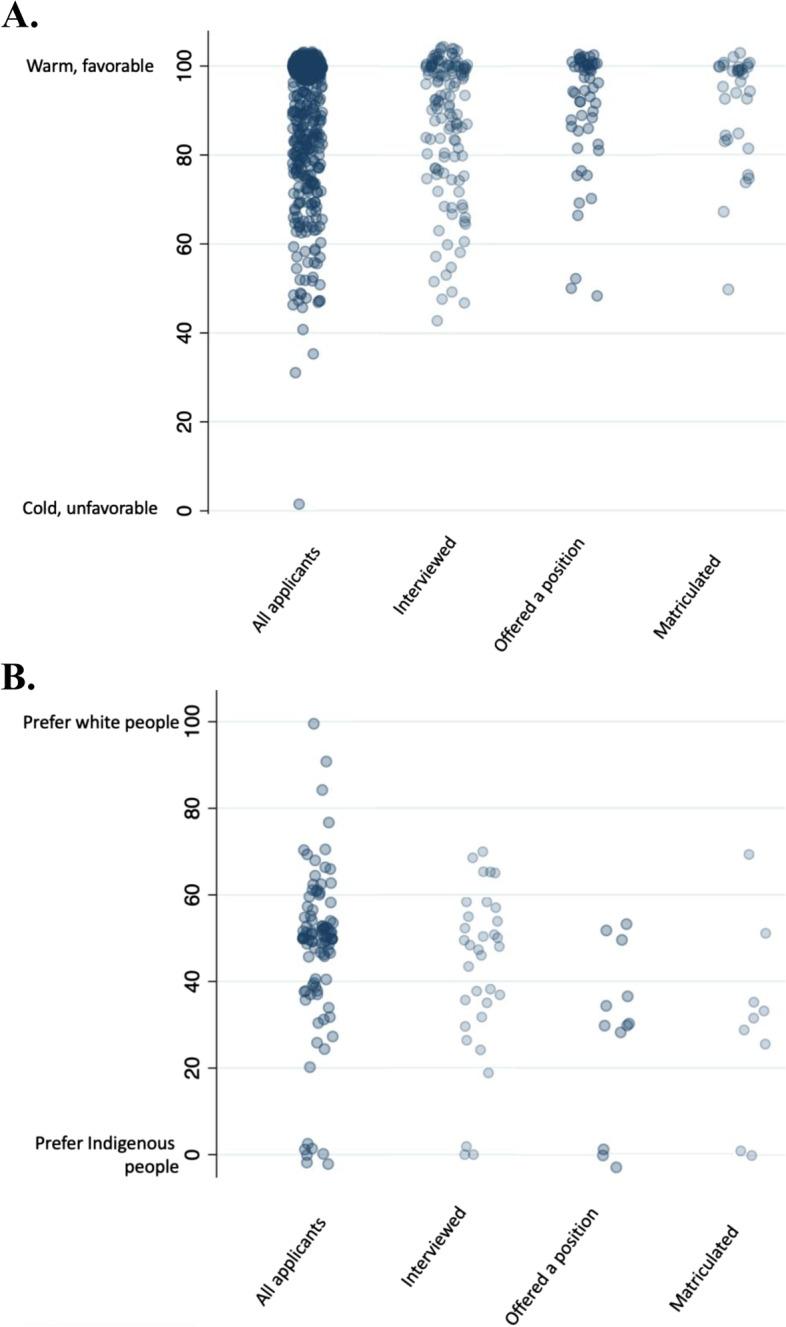
All applicants to a single university in the 2020-2021 admissions cycle were invited to participate. Explicit anti-Indigenous bias was measured using two sliding scale thermometers. The first asked how participants felt about Indigenous people (from 0, indicating 'cold/unfavourable' to 100, indicating 'warm/favourable') and the second asked whether participants preferred white (scored 100) or Indigenous people (scored 0). Participants then completed an implicit association test examining preferences for European or Indigenous faces (negative time latencies suggest preference for European faces). Explicit and implicit anti-Indigenous biases were compared by applicant demographics (including gender and racial identity), application status (offered an interview, offered admission, accepted a position), and compared to undergraduate medical and mathematics students.
RESULTS
There were 595 applicant respondents (32.4% response rate, 64.2% cisgender women, 55.3% white). Applicants felt warmly toward Indigenous people (median 96 (IQR 80-100)), had no explicit preference for white or Indigenous people (median 50 (IQR 37-55), and had mild implicit preference for European faces (- 0.22 ms (IQR -0.54, 0.08 ms)). There were demographic differences associated with measures of explicit and implicit bias. Applicants who were offered admission had warmer feelings toward Indigenous people and greater preference for Indigenous people compared to those were not successful.
CONCLUSIONS
Medical school applicants did not have strong interpersonal explicit and implicit anti-Indigenous biases. Outlier participants with strong biases were not offered interviews or admission to medical school.
背景
结构性和人际反原住民种族主义在加拿大医疗保健中普遍存在。真相与和解委员会呼吁医学院解决学生中的反原住民偏见。我们测量了医学院申请者之间人际反原住民偏见的流行程度,以了解医学院的选拔过程是如何选择或反对具有高度偏见的学生的。
方法
邀请 2020-2021 年招生周期内单一大学的所有申请者参加。使用两个滑动刻度温度计测量明确的反原住民偏见。第一个问题是参与者对原住民的感受(从 0 表示“冷/不利”到 100 表示“暖/有利”),第二个问题是参与者更喜欢白人(得分为 100)还是原住民(得分为 0)。然后,参与者完成了一个内隐联想测验,检查他们对欧洲或原住民面孔的偏好(负面时间延迟表示对欧洲面孔的偏好)。根据申请者的人口统计学特征(包括性别和种族认同)、申请状况(提供面试、提供录取、接受职位)以及与本科医学和数学专业学生进行比较,比较了明确和隐含的反原住民偏见。
结果
有 595 名申请者回答了问题(回应率为 32.4%,64.2%为顺性别女性,55.3%为白人)。申请者对原住民有温暖的感觉(中位数 96(IQR 80-100)),对白人或原住民没有明确的偏好(中位数 50(IQR 37-55)),对欧洲面孔有轻微的隐含偏好(-0.22 毫秒(IQR-0.54,0.08 毫秒))。与明确和隐含偏见的测量相关的有一些人口统计学差异。与未成功的申请者相比,获得录取的申请者对原住民的感觉更温暖,对原住民的偏好更大。
结论
医学院申请者没有强烈的人际明确和隐含的反原住民偏见。具有强烈偏见的离群值参与者未获得面试或被医学院录取。
 Zotero 插件