
通过基于结构设计靶向组氨酸的化学探针实现对 Cereblon 的共价修饰
Cereblon covalent modulation through structure-based design of histidine targeting chemical probes.
作者信息
Cruite Justin T, Dann Geoffrey P, Che Jianwei, Donovan Katherine A, Ferrao Silas, Ficarro Scott B, Fischer Eric S, Gray Nathanael S, Huerta Fidel, Kong Nikki R, Liu Hu, Marto Jarrod A, Metivier Rebecca J, Nowak Radosław P, Zerfas Breanna L, Jones Lyn H
机构信息
Center for Protein Degradation, Dana-Farber Cancer Institute Boston MA USA
Department of Biological Chemistry and Molecular Pharmacology, Harvard Medical School Boston MA USA.
出版信息
RSC Chem Biol. 2022 Jul 8;3(9):1105-1110. doi: 10.1039/d2cb00078d. eCollection 2022 Aug 31.
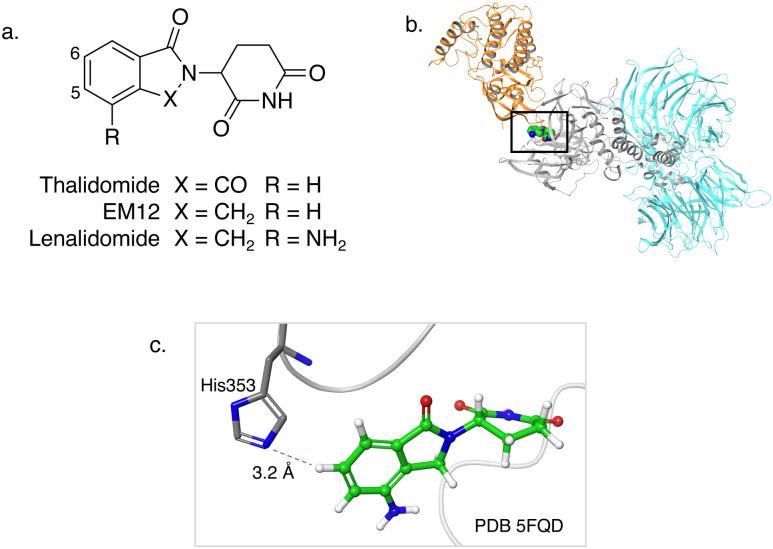
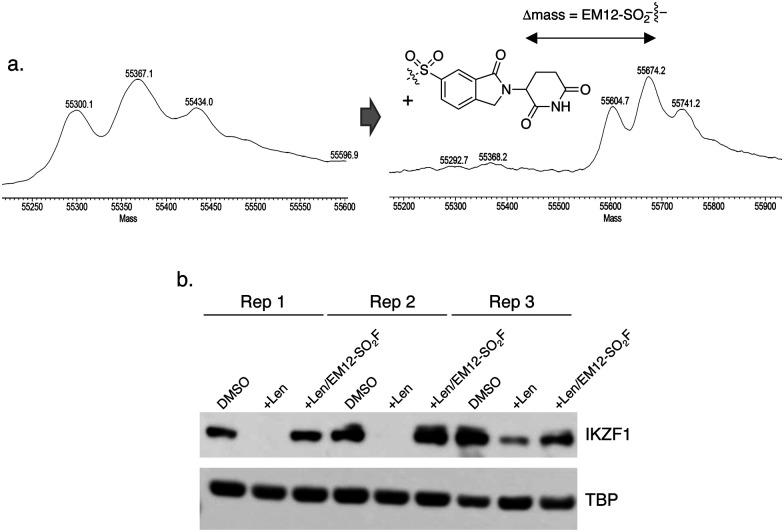
Electrophilic biocompatible warheads, particularly cysteine-reactive acrylamides, have enabled the development of covalent inhibitor drugs and chemical biology probes, but cysteine is rarely present in protein binding sites. Therefore, expansion of the list of targetable amino acid residues is required to augment the synthetic bology toolkit of site-selective protein modifications. This work describes the first rational targeting of a specific histidine residue in a protein binding site using sulfonyl exchange chemistry. Structure-based drug design was used to incorporate sulfonyl fluoride and triazole reactive groups into the isoindolinone thalidomide congener EM12 to yield potent covalent inhibitors of the cereblon E3 ubiquitin ligase complex through engagement of His353. Conversely, the fluorosulfate derivative EM12-FS labels His353, but degrades a novel neosubstrate, the protein N-terminal glutamine amidohydrolase NTAQ1, which is involved in the N-end rule pathway and DNA damage response. Targeted protein degradation using cereblon ligands has become an important new drug discovery modality and the chemical probes and covalent labeling strategy described here will broadly impact this exciting area of therapeutic research.
亲电生物相容性弹头,特别是半胱氨酸反应性丙烯酰胺,已推动了共价抑制剂药物和化学生物学探针的开发,但半胱氨酸很少存在于蛋白质结合位点。因此,需要扩大可靶向的氨基酸残基列表,以扩充位点选择性蛋白质修饰的合成生物学工具包。这项工作描述了首次使用磺酰基交换化学对蛋白质结合位点中的特定组氨酸残基进行合理靶向。基于结构的药物设计被用于将磺酰氟和三唑反应基团引入异吲哚啉酮沙利度胺类似物EM12中,通过与His353结合产生有效的cereblon E3泛素连接酶复合物共价抑制剂。相反,氟硫酸盐衍生物EM12-FS标记His353,但会降解一种新的新底物,即参与N端规则途径和DNA损伤反应的蛋白质N端谷氨酰胺酰胺水解酶NTAQ1。使用cereblon配体进行靶向蛋白质降解已成为一种重要的新药发现模式,此处描述的化学探针和共价标记策略将广泛影响这一令人兴奋的治疗研究领域。


 Zotero 插件