
基于氟代硫酸弹头的共价结合脑啡肽酶的PROTAC的开发。
Development of a covalent cereblon-based PROTAC employing a fluorosulfate warhead.
作者信息
Nowak Radosław P, Ragosta Leah, Huerta Fidel, Liu Hu, Ficarro Scott B, Cruite Justin T, Metivier Rebecca J, Donovan Katherine A, Marto Jarrod A, Fischer Eric S, Zerfas Breanna L, Jones Lyn H
机构信息
Center for Protein Degradation, Dana-Farber Cancer Institute Boston MA USA
Department of Biological Chemistry and Molecular Pharmacology, Harvard Medical School Boston MA USA.
出版信息
RSC Chem Biol. 2023 Aug 31;4(11):906-912. doi: 10.1039/d3cb00103b. eCollection 2023 Nov 1.
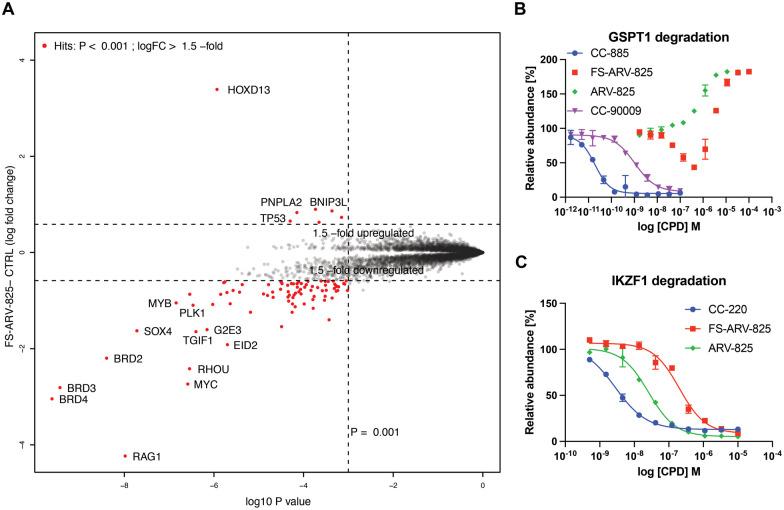
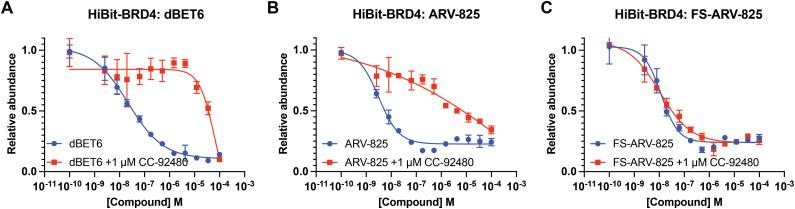
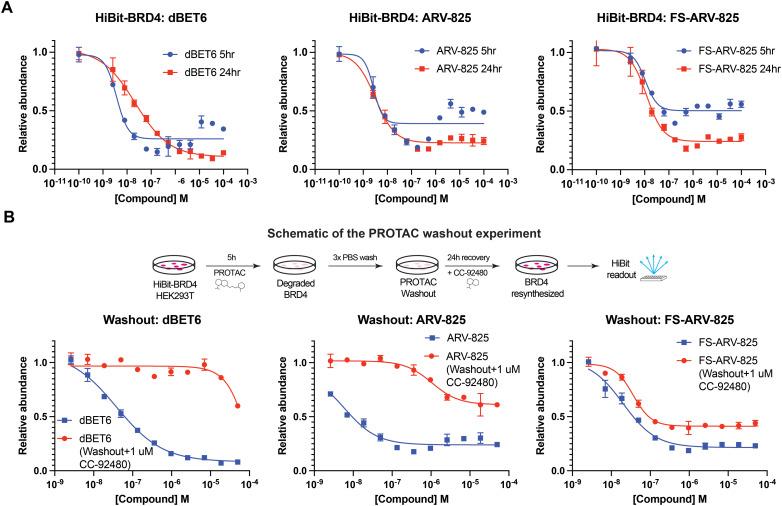
Many cereblon (CRBN) ligands have been used to develop proteolysis targeting chimeras (PROTACs), but all are reversible binders of the E3 ubiquitin ligase. We recently described the use of sulfonyl exchange chemistry to design binders that covalently engage histidine 353 in CRBN for the first time. Here we show that covalent CRBN ligands can be used to develop efficient PROTAC degraders. We demonstrate that the fluorosulfate PROTAC FS-ARV-825 covalently labels CRBN , and in cells the BRD4 degrader is insensitive to wash-out and competition by potent reversible CRBN ligands, reflecting enhanced pharmacodynamics. We anticipate that covalent CRBN-based PROTACs will enhance degradation efficiencies, thus expanding the scope of addressable targets using the heterobifunctional degrader modality.
许多 Cereblon(CRBN)配体已被用于开发靶向嵌合体的蛋白酶(PROTAC),但它们都是 E3 泛素连接酶的可逆结合剂。我们最近描述了利用磺酰基交换化学首次设计出能与 CRBN 中的组氨酸 353 共价结合的结合剂。在此我们表明,共价 CRBN 配体可用于开发高效的 PROTAC 降解剂。我们证明氟硫酸酯 PROTAC FS-ARV-825 能共价标记 CRBN,且在细胞中,这种 BRD4 降解剂对洗脱以及强效可逆 CRBN 配体的竞争均不敏感,这反映出其增强的药效动力学。我们预计,基于共价 CRBN 的 PROTAC 将提高降解效率,从而扩展使用异双功能降解剂模式可靶向的靶点范围。

 Zotero 插件