
烟草使用与非小细胞肺癌免疫检查点抑制剂治疗的反应。
Tobacco Use and Response to Immune Checkpoint Inhibitor Therapy in Non-Small Cell Lung Cancer.
机构信息
Division of Medical Oncology and Hematology, Department of Medicine, Princess Margaret Cancer Centre, University Health Network Toronto, Toronto, ON M5G 2C1, Canada.
Division of Medical Oncology, Department of Medicine, University of Toronto, Toronto, ON M5S 1A8, Canada.
出版信息
Curr Oncol. 2022 Aug 30;29(9):6260-6276. doi: 10.3390/curroncol29090492.
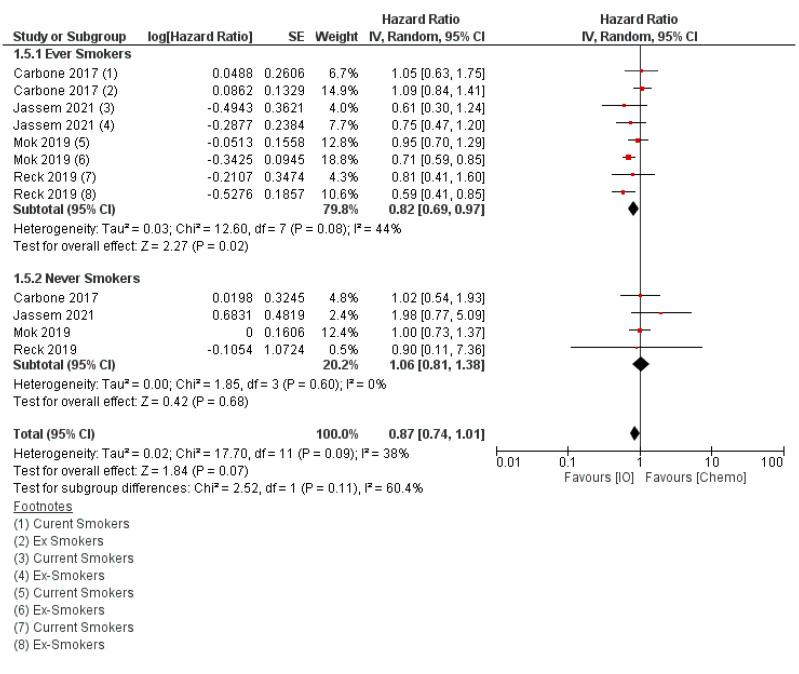
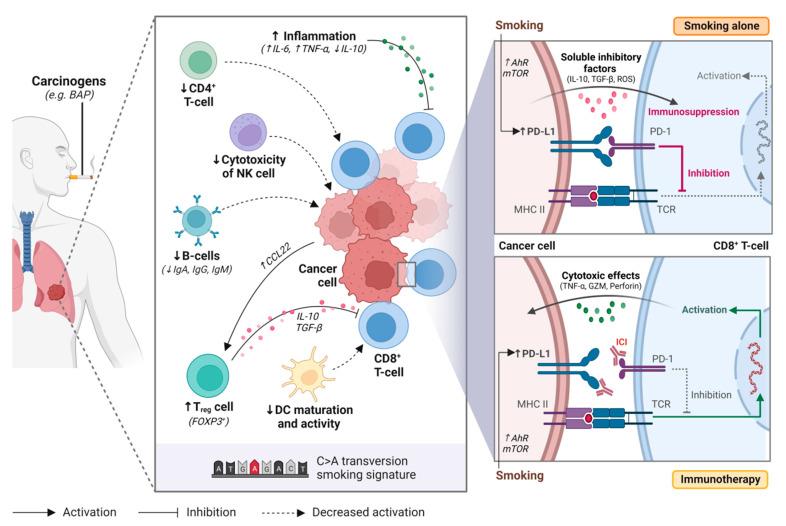
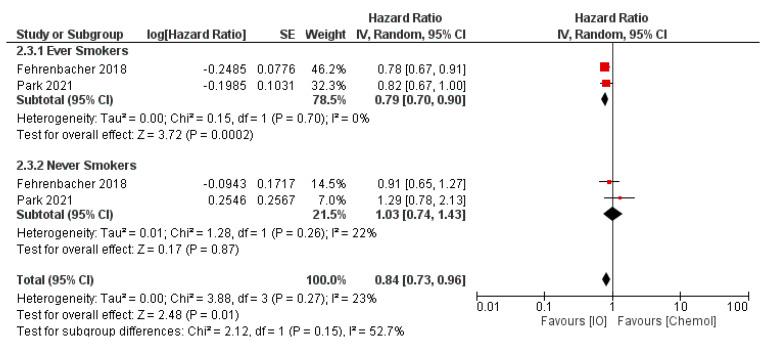
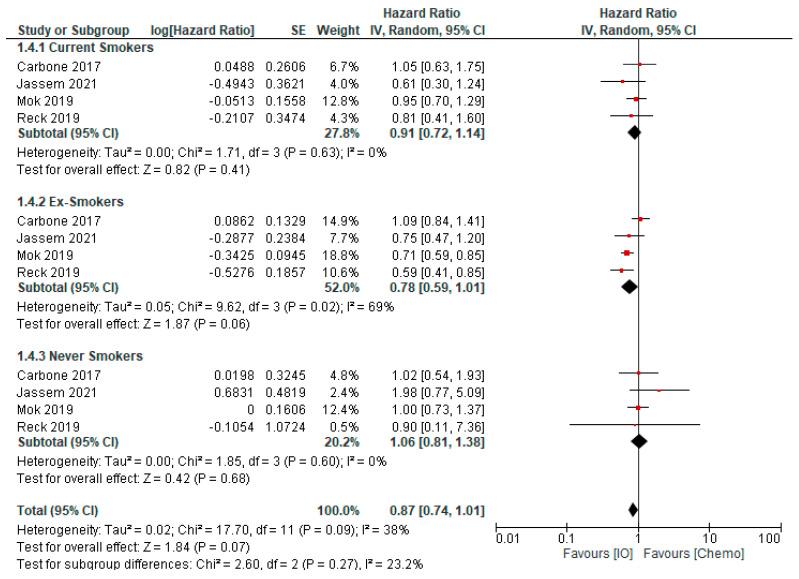
Tobacco is a known risk factor for lung cancer, and continued tobacco use is associated with poorer outcomes across multiple lung cancer treatment modalities including surgery, chemotherapy and radiation therapy. Less is known about the association of tobacco use and outcomes with immune checkpoint inhibitors (ICIs), which are becoming an important part of the treatment landscape in lung cancer, both in metastatic and curative settings. We reviewed the literature on the association of tobacco and tumor biology as it relates to immunotherapy. We also reviewed the association of tobacco use on outcomes among phase III randomized clinical trials involving ICIs in non-small cell lung cancer (NSCLC). We identified that patients with a smoking history may have a greater benefit with ICI treatment compared to never smokers in both treatment-naïve (HR 0.82, 95% CI 0.69-0.97, vs. HR 1.06, 95% CI 0.81-1.38) and pre-treated (HR 0.79, 95% CI 0.70-0.90 vs. 1.03, 95% CI 0.74-1.43) settings. In trials where smoking status was further defined, ex-smokers appear to demonstrate greater benefit with ICI therapy compared to current smokers (HR 0.78, 95% CI 0.59-1.01 vs. 0.91, 95% CI 0.72-1.14). We conclude by offering our perspective on future directions in this area of research, including implementation of standardized collection and analysis of tobacco use in clinical trials involving ICI therapy in lung cancer and other disease sites, and also evaluating how tobacco may affect toxicities related to ICI therapy. Based on our review, we believe that a patient's history of tobacco smoking does have a role to play in guiding treatment decision making in patients with lung cancer.
烟草是肺癌的已知危险因素,持续吸烟与多种肺癌治疗方式(包括手术、化疗和放疗)的预后较差相关。对于免疫检查点抑制剂(ICIs)的使用与结果之间的关联,人们了解较少,而这些抑制剂在转移性和根治性环境中,已成为肺癌治疗的重要组成部分。我们回顾了与免疫治疗相关的烟草和肿瘤生物学之间关联的文献。我们还回顾了在涉及非小细胞肺癌(NSCLC)ICI 的 III 期随机临床试验中,吸烟与结果之间的关联。我们发现,与从不吸烟者相比,有吸烟史的患者在治疗初治(HR 0.82,95%CI 0.69-0.97,vs. HR 1.06,95%CI 0.81-1.38)和预处理(HR 0.79,95%CI 0.70-0.90 vs. 1.03,95%CI 0.74-1.43)的情况下,可能从 ICI 治疗中获益更大。在进一步定义吸烟状况的试验中,与当前吸烟者相比,前吸烟者似乎从 ICI 治疗中获益更大(HR 0.78,95%CI 0.59-1.01 vs. 0.91,95%CI 0.72-1.14)。我们最后提出了在这一研究领域的未来发展方向的看法,包括在涉及肺癌和其他疾病部位的 ICI 治疗的临床试验中,标准化收集和分析烟草使用情况,并评估烟草如何影响与 ICI 治疗相关的毒性。基于我们的综述,我们认为患者的吸烟史确实在指导肺癌患者的治疗决策方面发挥了作用。
 Zotero 插件