
免疫检查点抑制剂治疗转移性非小细胞肺癌的无进展生存期:一项回顾性队列研究
Progression-Free Survival Under Immune Checkpoint Inhibitors for Metastatic Non-Small-Cell Lung Cancer: A Retrospective Cohort Study.
作者信息
Boré Paul, Geier Margaux, Campion Loïc, Raoul Jean-Luc, Doucet Ludovic, Hiret Sandrine, Bigot Frédéric, Bocquet François, Mezquita Laura, Gorria Teresa, Raimbourg Judith
机构信息
Institut de Cancérologie de l'Ouest, 44805, Saint-Herblain, France.
Department of Medical Oncology, University Hospital of Brest, Brest, France.
出版信息
Oncol Ther. 2025 Sep;13(3):783-796. doi: 10.1007/s40487-025-00362-2. Epub 2025 Aug 4.
INTRODUCTION
Immune checkpoint inhibitors (ICI) are the standard of care for non-small-cell lung cancer (NSCLC) regardless of program death ligand-1 (PDL1) expression. However, a majority of patients presented early progression, underlining the need for better patient selection. The aim of this study was to determine effective clinical and biological biomarkers of real-world progression-free survival (rwPFS) in addition to PDL1.
METHODS
From January 2015 to January 2020, 173 patients with metastatic NSCLC were treated with second line or further nivolumab at the Institut de Cancérologie de l'Ouest (ICO). Using univariate and multivariate analyses, we screened clinical and biological parameters associated with rwPFS. From the independent prognostic variables, a prediction model of 9 and 12 months of median PFS was calculated using a nomogram. This model was validated in a second retrospective cohort of 253 patients with NSCLC from eight centers.
RESULTS
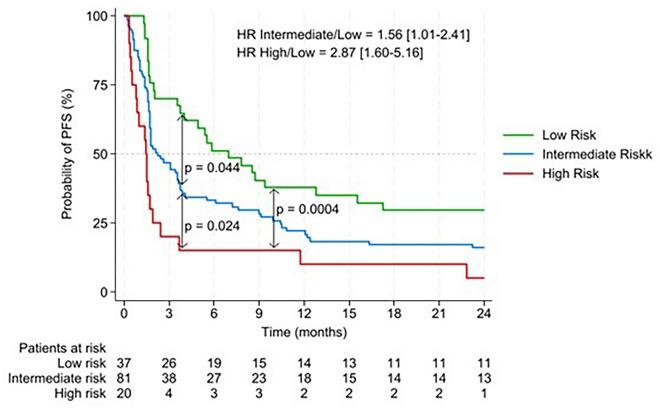
In the first cohort, we found five independent prognostic biomarkers: bone and lung metastases, current smoking status, PFS in first line (PFS1), and neutrophil-to-lymphocyte ratio (NLR). The nomogram identified three distinct prognostic groups with respective median rwPFS values of 11.7, 3.9, and 1.6 months. This prediction model was confirmed in our second retrospective cohort.
CONCLUSIONS
We created a predictive model on the basis of five simple biomarkers that may predict the efficacy of ICI regardless of PDL1 status. The presence of lung metastases, prolonged PFS1, low NLR, and smoking status are good prognostic factors, whereas the presence of bone metastases was associated with worse prognosis.
引言
免疫检查点抑制剂(ICI)是治疗非小细胞肺癌(NSCLC)的标准疗法,无论程序性死亡配体-1(PDL1)表达情况如何。然而,大多数患者出现早期进展,这凸显了更好地选择患者的必要性。本研究的目的是确定除PDL1之外的、用于预测真实世界无进展生存期(rwPFS)的有效临床和生物学生物标志物。
方法
2015年1月至2020年1月期间,173例转移性NSCLC患者在西部癌症研究所(ICO)接受二线或后续纳武单抗治疗。我们使用单变量和多变量分析筛选与rwPFS相关的临床和生物学参数。从独立的预后变量中,使用列线图计算了中位PFS为9个月和12个月的预测模型。该模型在来自八个中心的253例NSCLC患者的第二个回顾性队列中得到验证。
结果
在第一个队列中,我们发现了五个独立的预后生物标志物:骨转移和肺转移、当前吸烟状态、一线无进展生存期(PFS1)以及中性粒细胞与淋巴细胞比值(NLR)。列线图确定了三个不同的预后组,其各自的中位rwPFS值分别为11.7个月、3.9个月和1.6个月。这个预测模型在我们的第二个回顾性队列中得到了证实。
结论
我们基于五个简单的生物标志物创建了一个预测模型,该模型可能预测ICI的疗效,而无需考虑PDL1状态。肺转移的存在、较长的PFS1、较低的NLR以及吸烟状态是良好的预后因素,而骨转移的存在与较差的预后相关。


 Zotero 插件